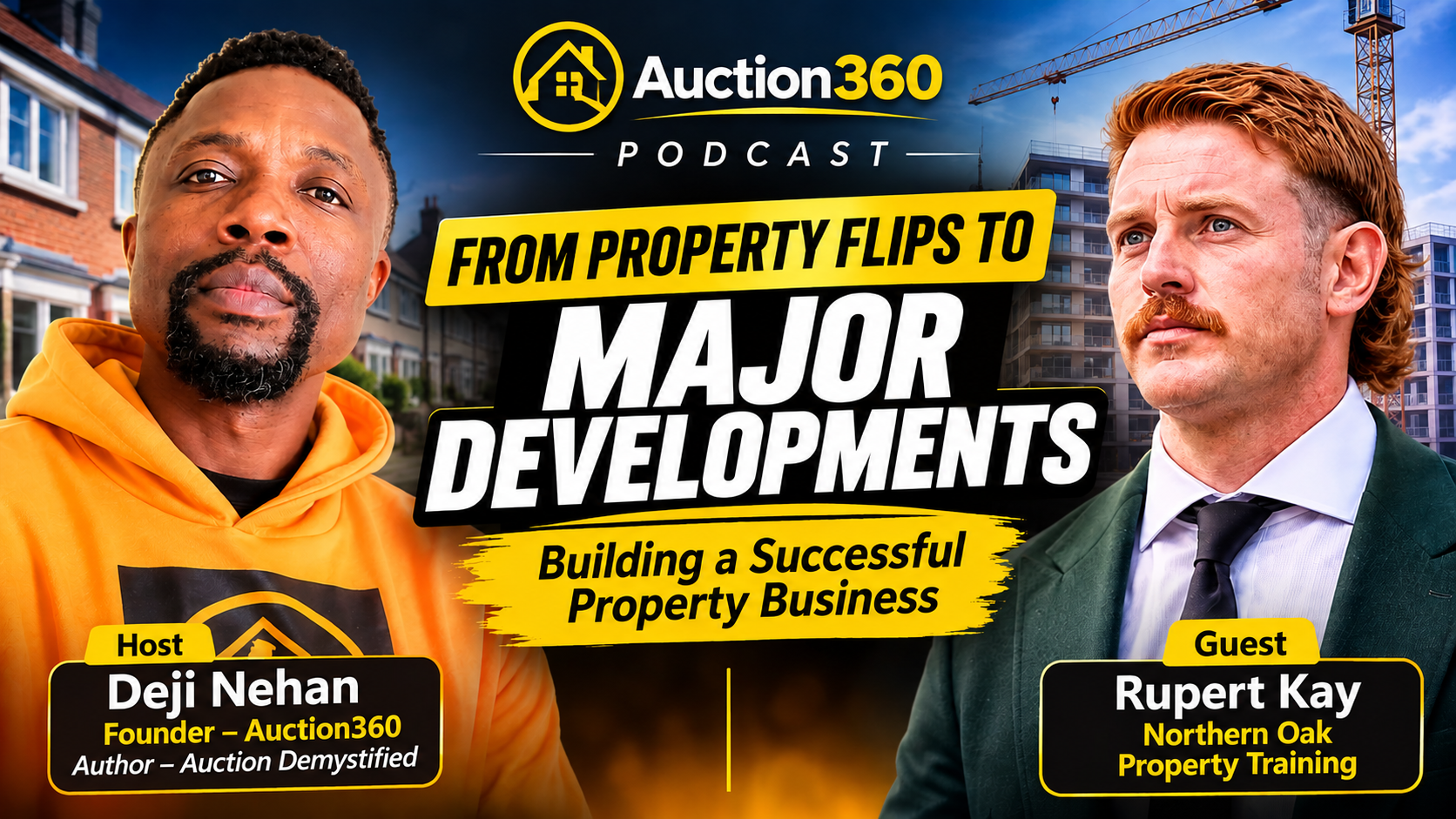
From Property Flips to Major Developments: Building a Successful Property Business
Does £50,000 still buy you a property portfolio in today's UK property market? The property investment landscape is …
View More
Episode 10 · The Auction360 Podcast
Mike Frisby, Founder Home of HMOs
The HMO Investment Blueprint – Building Wealth Through High-Yield Property Strategies
Host: Deji Nehan – Founder, Auction360 and Author of Auction Demystified
Guest: Mike Frisby – Founder, Home of HMOs
In this episode of Auction360, Deji Nehan sits down with Mike Frisby to explore how investors can build profitable and sustainable property portfolios through Houses in Multiple Occupation (HMOs), creative deal structuring, commercial property investment and strategic financing.
The conversation goes beyond simply buying properties and renting out rooms. Mike explains that successful property investment requires investors to understand planning regulations, property valuations, finance options and the importance of identifying opportunities that others may overlook.
One of the key discussions focuses on the difference between standard residential properties and HMOs. Mike explains how a property can move from C3 residential use to C4 shared accommodation, and why investors must understand local planning restrictions, licensing requirements and Article 4 directions before purchasing. He also advises beginners to start with manageable four- or five-bedroom HMOs, gain experience and understand their local markets before taking on more complex projects.
A particularly interesting part of the discussion is Mike's account of a £1.4 million mixed-use property acquisition involving commercial units and approximately 15 flats. He explains how the deal was structured using different property titles, pension funding for the commercial element and bridging finance for the residential section. According to Mike, the property was valued at approximately £1.82 million and generated more than £200,000 in annual rental revenue, with close to £100,000 remaining after mortgage costs. The example demonstrates how understanding valuations and structuring finance creatively can help investors acquire substantial assets without committing large amounts of their own capital. Pasted text(20261121-101206).txt
The episode also examines the importance of focus and consistency in property investment. Drawing on lessons from his corporate career, Mike encourages investors to select a strategy, master it and avoid constantly jumping between different investment opportunities. Rather than attempting to do everything at once, he recommends building experience through repeated execution and improving with every transaction.
Mike further introduces his CALM methodology, which provides a framework for building and managing a property business:
- Clarity: Understand your goals, resources, preferred location and investment strategy.
- Actionable Advanced Strategies: Develop a deep understanding of the investment strategy you intend to pursue.
- Leverage: Make effective use of finance, people, teams, technology, personal branding and other resources.
- Monitor, Manage and Modify: Review performance, track results and adjust your approach when necessary.
He also explains the importance of developing high-performance habits, maintaining accountability and surrounding yourself with the right people.
Another memorable concept from the conversation is Mike's idea of building a “Calm Castle” – a property business that generates reliable income without demanding constant involvement from its owner. His argument is that investors should aim for a sustainable business supported by good systems, long-term contracts, effective teams and carefully selected properties, rather than accumulating a scattered portfolio that becomes difficult to manage.
The discussion concludes with practical lessons on property auctions and managing contractors. Mike shares how he looks for opportunities before and after auctions, the importance of understanding legal packs and market values, and why investors must establish a maximum bidding price before entering an auction. He also reflects on some of his biggest challenges with builders, advising investors to use clear contracts, agree payment structures, check references and assess contractors on smaller jobs before trusting them with major projects.
Ultimately, this episode delivers an important message: building wealth through property is not simply about acquiring more properties; it is about understanding the numbers, structuring deals intelligently, mastering a strategy and creating a business that can deliver sustainable income over the long term.
Key lessons from the conversation
1. Understand the market before investing: Research local demand, planning restrictions and rental opportunities before purchasing an HMO.
2. Start with a manageable strategy: Beginners should consider smaller HMOs before progressing to more complex commercial investments.
3. Understand property valuations: A property's investment value may be influenced by its income, planning status and potential use.
4. Be creative with deal structuring: The purchase price is not the only aspect of a transaction that can be negotiated.
5. Master one strategy at a time: Focus and consistency can produce better results than constantly chasing new opportunities.
6. Use leverage intelligently: Finance, professional expertise, technology and people can help investors grow.
7. Monitor your performance: Review actual costs, rental income, refurbishment spending and investment returns.
8. Build a sustainable property business: Aim for reliable income and effective management systems rather than unnecessary complexity.
9. Prepare properly for property auctions: Understand the legal pack, calculate your numbers and establish your maximum bid.
10. Choose contractors carefully: Clear agreements, references and proper payment arrangements can help reduce project risks.
Closing perspective
This episode is particularly valuable for aspiring HMO investors, experienced landlords, property entrepreneurs and anyone interested in developing a more strategic approach to property investment.
Mike Frisby's contribution reinforces the importance of moving beyond simply owning property towards building a well-structured investment business. Through the combination of market knowledge, creative finance, disciplined execution and effective management, investors can work towards building property portfolios that support long-term financial security and personal freedom.
The central takeaway: Don't just build a property portfolio. Build a property business that works.
AUCTION360 PODCAST – EPISODE SUMMARY
In this insightful episode of Auction360, Deji Nehan sits down with Mike Frisby, Founder of Home of HMOs, to explore how investors can build profitable property portfolios through Houses in Multiple Occupation (HMOs), creative deal structuring, commercial finance and strategic property investment.
Mike shares his extensive experience in the UK property market, explaining why HMOs have become an attractive investment strategy compared with traditional single-let properties, particularly in a market characterised by high property prices and borrowing costs.
The conversation explores the differences between C3 residential properties and C4 HMOs, the importance of understanding local planning regulations, and how Article 4 Directions affect investors looking to convert residential properties into shared accommodation.
One of the standout discussions is Mike's explanation of a £1.4 million mixed-use property acquisition. Through creative deal structuring, title segmentation, pension funding and strategic use of bank finance, his mentee was able to acquire a property valued at approximately £1.8 million. The investment subsequently generated more than £200,000 in annual rental revenue, with close to £100,000 remaining after mortgage costs, according to the example shared.
Mike also discusses the importance of understanding commercial property valuations, recycling investment capital, negotiating win-win arrangements with vendors and using finance strategically rather than relying entirely on personal funds.
Beyond property acquisition, the episode examines the business principles required to build a sustainable property investment company. Drawing from his previous experience working with major brands such as Guinness and Unilever, Mike highlights the importance of focus, marketing, branding, execution and transferable corporate skills.
He introduces his CALM methodology, which emphasises Clarity, Actionable Strategies, Leverage, and Monitoring, Managing and Modifying. He also explains the importance of building a property business that operates efficiently without depending entirely on its owner.
The discussion concludes with practical insights into property auctions, avoiding costly mistakes with builders, understanding legal documentation, and the importance of setting investment limits before bidding.
Ultimately, this episode demonstrates that successful property investing is not simply about buying more properties. It is about understanding the numbers, structuring deals intelligently, mastering a strategy and building a sustainable business that creates long-term financial freedom.
The following timestamps are selected from the transcript to help viewers navigate the most valuable discussions.
| Timestamp | Highlight |
|---|---|
| 04:58 – 07:23 | Understanding HMOs and Property Valuations: Mike explains C3 and C4 planning classifications, why HMOs are attractive and how rental income can influence property valuations. |
| 07:53 – 09:46 | How Beginners Can Get Started in HMOs: Advice on starting with smaller four- or five-bedroom HMOs, understanding compliance and exploring guaranteed-rent arrangements. |
| 11:22 – 17:34 | The £1.4 Million Creative Property Deal: A practical case study showing how mixed-use property, title segmentation and creative finance helped unlock significant equity and cash flow. |
| 19:24 – 26:32 | Article 4 Explained: Understanding permitted development rights, local planning restrictions and why some investors deliberately target Article 4 areas. |
| 27:06 – 31:58 | Mike Frisby's Journey into Property Investment: How his corporate experience with Guinness and Unilever influenced his decision to pursue property as a business. |
| 33:14 – 36:31 | The Power of Focus in Property Investment: Why investors should master one strategy before moving into multiple property investment approaches. |
| 39:37 – 45:28 | Building Wealth and Financial Freedom: The five-HMO strategy, recycling capital and combining trading income with long-term investment income. |
| 46:21 – 55:58 | HMO Training, Mentorship and the CALM Methodology: Mike explains his training events, mentorship programmes, done-for-you services and business development framework. |
| 1:02:40 – 1:06:58 | Using Property Auctions to Find Investment Opportunities: Pre-auction acquisitions, post-auction negotiations, underwriting, legal packs and setting bidding limits. |
| 1:07:20 – 1:11:40 | Lessons from Property Investment Mistakes: Mike discusses challenges with unreliable builders, renovation problems, contracts, payment structures and contractor selection. |
These are ten audience-focused questions based on the subjects discussed during the podcast, with answers drawn from the conversation.
An HMO (House in Multiple Occupation) is a property occupied by multiple people who are not all members of the same household and who share facilities such as kitchens or bathrooms.
HMOs can generate higher rental income than traditional single-let properties because rooms are rented individually. Mike explains that their income potential can also influence how the property is valued, particularly where the appropriate planning and commercial arrangements are in place.
C3 generally refers to ordinary residential dwelling houses, while C4 relates to small HMOs occupied by three to six people.
Converting a C3 property into a C4 HMO may require planning permission depending on the local authority's planning restrictions and whether an Article 4 Direction applies.
Article 4 Directions remove certain permitted development rights.
In areas where an Article 4 Direction applies to HMOs, investors generally need to obtain planning permission before converting an ordinary residential property into an HMO.
Mike explains that investors should not automatically avoid Article 4 areas. With the right knowledge, planning strategy and understanding of local demand, these areas can offer attractive opportunities.
Mike recommends starting with a manageable project rather than immediately pursuing a large commercial HMO.
A four- or five-bedroom HMO with a light refurbishment can be a useful starting point. Beginners should first understand:
Their investment objectives and available capital.
Local rental demand.
Planning and licensing requirements.
Property safety and compliance.
Financing options and expected returns.
Working with experienced professionals can also help investors avoid costly mistakes.
Creative finance involves structuring a transaction using different funding methods to reduce the amount of personal capital required.
Mike discusses techniques such as:
Bank finance.
Commercial property finance.
Pension funding through appropriate structures.
Vendor finance.
Title segmentation.
Negotiating purchase arrangements around the vendor's needs.
His £1.4 million mixed-use property example demonstrates how understanding valuations and structuring a transaction can unlock opportunities that might otherwise appear financially inaccessible.
A mixed-use property combines different property uses within one building or development.
For example, the case study discussed in the podcast involved a parade of shops with approximately 15 flats above them.
Mike explains how investors can examine the individual property titles, value different sections separately and structure the acquisition using suitable finance arrangements.
This can create opportunities for investors looking beyond conventional residential buy-to-let properties.
One strategy discussed is recycling investment capital.
This involves acquiring a property, adding value, obtaining an appropriate valuation and refinancing where suitable to release capital for another investment.
Mike explains that investors who understand commercial valuations and finance structures may be able to grow their portfolios faster than those who rely solely on waiting for property prices to appreciate.
However, refinancing depends on lender criteria, valuation outcomes, affordability and the costs involved.
Mike shares an illustrative strategy of building a portfolio of five HMOs, with each generating approximately £20,000 or more annually.
According to his example, five such properties could produce over £100,000 in annual income.
The actual outcome depends on acquisition costs, finance, occupancy, operating expenses, management and local rental demand. Investors should distinguish gross rental income from net profit.
Mike identifies unreliable builders, poor workmanship, business failures and unexpected renovation costs as some of his biggest property investment challenges.
His recommendations include:
Use clear written contracts.
Agree payment schedules and project milestones.
Obtain recommendations and check references.
Start with smaller projects to assess contractors.
Monitor punctuality and communication.
Inspect work regularly.
Never assume that verbal assurances are sufficient.
He stresses that contracts are important, although they cannot guarantee that every problem will be avoided.
Mike explains several ways investors can benefit from his experience:
Understanding HMO Commercial Finance Event: A practical training event held approximately once a quarter.
Property Business Accelerator: Support for developing and growing a property investment business.
HMO Mentorship Programme: Guidance for investors building or expanding HMO portfolios.
Done-for-you services: Support for investors who want experienced professionals to facilitate and manage their property investment projects.
Clarity calls: Initial conversations to establish an investor's objectives and identify the support they need.
He encourages interested investors to contact him through his website or social media channels for further information.
The most important lessons viewers should take away from this episode are:
Property investment is a business: Treat every investment as a business decision, not simply a property purchase.
Understand the numbers: Know your acquisition costs, rental income, finance costs and expected returns before committing.
Master one strategy: Focus on one investment model and become proficient before diversifying.
Understand planning regulations: Article 4, licensing and HMO compliance can significantly affect investment decisions.
Learn creative deal structuring: The right transaction structure can create opportunities without relying entirely on personal funds.
Build relationships: Experienced brokers, solicitors, builders and property professionals can make a significant difference.
Protect your investment: Proper contracts, due diligence and contractor management are essential.
Build a business that gives you freedom: Develop systems, processes and a team so the business does not depend entirely on you.
Work out exactly what you need to complete inside the 28 days, then talk it through with a specialist.
Auction Finance Calculator Book A Discovery Call
Does £50,000 still buy you a property portfolio in today's UK property market? The property investment landscape is …
View More
Podcast Summary The UK property and private rental sectors are experiencing significant changes, driven by government policies, rising …
View More
Podcast Summary “Beyond Borders: The Expat Property Story – Investing, Buying and Building Wealth Abroad” explores the realities …
View More