
Regional Property Yields 2026: Why Investors Are Moving Capital North
Introduction: Why Property Investors Are Moving Capital North in 2026
Why are property investors moving capital north in 2026? The answer is increasingly visible in the numbers.
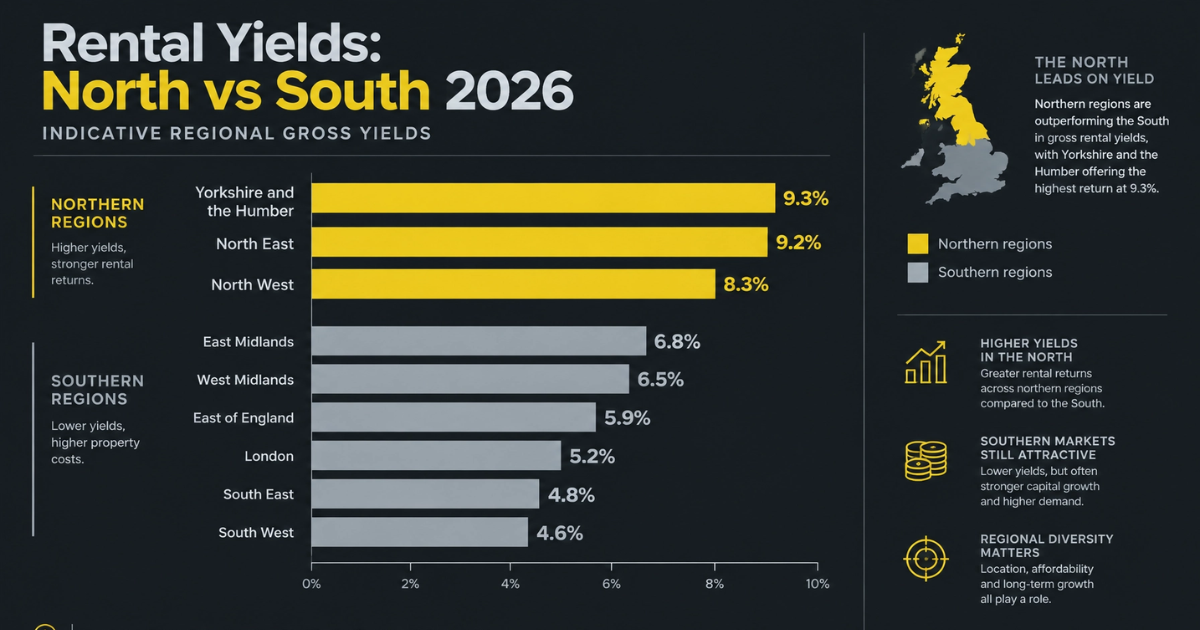
Published regional property trackers indicate that some northern regions are delivering indicative gross rental yields of around 8%–9% or more. Yorkshire and the Humber is reported at approximately 9.3%, while the North East is around 9.2%. By comparison, London’s gross rental yield remains in the mid-4% range.
That difference is attracting investors who prioritise rental income, cash flow and the ability to acquire property at a lower entry price.
The attraction is not simply that northern properties are cheaper. It is that, in selected towns and neighbourhoods, rents remain relatively strong compared with purchase prices. This creates opportunities for investors using buy-to-let, refurbishment, buy-refurbish-refinance-rent (BRRR) and property auction strategies.
However, a high regional yield does not automatically make a property a good investment. Local employment, tenant demand, property condition, resale liquidity, finance costs and the availability of a credible exit remain essential.
This guide compares indicative regional rental yields, explains the factors driving the northward movement of capital and examines what it means for UK property auction buyers.
Market position: October 2026. All regional yield figures are indicative estimates drawn from published lender barometers and market trackers. They are not guarantees of individual property performance, and actual figures vary by source, location, property type and calculation method.
"The yield table tells you where to hunt. The comparables tell you what to buy, and the exit depth tells you whether to bid at all."
— Deji Nehan, Auction Demystified: Unlocking Auction Success
Key Takeaways
- Northern regions offer attractive indicative gross yields: Yorkshire and the Humber and the North East are among the stronger-performing regions in the published figures used in this comparison.
- London remains a different investment proposition: Higher entry prices and stronger absolute rents produce a lower gross yield, with investors often placing greater emphasis on long-term capital growth.
- The yield gap is largely a price effect: Northern properties can generate competitive rents at substantially lower purchase prices.
- Regional averages are only a starting point: Town-level and street-level rental demand, achievable rents and resale comparables matter more than a regional headline.
- Auctions can provide access to discounted stock: Tenanted properties, repossessions, ex-rental homes and refurbishment projects can suit investors seeking income-led opportunities.
- Finance must be structured around the exit: A successful auction purchase needs an evidenced refinance or resale strategy, not simply an attractive gross yield.
1. What the Indicative UK Regional Rental Yield Data Shows in 2026
The regional yield gap is one of the reasons investors are reassessing where to deploy property capital.
The following figures provide an indicative comparison based on the regional data referenced in this guide.
Indicative gross rental yields by region
| Region | Indicative gross rental yield |
|---|---|
| Yorkshire and the Humber | 9.3% |
| North East | 9.2% |
| North West | 8.3% |
| London | Mid-4% range |
These are indicative regional figures, not verified valuations or rental forecasts for individual properties. The comparison is not a complete ranking of every UK region. Different trackers may use different property samples, rental estimates and calculation periods.
Two qualifications are particularly important.
First, these are gross yields. The calculation is annual rental income divided by the property's purchase price, before deducting costs such as:
- Letting and property management fees.
- Repairs and ongoing maintenance.
- Insurance.
- Landlord compliance and safety requirements.
- Void periods and tenant turnover.
- Service charges and ground rent, where applicable.
- Finance interest and arrangement fees.
- Tax.
Second, regional averages conceal significant differences between individual towns, neighbourhoods and streets. A strong regional average does not guarantee that a particular property has reliable tenants, sustainable rent or a straightforward resale market.
The table tells an investor where further research may be worthwhile. It does not establish what an individual property is worth.
What the same £850 monthly rent looks like at different purchase prices
A useful way to understand the yield difference is to reverse the calculation.
If a property generates £850 per month in rent, its annual rental income is £10,200. The purchase price required to produce different gross yields would be approximately:
| Gross yield | Illustrative purchase price |
|---|---|
| 9.3% | £109,677 |
| 9.2% | £110,870 |
| 8.3% | £122,892 |
| 4.5% | £226,667 |
| 4.9% | £208,163 |
These are mathematical illustrations, not claims that equivalent properties are available at those prices in each region.
The calculation demonstrates the underlying investment argument: an investor may be able to acquire a property producing a similar rental income for substantially less capital in a selected northern market.
The trade-off is that capital growth, tenant demand, property liquidity and local economic conditions may differ considerably.
2. Why Is There Such a Large North-South Rental Yield Gap?
The main explanation is the relationship between rental income and property prices.
Gross rental yield is calculated as:
Annual gross rent ÷ Purchase price × 100
Northern entry prices are often considerably lower than those in London and parts of the South East. Although rents are generally lower too, the reduction in purchase price can be proportionately greater.
Consider two illustrative investments:
| Investment | Northern property | Higher-priced southern property |
|---|---|---|
| Purchase price | £110,000 | £480,000 |
| Monthly rent | £850 | £1,950 |
| Annual rent | £10,200 | £23,400 |
| Gross yield | 9.27% | 4.88% |
The southern property generates more rental income in absolute terms. However, it requires substantially more capital to acquire.
This creates two different investment propositions.
The northern income-led strategy: Acquire at a lower price, focus on rental demand and aim to generate stronger gross income relative to invested capital.
The southern growth-led strategy: Accept a lower initial yield in pursuit of potential long-term capital appreciation, deeper resale markets or other location-specific advantages.
Neither approach is automatically superior. The right choice depends on the investor's objectives, available capital, financing arrangements and appetite for risk.
3. What Is Driving the Northward Movement of Property Investment Capital?
The movement towards northern markets reflects several overlapping investment considerations.
3.1 Lower acquisition costs
Lower property prices can make it possible to build a portfolio with less initial capital.
An investor who might struggle to acquire a single higher-priced property in London could potentially spread capital across several lower-priced properties elsewhere.
However, multiple acquisitions also create additional management responsibilities, maintenance exposure, compliance requirements and transaction costs.
3.2 Stronger headline rental yields
Higher gross yields are attractive to investors who prioritise rental income.
For leveraged investors, the relationship between rent and borrowing costs is particularly important. A property with a stronger rental income relative to its purchase price may provide more room to absorb operating expenses and finance payments.
But gross yield is not cash flow. The investor must still calculate the net income after realistic operating costs and debt servicing.
3.3 Opportunities through refurbishment and BRRR
The BRRR strategy is based on acquiring a property, improving it, refinancing against its post-works value and retaining it as a rental investment.
Selected northern markets can be attractive because lower acquisition prices may create opportunities to add value through refurbishment.
The strategy only works where the purchase discount, refurbishment budget, completed valuation, achievable rent and refinance criteria align.
A projected uplift in value is not the same as a lender-approved valuation.
3.4 Diversification away from expensive markets
Some investors are reconsidering whether concentrating their capital in a single high-value market offers the best balance of income and risk.
Moving into different regions can diversify geographical exposure, although it does not remove property-market risk.
Investors should assess each location independently rather than assuming that all northern markets behave in the same way.
3.5 More selective investment underwriting
Higher financing costs and tighter investment margins make purchase discipline increasingly important.
Investors are looking beyond headline capital appreciation and examining:
- Achievable rent.
- Net operating income.
- Total acquisition and refurbishment costs.
- Finance costs and loan terms.
- Refinance valuation.
- Local resale demand.
- The time required to sell or refinance.
The northward movement is therefore not simply a search for cheaper property. It is also a search for investments where the income and total acquisition costs can be modelled more clearly.
4. The Regional Yield Opportunity: Why Town-Level Research Matters
Regional averages are useful for identifying potential investment areas, but property investment decisions are made at a much more local level.
Two properties in the same city can have very different investment characteristics because of their condition, street, tenant profile, transport access, employment catchment and resale demand.
A high-yield property in a location with weak tenant demand can be less attractive than a lower-yield property in a stronger rental market.
Before buying, investors should investigate:
Employment and economic diversity: Is the local economy supported by several industries, or is rental demand heavily dependent on one employer?
Tenant demand: Are there multiple sources of demand, such as professionals, families, students or local workers?
Achieved rental comparables: What have similar properties actually let for, rather than what are landlords currently asking?
Property condition: Does the building need cosmetic improvements, substantial modernisation or structural work?
Resale comparables: How many similar properties have sold recently, and how long did they take to sell?
Exit depth: If the investment needs to be sold, is there a realistic pool of buyers?
This final point is particularly important for auction investors. A property can look attractive on a rental spreadsheet but become difficult to refinance or sell if the local market has limited demand.
5. Why Northern Property Markets Matter to Auction Investors
Property auctions can provide access to the types of properties that income-focused investors are actively seeking.
These may include:
- Tenanted residential properties.
- Ex-rental terraces and semi-detached houses.
- Repossessed properties.
- Properties requiring modernisation.
- Vacant homes with refurbishment potential.
- Part-completed refurbishment or development projects.
Some of these properties may be unsuitable for conventional mortgage finance in their current condition. Others may have title, tenancy or legal complications that require specialist assessment.
For prepared buyers, that can create opportunities to acquire property where the purchase price reflects condition, complexity or the seller's circumstances.
However, auction buyers must understand the contractual commitment. At an unconditional auction, the successful bidder will generally exchange contracts when the hammer falls and become legally committed to the purchase. The deposit and completion requirements are governed by the auction conditions and contract.
A buyer who has not reviewed the legal pack, arranged appropriate finance and calculated the full acquisition cost can quickly turn an apparently attractive investment into an expensive problem.
The Manchester BRRR and Birmingham refurbishment examples
The Manchester BRRR case discussed in the earlier investment example involved a £118,000 purchase and £17,000 of capital released at refinance.
The Birmingham example involved a £92,000 purchase, £45,000 refurbishment budget and an illustrative £850 monthly rental cash flow.
Both illustrate the type of investment logic behind the northward movement: acquire at a price that supports the strategy, improve the property where appropriate, and establish a credible rental and refinancing position.
These figures should be treated as individual worked examples, not evidence of typical regional returns. The actual result depends on the property's condition, valuation, rent, financing costs and exit terms.
6. Financing Northern Property Investments in 2026
The financing structure can determine whether a northern property investment works.
A low purchase price and strong gross yield are not enough if the buyer cannot complete within the auction deadline or cannot refinance when the initial loan reaches maturity.
Different finance routes serve different purposes.
Bridging finance
Bridging finance can be suitable where a property needs refurbishment, is not currently mortgageable or must be acquired within a short auction completion period.
It is generally short-term finance, so the borrower should establish a credible repayment strategy before completing the purchase.
That may involve:
- Selling the property after refurbishment.
- Refinancing onto a buy-to-let mortgage.
- Refinancing onto a commercial mortgage.
- Repaying from another confirmed source of funds.
The proposed exit should be realistic, documented and supported by the property's likely condition and value at the relevant time.
Auction finance
Auction finance is designed to address the funding requirements associated with auction purchases.
The key consideration is whether the finance can be arranged in time for the contractual completion deadline and whether the lender is comfortable with the property, borrower, legal position and intended exit.
An Agreement in Principle should not be confused with a fully assessed facility. The lender may still need to review the asset, valuation, legal pack, borrower and repayment strategy.
Buy-to-let finance
Where a property is already in suitable condition and meets lender requirements, a buy-to-let mortgage may provide longer-term funding.
Lenders typically assess rental income, valuation, loan-to-value, borrower circumstances and their own affordability or rental stress criteria.
A property with a high gross yield does not automatically satisfy those requirements.
Development and refurbishment finance
More substantial projects may require finance structured around the works.
The lender's assessment may consider the existing property value, projected completed value, build costs, works programme, borrower experience and available security.
Investors should distinguish between funds available on day one and any staged drawdowns that depend on progress or inspections.
The importance of matching the loan to the exit
The strongest finance structure is not necessarily the one with the lowest headline interest rate.
Investors should compare:
- Interest rate and how interest is charged.
- Arrangement and exit fees.
- Valuation and legal costs.
- Net funds available at completion.
- Whether interest is serviced, retained or rolled up.
- Extension provisions and potential costs.
- Early repayment terms.
- The repayment deadline.
- The evidence supporting the proposed exit.
A loan that appears inexpensive but cannot complete in time may be less useful than a more expensive facility that genuinely meets the transaction requirements.
7. How the Northward Capital Flow Changes Auction Room Behaviour
As more investors target attractive rental markets, competition can increase for properties with the right combination of price, condition and rental potential.
That has several implications for auction buyers.
Competition for obvious high-yield properties
Properties in well-known investment locations can attract multiple bidders.
A strong headline yield may already be reflected in the guide price or bidding competition. Investors should therefore avoid assuming that every northern property represents a bargain.
The response: Establish a maximum bid using comparable sales, achievable rent and total project costs before entering the auction.
Greater importance of pre-auction finance preparation
Investors who have already discussed the transaction with a suitable lender are better placed to assess whether a property can be funded.
The response: Arrange pre-auction approval against the specific property wherever possible. Check the lender's requirements, valuation position, legal process and completion timetable.
More attention to less fashionable locations
As competition increases in popular investment areas, some buyers may look towards smaller towns and satellite locations.
These can offer opportunities, but lower prices can also reflect weaker demand or more limited resale liquidity.
The response: Research local employment, rental evidence, sales comparables and the depth of the future buyer market. Do not confuse a low purchase price with an undervalued asset.
More disciplined legal and physical due diligence
Investors competing for auction stock may be tempted to move quickly.
That is precisely when legal and physical checks matter most.
The response: Review the legal pack, inspect the property where possible, identify title and tenancy issues, and obtain specialist advice before bidding.
The desk-level lesson is straightforward: stronger competition makes preparation more valuable, not less. In a crowded auction room, the buyer who understands the funding, legal position and exit has a clearer basis for deciding when to bid and when to walk away.
8. How to Assess a High-Yield Northern Property Properly
A regional yield figure is only the first stage of investment analysis.
Before bidding, calculate the property's return using the total amount of capital required, not simply the hammer price.
Step 1: Verify the achievable rent
Use evidence from comparable properties that have actually been let, where available.
Consider the property's size, condition, location, facilities and likely tenant profile. Asking rents are not proof that a tenant will pay the same amount.
Step 2: Calculate the gross yield
Use:
Annual gross rent ÷ Purchase price × 100
For example, a property purchased for £110,000 and rented at £850 per month produces:
- Annual rent: £10,200.
- Purchase price: £110,000.
- Gross rental yield: approximately 9.27%.
Step 3: Calculate the net yield
Deduct realistic operating expenses, including management, maintenance, insurance, compliance and an allowance for voids.
The resulting figure provides a more useful view of the property's income performance.
Step 4: Calculate yield on total investment cost
Include the costs required to acquire and prepare the property:
- Purchase price.
- Auction buyer's premium, where applicable.
- Stamp Duty Land Tax or the relevant property transaction tax.
- Legal fees and searches.
- Valuation and survey costs.
- Refurbishment.
- Finance arrangement and exit fees.
- Interest.
- Initial repairs and compliance work.
A property that looks attractive against its hammer price may produce a materially lower return once these costs are included.
Step 5: Stress-test the investment
Model what happens if:
- The property takes longer to let.
- The achievable rent is lower than expected.
- Refurbishment costs increase.
- The valuation is below the forecast.
- Interest rates or finance costs change.
- The refinance takes longer than planned.
- The property takes longer to sell.
A robust investment should not depend on every assumption being achieved perfectly.
Step 6: Verify the exit
For a BRRR investment, establish whether a refinance is realistic under the likely completed valuation, rental assessment, lender criteria and borrower circumstances.
For a resale strategy, investigate comparable sales, buyer demand and the likely marketing period.
The exit is not an administrative detail. It is part of the investment decision.
9. SDLT and Other Purchase Costs: Does Buying in the North Change the Rules?
No. A property's location in northern England does not remove the applicable property transaction tax rules.
For qualifying purchases in England and Northern Ireland, Stamp Duty Land Tax (SDLT) may include higher rates where the buyer is acquiring an additional residential property.
The relevant treatment depends on the buyer's circumstances, the transaction date, the property and applicable reliefs or exceptions.
Purchasing through a limited company does not automatically avoid the higher rates applicable to additional residential property. Corporate acquisitions can also involve separate rules, including special treatment for certain high-value residential property purchases.
Scotland and Wales have their own property transaction tax systems:
- Scotland: Land and Buildings Transaction Tax (LBTT).
- Wales: Land Transaction Tax (LTT).
Investors should calculate the tax applicable to their specific transaction before bidding. Do not rely on a generic regional yield calculation that excludes acquisition tax.
Useful official resources include:
10. How Auction360 Helps Investors Assess Northern Auction Opportunities
Identifying a high-yield region is the beginning of the process. The next step is assessing whether a specific property can be acquired, funded, improved and exited on commercially sensible terms.
Auction360 supports investors through the key stages of that process:
Auction risk analysis – Assess the risks associated with a particular auction opportunity, including the legal, property and financial considerations that can affect the investment.
Auction finance – Explore funding options for auction purchases where speed, property condition or transaction complexity requires specialist consideration.
Bridging finance – Consider short-term funding for acquisition, refurbishment and other property transactions where a credible repayment strategy is in place.
Pre-auction approval – Prepare the funding position before bidding rather than relying on an untested finance assumption after the hammer falls.
The objective is not to encourage investors to buy simply because a regional yield figure looks attractive. It is to help establish whether the actual property, finance structure and exit strategy work together.
Conclusion: The Northward Investment Opportunity Is About More Than Yield
The movement of property investment capital north in 2026 reflects a clear financial consideration: in selected regional markets, lower purchase prices can produce stronger gross rental yields relative to the capital required.
Yorkshire and the Humber, the North East and parts of the North West feature prominently in the indicative yield figures used in this guide. For investors seeking rental income, refurbishment opportunities and BRRR strategies, these markets deserve serious investigation.
But regional yield data should never replace property-level underwriting.
The strongest opportunities are those where the purchase price is supported by comparable evidence, the rent is achievable, the total costs are understood, the finance is appropriate and the exit is credible.
For auction buyers, that means doing the work before the hammer falls. The regional figures may identify where to look, but disciplined due diligence determines whether a property is worth buying.
As Deji Nehan explains in Chapter 21 of Auction Demystified: Unlocking Auction Success, regional strategy must be supported by a proper understanding of yield on cost and the practical realities of the local market.
Frequently Asked Questions
1. Which UK region has the highest rental yields in 2026?
In the indicative figures used in this guide, Yorkshire and the Humber leads at approximately 9.3%, followed closely by the North East at around 9.2%. These are gross regional estimates, not guaranteed returns on individual properties.
2. Why are northern properties offering higher rental yields than London?
The main reason is the relationship between purchase prices and rents. Northern properties can cost substantially less while still generating meaningful rental income. This produces a higher rent-to-price ratio, although London may offer different capital growth and liquidity characteristics.
3. Are northern property markets good for buy-to-let investment?
Selected northern markets can suit buy-to-let investors, particularly where local tenant demand is established and purchase prices are supported by comparable evidence. Investors should assess achievable rent, operating costs, local employment and resale demand before committing capital.
4. Is a 9% gross rental yield a good investment return?
It may be an attractive starting point, but gross yield does not account for expenses, finance costs, tax or voids. Investors should calculate net yield and yield on total investment cost before deciding whether a property offers an acceptable return.
5. Why are property investors using auctions to buy northern properties?
Auctions can provide access to tenanted properties, repossessions, refurbishment opportunities and other stock that may not be available through conventional estate agency channels. Some properties may also be priced to reflect their condition or complexity. However, buyers must complete appropriate legal, physical and financial checks before bidding.
6. Can I use bridging finance to buy a northern auction property?
Potentially. Bridging finance can be suitable for properties requiring refurbishment, properties that do not currently meet conventional mortgage criteria, or purchases with short completion deadlines. Approval depends on the borrower, security, lender criteria, valuation, legal position and proposed repayment strategy.
7. Which northern locations are suitable for a BRRR strategy?
There is no universal list of suitable towns. The right location is one where acquisition discounts, achievable rents, refurbishment costs, completed valuations and refinance options support the strategy. Investors should also assess local employment, tenant demand and resale liquidity.
8. Does the additional-property SDLT surcharge apply to northern purchases?
Yes, where the relevant higher-rate rules apply to a purchase in England or Northern Ireland. The property's northern location does not remove the surcharge. Buying through a limited company does not automatically avoid the higher rates. Scotland and Wales have separate transaction tax systems.
9. How do I calculate the true return on a northern auction property?
Start with the achievable annual rent, then deduct realistic operating expenses to estimate net income. Include acquisition tax, auction fees, legal costs, refurbishment, finance charges and other project costs when calculating yield on total investment cost. Finally, stress-test the refinance or resale exit.
10. Should I invest in the North rather than London?
That depends on your investment objectives. Northern markets may offer stronger headline rental yields and lower acquisition costs, while London may appeal to investors prioritising different capital growth and liquidity characteristics. Compare individual opportunities using consistent assumptions rather than choosing a region solely on its average yield.
11. Does a high-yield property automatically qualify for buy-to-let finance?
No. Buy-to-let lenders assess more than gross yield. They may consider rental stress tests, valuation, loan-to-value, property condition, borrower circumstances and their own lending criteria. A strong headline yield does not guarantee mortgage approval.
12. What should I check before bidding on a northern auction property?
Review the legal pack, inspect the property where possible, verify rental and sales comparables, calculate all purchase and refurbishment costs, confirm the funding route and establish a credible exit. The auction contract and completion deadline should be understood before bidding.
About the Author
Deji Nehan is the author of Auction Demystified: Unlocking Auction Success and has more than 15 years of experience in property auctions and finance. He is the founder of Auction360, a platform focused on auction and bridging finance.
Explore the book: Auction Demystified: Unlocking Auction Success.
Disclaimer
The information in this article is for educational purposes only and does not constitute financial, investment, legal, tax or mortgage advice. Regional rental yields are indicative and do not guarantee future income or capital growth. Property values and rental income can fall as well as rise. Investors should obtain appropriate professional advice and conduct independent due diligence before purchasing.
Your property may be repossessed if you do not keep up repayments on a mortgage or any other debt secured against it.