
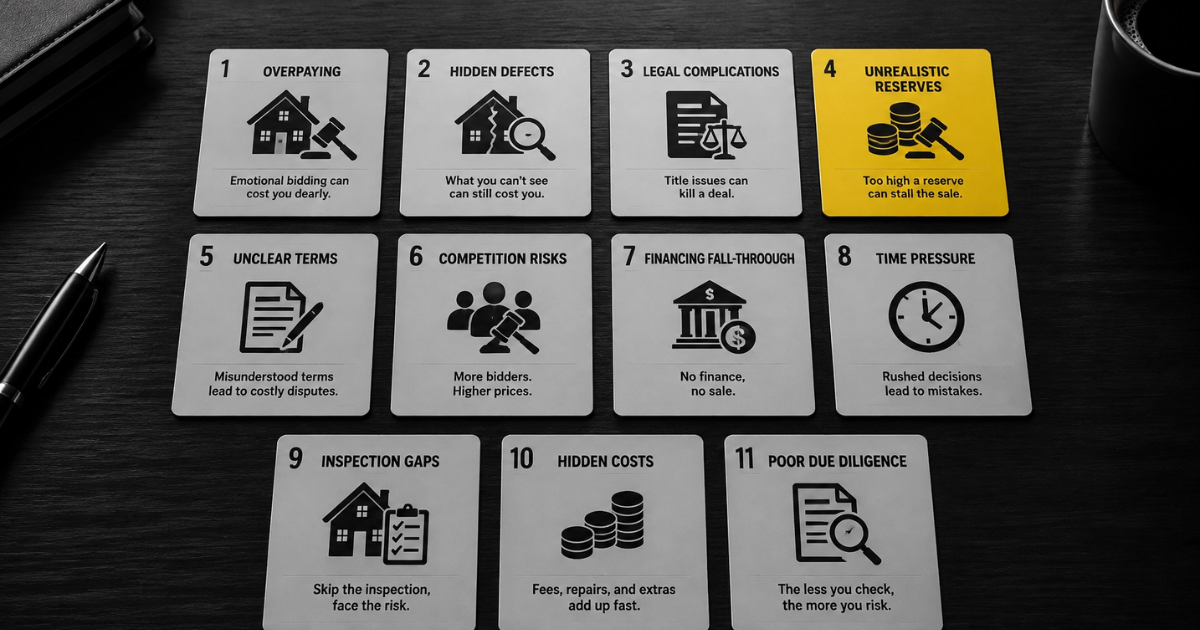
Property Auction Pitfalls: 11 Costly Mistakes to Avoid (Spot It / Fix It)
Introduction: The Mistakes That Cost Buyers Before and After the Hammer
What are the most costly mistakes when buying a property at auction?
They are not always obvious. Some happen before the auction catalogue is even published. Others take place in the room, when competitive bidding overrides a carefully prepared budget. A few only become apparent after the buyer has won, signed the contract and discovered that an important detail was overlooked.
The consequences can be substantial: an unexpectedly large tax bill, an unprofitable purchase, a refurbishment budget that no longer works, a missed completion deadline or, in the worst cases, losing the deposit and facing further contractual costs.
At Auction360, we approach auction buying as a process of risk management. The objective is not simply to secure a property at a competitive price. It is to ensure that the buyer can fund the purchase, understand the legal obligations, complete on time and execute a realistic investment strategy.
This guide examines eleven costly property auction pitfalls using a simple format:
- Spot It: The warning sign that tells you the mistake is happening.
- Fix It: The practical action that prevents it becoming expensive.
The most important lesson is straightforward: many auction mistakes are preventable before the hammer falls.
This guide reflects the UK property auction market position at November 2026. The practical observations are informed by property auction and finance experience. Tax, legal and finance rules should always be checked against the circumstances of the individual transaction.
"Every one of the eleven mistakes was available to fix before the hammer. The auction room just checks whether you took the chance."
— Deji Nehan, Auction Demystified: Unlocking Auction Success
Key Takeaways
- Do not bid without a credible finance plan. An auction win creates a contractual commitment, not an opportunity to start arranging funding.
- Never treat the guide price as market value. Use comparable completed sales and calculate your maximum bid backwards.
- Read the legal pack before bidding. Important restrictions, liabilities and special conditions may not be obvious from the property listing.
- Calculate every cost. SDLT, buyer's premiums, legal fees, finance charges and refurbishment can change the economics of a purchase.
- Set a maximum bid and stick to it. A written ceiling protects the investment from auction-room pressure.
- Understand the deposit and completion requirements. Winning the property is only the beginning of the contractual obligations.
- Build a realistic exit strategy. Know how the bridging loan or other funding will be repaid before committing to the purchase.
The 11 Property Auction Pitfalls: Spot It / Fix It
Mistake 1: Bidding Without Pre-Auction Finance Approval
<badge color="danger">Existential risk</badge>
This is one of the most dangerous auction mistakes because it can turn a successful bid into a serious financial problem.
Some buyers assume that once they have won the property, they can approach a lender or broker and arrange the finance afterwards. That approach is particularly risky where the auction contract requires completion within a short period.
A bridging lender may be willing to consider the transaction, but that does not mean the property, borrower, valuation, legal position and proposed exit will all satisfy the lender's requirements.
Spot It
- You have identified the property but have not spoken to a finance adviser.
- You are relying on an informal conversation with a lender.
- You have an Agreement in Principle but have not checked the actual property.
- You do not know how much cash you need to complete.
- You are assuming that a bridging loan can be arranged after the auction.
Fix It
Obtain a realistic finance assessment before bidding.
For auction purchases, this should include an assessment of the borrower, property, funding requirement, available deposit, legal pack, completion deadline and intended exit.
An Agreement in Principle can be a useful starting point, but it is not the same as a fully assessed and completed facility.
The buyer should understand the likely loan amount, fees, interest structure, conditions and cash contribution before entering the auction room.
Auction360 rule: No credible finance plan, no paddle.
Explore pre-auction approval before committing to a bid.
Mistake 2: Treating the Guide Price as the Property's Market Value
A guide price is not a formal valuation and should not be treated as proof that the property is worth that amount.
Auctioneers use guide prices to market lots and generate interest. The reserve price is a separate figure agreed with the seller and may not be disclosed.
A property with a £100,000–£140,000 guide range is not automatically worth £140,000. Nor does a guide price of £100,000 mean that £100,000 represents a bargain.
Buyers who anchor their calculations to the guide price can end up paying too much, particularly when they have not researched comparable sales.
Spot It
- Your maximum bid is based mainly on the guide price.
- You have not checked recently completed sales nearby.
- You are comparing the auction property with properties in significantly better condition.
- You assume that a low guide price automatically means a below-market purchase.
Fix It
Research comparable completed transactions before calculating your maximum bid.
Compare properties with similar:
- Location and street position.
- Property type and size.
- Tenure and lease length.
- Condition and refurbishment requirements.
- Layout and accommodation.
- Market appeal.
Where the auction property needs work, compare it with similar properties in their improved condition to estimate the potential end value. Then deduct the purchase and project costs, finance charges, selling expenses and required profit or investment margin.
The maximum bid should come from the numbers, not the catalogue.
Mistake 3: Skipping the Legal Pack
<badge color="danger">Existential risk</badge>
A property can look attractive during a viewing and still carry legal problems that make it unsuitable for the intended purchase.
The legal pack is not optional background reading. It contains important documents governing the property, the sale and the buyer's obligations.
Depending on the lot, it may reveal title restrictions, easements, covenants, lease issues, tenancy arrangements, missing documentation, unusual completion conditions or additional costs.
Some of these issues may affect the property's value, mortgageability, future use or resale prospects.
Spot It
- You have only looked at the online listing and photographs.
- You assume the solicitor will deal with everything after the auction.
- You have not read the special conditions of sale.
- You do not know whether there are restrictions affecting the property.
- You have not checked whether the legal pack is complete or whether documents are outstanding.
Fix It
Have the legal pack reviewed by a solicitor experienced in auction transactions before bidding.
Pay particular attention to:
- Official copies of the title register and title plan.
- Special conditions of sale.
- Searches and search results.
- Easements, covenants and restrictions.
- Lease terms, ground rent and service charges.
- Tenancies and occupation rights.
- Planning and building regulation documentation.
- Completion deadlines and additional seller costs.
- Any unusual obligations imposed on the buyer.
Do not assume that a problem can be resolved after the auction. If an issue is material, establish its implications before committing.
Use Auction360's legal pack review service as part of your pre-bid checks.
Mistake 4: Buying Without Properly Inspecting the Property
Photographs can make a property look considerably more attractive than it is in reality.
An auction listing may show the main rooms, but it cannot reliably establish the condition of the roof, foundations, drainage, services or concealed structural elements.
A quick viewing is not a substitute for an appropriate inspection.
Spot It
- You are relying entirely on the photographs.
- You have not inspected the property internally.
- You have ignored signs of damp, movement or poor maintenance.
- You have not checked the roof, windows, services or external condition.
- You have prepared a refurbishment budget without understanding the actual work required.
Fix It
Arrange a suitable viewing and, where appropriate, commission a survey or specialist inspection.
Depending on the property, this could include:
- A building survey.
- Structural inspection.
- Damp and timber assessment.
- Electrical inspection.
- Gas and heating checks.
- Roof inspection.
- Drainage investigation.
- Asbestos assessment where relevant.
The inspection should help establish the likely cost and complexity of the work.
If access is restricted or the property is sold with limited information, price that uncertainty into your maximum bid. Do not assume that unseen problems will be inexpensive to resolve.
Mistake 5: Underestimating SDLT and Other Purchase Taxes
<badge color="warning">High-cost risk</badge>
Stamp Duty Land Tax can materially change the cost of an auction purchase.
One persistent misconception is that purchasing through a limited company or Special Purpose Vehicle (SPV) automatically avoids the higher rates applicable to additional residential property purchases.
That is not correct.
In England and Northern Ireland, companies purchasing residential property will generally be subject to the higher residential SDLT rates, subject to the applicable rules and reliefs. Individuals purchasing additional residential properties may also be subject to the higher rates.
Certain corporate purchases above £500,000 can fall within a separate 17% flat-rate regime, although qualifying reliefs may be available. The treatment depends on the transaction and the purchaser's circumstances.
Spot It
- You have calculated SDLT using only the standard residential rates.
- You assume an SPV automatically avoids the additional property surcharge.
- You have not checked whether the purchase is residential, mixed-use or non-residential.
- You have not considered whether a non-UK resident surcharge applies.
- You have left the tax calculation until after the auction.
Fix It
Calculate the likely tax liability before bidding.
For England and Northern Ireland, use the official GOV.UK SDLT calculator and review the relevant GOV.UK SDLT guidance.
For mixed-use or non-residential transactions, check the relevant classification and rates rather than assuming that the residential calculation applies.
Remember that Scotland uses Land and Buildings Transaction Tax (LBTT), while Wales uses Land Transaction Tax (LTT). SDLT guidance should not be applied indiscriminately across the UK.
Also consider the following:
- The buyer's ownership position.
- Whether the purchase is made personally or through a company.
- Whether the property is an additional dwelling.
- Whether any relevant relief is available.
- Whether the non-UK resident surcharge applies.
- Whether the property is residential, mixed-use or non-residential.
A tax calculation should be confirmed with an appropriate tax adviser or conveyancer where the position is not straightforward.
Mistake 6: Overbidding in the Auction Room
<badge color="warning">High-cost risk</badge>
Auction rooms are competitive environments. A buyer who has spent weeks researching a property can suddenly find themselves bidding against another person who appears equally determined to win.
The danger is that the original investment calculation gets forgotten.
A few additional bids may seem insignificant in isolation. But on a leveraged property purchase, the extra money can consume the margin that made the deal attractive in the first place.
Spot It
- You have not written down your maximum bid.
- You are increasing your offer because another bidder is competing.
- You are thinking about the time and effort already invested in the property.
- You are telling yourself that another £2,000 or £5,000 will not make much difference.
- You are bidding beyond the price used in your finance and cost calculations.
Fix It
Set a maximum bid before the auction and treat it as a firm limit.
Consider using:
- A proxy bid.
- A remote bid.
- A trusted representative who knows your ceiling.
- A written bidding plan.
- A clear stop point that cannot be changed during the auction.
Do not confuse winning with investing successfully.
If the bidding exceeds your maximum, walk away. Another property will come to market.
Mistake 7: Failing to Calculate the Full Cost of the Purchase
The hammer price is not the total investment.
Auction buyers sometimes calculate their required funds using only the purchase price and deposit. They then discover that the actual project requires substantially more capital.
Depending on the transaction, additional costs may include:
- Buyer's premium.
- Auction administration or completion fees.
- SDLT or the relevant property transaction tax.
- Solicitor's fees and searches.
- Survey and valuation costs.
- Bridging arrangement fees.
- Lender legal fees.
- Monthly interest.
- Exit fees.
- Refurbishment and professional costs.
- Insurance and utilities.
- Council tax and other holding costs.
- Estate agent and resale conveyancing fees.
Spot It
- Your budget contains only the hammer price and deposit.
- You have not read the auctioneer's fee schedule.
- You have not calculated the total interest payable over the expected loan term.
- You have ignored the cost of selling or refinancing.
- You do not know how much cash you will need beyond the deposit.
Fix It
Prepare a complete project cost model before bidding.
A useful starting point is:
Total project cost = Purchase price + acquisition costs + finance costs + refurbishment + holding costs + professional fees + contingency.
For a resale project, include the expected selling expenses and any relevant tax liabilities.
For a refinance project, consider the new mortgage costs, the amount required to redeem the bridge and the cash contribution needed if the new mortgage advance is lower than expected.
The deposit is normally part of the purchase price, not an additional cost on top of it. However, it is an immediate cash requirement and must be available in the required form and timeframe.
For a practical worked example, see the Auction360 article on calculating the true cost of a £120,000 auction lot.
Mistake 8: Underestimating Refurbishment Costs and Timescales
A refurbishment budget based on optimistic estimates can quickly undermine the investment.
The problem is not simply that contractors may charge more than expected. It is that the scope of work may be incomplete.
A property that appears to need cosmetic improvement may require rewiring, plumbing, structural repairs, roof work or additional compliance measures.
Delays can also increase bridging interest and holding costs.
Spot It
- Your refurbishment budget is based on a quick viewing.
- You have not obtained contractor estimates.
- You have not included professional fees or compliance work.
- You have assumed all work will be completed without delays.
- Your bridging loan term has no meaningful time buffer.
Fix It
Obtain detailed estimates and establish the scope of work before bidding.
Break the project into categories:
- Essential structural and safety work.
- Electrical, plumbing and heating.
- Roof, windows and external repairs.
- Internal refurbishment.
- Finishing and presentation.
- Professional fees and statutory compliance.
For planning purposes, an indicative contingency of 10–20% of the quoted works cost may be appropriate, depending on the property's condition and the amount of uncertainty. This is a budgeting guide, not a universal rule.
Allow a separate time contingency for delays. A financial reserve does not replace the need for a realistic bridging loan term.
Mistake 9: Misunderstanding the Deposit and Completion Mechanics
<badge color="danger">Existential risk</badge>
Winning at auction can create immediate contractual and payment obligations.
Buyers sometimes focus on the amount they need to borrow without understanding when the deposit must be paid, which payment methods are accepted, what documents must be signed and when the remaining purchase balance is due.
The requirements depend on the auction method and the contract.
For a traditional unconditional auction, the fall of the hammer will generally create a binding contract. A deposit is commonly payable immediately, often 10%, although the precise amount and arrangements must be checked in the auction conditions.
The completion date may be 20–28 days or another period specified in the contract. Do not assume every auction uses the same timetable.
Spot It
- You do not know the required deposit amount.
- You have not checked the accepted payment methods.
- You assume the deposit can be paid later.
- You have not read the completion date in the special conditions.
- You have not arranged the remaining cash or finance required for completion.
Fix It
Before bidding, confirm the exact contractual mechanics with the auctioneer and your solicitor.
Establish:
- The deposit percentage or fixed amount.
- The payment method accepted.
- Any minimum deposit requirement.
- Whether buyer's fees are payable immediately.
- The documents that must be signed.
- The contractual completion date.
- Any additional costs or obligations under the special conditions.
Have the deposit funds available in the required form before entering the auction.
If you win but cannot complete, the seller may have contractual remedies that can include retaining the deposit, rescinding the contract and seeking additional losses or costs where permitted by the contract and applicable law. The precise consequences depend on the terms of sale and the circumstances.
This is why deposit mechanics and completion requirements must be understood before bidding, not discovered afterwards.
Mistake 10: Ignoring Tenants, Occupation Rights and Existing Tenancies
A tenanted property may look attractive because it appears to offer immediate rental income. But the tenancy position can introduce legal, financial and practical complications.
The buyer must understand who occupies the property, what rights they have and what obligations transfer with the purchase.
Potential issues include:
- Existing tenancy agreements.
- Deposit protection compliance.
- Rent arrears.
- Unclear occupation arrangements.
- Restrictions on possession.
- Disputes with tenants.
- Repairs and landlord obligations.
- Whether the tenancy affects the intended refinance or resale.
A property described as vacant possession should also be checked carefully against the legal documents and actual occupation position.
Spot It
- The listing says "investment opportunity" but gives little tenancy information.
- You have not seen the tenancy agreement.
- You do not know whether the tenant's deposit is protected.
- You have not checked rent arrears or the payment history.
- You assume vacant possession will be available immediately after completion.
Fix It
Ask your solicitor to investigate the tenancy and occupation position before bidding.
Where relevant, obtain and review:
- The tenancy agreement.
- Deposit protection information.
- Rent statements and arrears details.
- Notices served.
- Relevant correspondence.
- Any possession proceedings.
- Information about who currently occupies the property.
Check whether the existing arrangement is compatible with your intended investment strategy and lender requirements.
Do not assume that buying the property automatically gives you the right to remove the occupier or change the tenancy.
Mistake 11: Bidding Without a Credible Exit Strategy
The final mistake is buying the property without knowing how the investment will be completed financially.
This is especially important for buyers using bridging finance.
A bridging loan is short-term funding. The investor must have a realistic route to repay it, commonly through refinancing or resale.
An exit strategy based on an optimistic valuation or an assumed quick sale is not enough.
Spot It
- You plan to "sort out the refinance later".
- You have not checked whether the property will be mortgageable after the works.
- Your expected refinance depends on an unsupported end valuation.
- You have not researched the resale market.
- Your loan term leaves little time for delays.
- You have no credible alternative if the original exit fails.
Fix It
Identify and test the intended exit before bidding.
For a refinance, investigate:
- Mortgageability after refurbishment.
- Expected end valuation.
- Potential loan-to-value.
- Rental income and lender stress tests, where applicable.
- Borrower eligibility.
- Time needed for valuation, underwriting and completion.
For a resale, investigate:
- Achievable sale price.
- Comparable completed sales.
- Likely buyer demand.
- Selling and conveyancing costs.
- Expected marketing period.
- Bridging redemption figure.
- The minimum sale price required to repay the finance.
Then model a downside scenario. Ask what happens if the valuation is lower, the refurbishment costs more or the sale takes longer.
A credible exit should work under realistic assumptions, not just the most favourable outcome.
For further guidance, read Exit Strategies: How to Structure Your Refinance or Resale Plan Before the Hammer Falls.
Which Auction Mistakes Are the Most Expensive?
Not all auction mistakes have the same consequences. Some reduce the potential profit; others can threaten the entire transaction.
The following is a practical risk ranking based on the potential severity of the consequences, rather than a statistically measured ranking of how frequently each mistake occurs.
| Mistake | Potential consequence | Risk category |
|---|---|---|
| 1. Bidding without finance approval | Inability to complete, deposit loss and possible further contractual costs | Existential |
| 2. Treating the guide price as value | Overpaying and reducing investment margin | High |
| 3. Skipping the legal pack | Discovering restrictions, liabilities or contractual problems after committing | Existential |
| 4. Failing to inspect the property | Unexpected repairs and potentially serious defects | High |
| 5. Underestimating SDLT | Unexpected cash requirement and reduced project return | High |
| 6. Overbidding | Paying more than the investment supports | High |
| 7. Ignoring full costs | Underfunding the purchase or miscalculating profitability | High |
| 8. Underestimating refurbishment | Cost overruns and delays | High |
| 9. Misunderstanding deposit and completion mechanics | Contractual default and potential deposit loss | Existential |
| 10. Ignoring tenants and occupation | Legal, possession, income and lender complications | High |
| 11. Failing to plan the exit | Inability to repay bridging finance on time | Existential |
The existential risks deserve particular attention because they can threaten the purchase itself or the ability to complete it.
The other mistakes can still be extremely expensive. A buyer who overpays, miscalculates SDLT or underestimates refurbishment costs may complete successfully but end up with an investment that no longer makes commercial sense.
Why These Eleven Mistakes Keep Happening
Although the mistakes appear different, most fall into four underlying categories.
1. Preparation failures
These include:
- Bidding without finance approval.
- Skipping the legal pack.
- Failing to inspect the property.
- Ignoring tenancy and occupation issues.
The solution is a disciplined pre-auction process.
2. Financial calculation failures
These include:
- Treating the guide price as value.
- Underestimating SDLT.
- Ignoring acquisition and finance costs.
- Underestimating refurbishment.
The solution is a complete cost model built around realistic evidence.
3. Behavioural failures
Overbidding is the clearest example.
The solution is to design a bidding process that protects the buyer from pressure. A written maximum, proxy bid or remote bid can help enforce the limit.
4. Completion and exit failures
These include:
- Misunderstanding deposit mechanics.
- Failing to allow sufficient time for completion.
- Having no credible refinance or resale strategy.
The solution is to understand the contract, arrange funding early and work backwards from the repayment date.
The Pre-Auction Routine That Prevents All Eleven Mistakes
The best way to avoid costly auction mistakes is to make the preparation process repeatable.
A buyer should not rely on memory, instinct or last-minute checks. Every property should pass through a structured process before a bid is placed.
Stage 1: Finance approval
- Confirm the available deposit and cash contribution.
- Discuss the property with an experienced finance adviser.
- Assess potential lender appetite.
- Understand the likely loan amount, fees and interest.
- Confirm the auction completion deadline can be supported.
Stage 2: Legal due diligence
- Obtain the legal pack.
- Instruct an auction-experienced solicitor.
- Review title, searches and special conditions.
- Check lease and tenancy information.
- Identify unusual obligations or additional costs.
- Establish the contractual deposit and completion requirements.
Stage 3: Property assessment
- Arrange a viewing.
- Commission an appropriate survey or specialist inspection.
- Identify essential works.
- Obtain refurbishment estimates.
- Assess planning, building regulations and compliance issues where relevant.
Stage 4: Financial modelling
- Research comparable completed sales.
- Estimate the realistic end value.
- Calculate SDLT or the relevant property transaction tax.
- Include the buyer's premium and all other acquisition costs.
- Calculate finance charges and holding costs.
- Add refurbishment contingency.
- Establish the minimum acceptable investment return.
Stage 5: Bidding and exit planning
- Set a written maximum bid.
- Decide how the bid will be placed.
- Confirm the primary exit strategy.
- Test a downside scenario.
- Establish what happens if the valuation, works or sale timetable changes.
- Walk away if the numbers no longer work.
Auction360's service suite can support important parts of this process:
These services are designed to help buyers address funding, legal and transaction risks before committing to an auction purchase.
Frequently Asked Questions
1. What is the most common mistake at property auctions?
One of the most serious mistakes is bidding without a credible finance plan. Buyers who win without being able to complete may face deposit forfeiture and further contractual consequences. Guide-price anchoring and overbidding are also important risks.
2. What are the most expensive property auction mistakes?
The most serious potential mistakes include bidding without finance, failing to review the legal pack, misunderstanding deposit and completion requirements, and having no credible exit strategy. These can threaten the entire transaction rather than simply reduce the profit margin.
3. Is the auction guide price the property's market value?
No. A guide price is a marketing indication, not a formal valuation. Buyers should research comparable completed sales and assess the property's condition, tenure, location and legal position before calculating a maximum bid.
4. Do I pay additional SDLT if I buy an auction property through a limited company?
Companies purchasing residential property in England and Northern Ireland will generally be subject to the higher residential SDLT rates, subject to the applicable rules and reliefs. Certain corporate purchases above £500,000 may fall within the separate 17% regime. The exact liability depends on the transaction, property and purchaser. Obtain professional tax advice before bidding.
5. What should I check in an auction legal pack?
Important documents and issues include the title register and plan, special conditions of sale, searches, covenants, easements, lease terms, tenancy agreements, planning and building regulation documentation, completion deadlines and any additional costs payable by the buyer.
6. How do I avoid overbidding at a property auction?
Calculate your maximum bid before the auction using comparable sales and a full project cost model. Write the limit down and consider using a proxy or remote bid. If the bidding exceeds your ceiling, stop.
7. How much contingency should I allow for refurbishment?
An indicative contingency of 10–20% of the quoted works cost may be appropriate, depending on the property's condition and the uncertainty involved. More complex or poorly documented projects may require a larger reserve. Obtain professional estimates rather than relying on a general percentage alone.
8. What happens if I win a property auction but cannot complete?
The consequences depend on the auction contract and circumstances. They may include the seller retaining the deposit, rescinding the contract and pursuing additional losses or costs where the contract and law permit. Buyers should understand the deposit, payment arrangements and completion deadline before bidding.
9. Are tenanted auction properties riskier?
They can carry additional legal, financial and management risks. Buyers should investigate the tenancy agreement, deposit protection, rent arrears, occupation rights and any possession issues. The tenancy must also be compatible with the intended finance and exit strategy.
10. Can I arrange bridging finance after winning an auction?
You can apply after winning, but doing so creates unnecessary risk where the contract requires a short completion period. The property, borrower, valuation, legal position and exit may not meet the lender's requirements. It is much safer to assess the funding route before bidding.
11. Should I bid if I have not read the legal pack?
No. If the legal position has not been reviewed, you may be committing to obligations or risks you do not understand. Have an experienced solicitor examine the relevant documents before placing an unconditional bid.
Conclusion: The Best Auction Buyers Prevent Mistakes Before They Happen
Property auctions reward preparation, not guesswork.
The buyer who understands the finance, legal pack, property condition, tax position, full costs and exit strategy is in a much stronger position than someone who relies on the guide price and makes decisions in the auction room.
The eleven pitfalls in this article are different expressions of the same underlying problem: committing before the important questions have been answered.
The solution is to establish a repeatable pre-auction routine, calculate the numbers properly and set a firm bidding limit.
At Auction360, we believe that a successful auction purchase starts well before the hammer falls. The objective is not simply to win the property. It is to secure the right property, at the right price, with the right funding and a credible plan for completion.
Do the preparation before the auction. Once the hammer falls, the cost of getting it wrong can be considerably higher.
About the Author
Deji Nehan is the author of Auction Demystified: Unlocking Auction Success and has more than 15 years' experience in property auctions and property finance. He is the founder of Auction360, which focuses on auction finance, bridging finance and practical support for property buyers navigating auction transactions.
Learn more about the book: Auction Demystified: Unlocking Auction Success.
Disclaimer
This article is for general educational purposes only and does not constitute legal, financial, tax or investment advice. Auction contracts and conditions vary, and buyers should obtain independent legal advice before bidding. SDLT guidance in this article relates to England and Northern Ireland; Scotland and Wales have separate property transaction tax systems. Finance is subject to lender criteria, valuation and underwriting. Your property may be repossessed if you do not keep up repayments on a mortgage or other debt secured against it.