
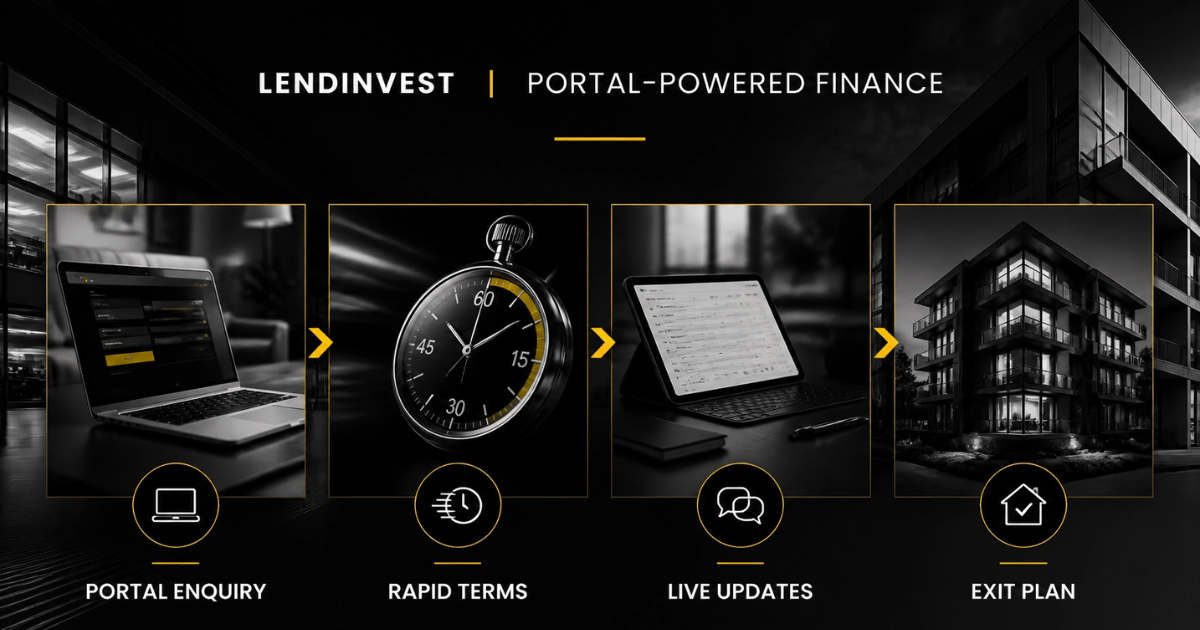
LendInvest Lender Intelligence: Portal-Powered Speed and Scale
LendInvest is best understood as a technology-enabled specialist property finance platform rather than a traditional lender relying on a basic online enquiry form.
Its proposition combines digital case submission, automated valuation technology, specialist underwriting and access to institutional funding. For brokers arranging auction finance, bridging loans and development facilities, this creates a lending environment where the quality and structure of the initial submission can have a meaningful impact on how efficiently a case progresses.
The broker portal is central to that proposition. It allows intermediaries to submit enquiries, access indicative terms, track applications and communicate with the underwriting team. On eligible cases, automated valuation models (AVMs) can also provide an alternative to a physical valuation.
However, speed of information flow should not be confused with guaranteed completion speed.
A portal-generated indication or heads of terms is not a formal mortgage offer, and neither guarantees that a transaction will complete. Property condition, valuation, legal title, borrower suitability, source of funds, works schedules and exit strategy remain important underwriting considerations.
For auction buyers and property investors, one distinction deserves particular attention: LendInvest's standard portal refurbishment bridge is not the same product as its refurbishment GDV facility.
The first is structured around a single facility without staged refurbishment drawdowns. The second is designed around a more structured works and gross development value assessment, with up to three drawdowns and a separate application route.
Choosing the right product before submitting a case can help avoid unnecessary delays.
This lender intelligence guide examines LendInvest's platform, product appetite, published criteria, strengths, limitations and the types of property transactions for which its lending proposition may be relevant.
Criteria referenced in this article include LendInvest's published bridging documentation and product information available in 2026. Product terms and eligibility can change. Brokers should confirm the latest criteria directly before submitting a case.
1. Understanding LendInvest's Lending Model
LendInvest operates as a technology-led specialist property finance lender, with products covering short-term bridging, development finance and buy-to-let mortgages.
Its model combines an online broker experience with specialist lending teams. The technology is intended to make it easier to submit cases, obtain initial terms and monitor progress, while underwriting teams assess the individual transaction.
For brokers, this creates three practical advantages.
Digital case submission
The broker portal provides a structured route for submitting enquiries and applications. Brokers can select the relevant product, enter borrower and security details, provide the proposed loan information and upload supporting documents.
This can reduce the administrative friction associated with traditional paper-based submissions.
Faster initial feedback
LendInvest promotes rapid enquiry reviews and heads of terms through its portal. Its published bridging criteria describe initial enquiry approvals and heads of terms being generated in minutes on suitable cases.
This is particularly relevant when a broker is assessing an auction opportunity and needs an early indication of whether the proposed funding structure is worth pursuing.
However, an initial indication is not a substitute for full underwriting.
Visibility during underwriting
The portal is designed to provide live updates on case progress and outstanding requirements.
Rather than relying entirely on email exchanges, brokers can use the platform to monitor the application and identify what the underwriting team still needs.
This is useful when coordinating a transaction involving an auction deadline, solicitor, valuer, borrower and multiple supporting documents.
The technology improves visibility. It does not remove the underlying due diligence.
2. The LendInvest Broker Portal: What Makes It Different?
The broker portal is one of LendInvest's central differentiators in the short-term lending market.
Its purpose is to make the journey from initial enquiry to application more structured and accessible.
The published process allows brokers to:
- Log in and create a new enquiry.
- Select the appropriate lending product.
- Enter the security property details.
- Provide the proposed value and transaction information.
- Add the loan requirements and borrower details.
- Upload supporting documentation.
- Submit the enquiry for assessment.
For suitable cases, the system can generate indicative terms quickly and provide a route into the full application process.
What brokers should understand about the portal
The portal is particularly useful when the case is straightforward enough to fit the relevant product criteria and the broker has reliable information available.
A standard residential purchase with a clear title, realistic valuation and uncomplicated exit may be easier to assess than a complex commercial property with multiple title issues, unusual planning arrangements and extensive refurbishment requirements.
The portal does not eliminate those differences.
A case with incomplete information may still require substantial clarification, even if the initial enquiry is submitted in minutes.
Live underwriter updates
LendInvest's portal includes case progress updates and visibility of outstanding requirements.
For brokers, this can make it easier to identify issues such as:
- Missing proof of deposit.
- Outstanding evidence of funds for refurbishment.
- Incomplete borrower information.
- Unresolved valuation requirements.
- Additional documents requested by underwriting.
This is particularly valuable when managing several cases simultaneously.
Heads of terms are not a funding guarantee
An important distinction must be maintained between:
- An initial enquiry.
- Indicative heads of terms.
- A decision in principle, where applicable.
- A full application.
- Formal credit approval and any formal offer.
- Completion and release of funds.
Each stage has its own requirements.
A broker should never advise an auction buyer to treat portal-generated terms as confirmation that the purchase funds are guaranteed.
The property, borrower and legal position must still satisfy the lender's requirements.
3. LendInvest Appetite Matrix
LendInvest's published bridging criteria cover several types of security and transaction, including residential property, semi-commercial property, commercial property and land for applicable unregulated products.
The following matrix summarises the main published product distinctions relevant to brokers.
| Product or facility | Published headline criteria | Important distinction |
|---|---|---|
| Unregulated bridging | Up to 85% gross LTV | Actual leverage depends on security, product and underwriting |
| Portal refurbishment bridge | Up to 73% net LTV, targeting up to 85% gross LTV | Single facility; no refurbishment drawdowns |
| Refurbishment GDV | Up to 70% LTGDV | Separate route; up to three drawdowns |
| Regulated bridging | Up to 75% gross LTV | Residential security and regulated lending requirements |
| AVM-supported bridging | Up to 75% gross LTV on eligible cases | Subject to property and valuation eligibility |
| Development finance | Up to 70% LTGDV and 85% LTC | Intended for qualifying development projects |
These are published maximums, not automatic lending entitlements. A case may receive a lower offer depending on valuation, property type, borrower profile, works, loan size and underwriting.
Unregulated bridging
LendInvest's published criteria advertise unregulated bridging up to 85% gross LTV.
The product range covers different types of property security and transaction, including:
- Residential property.
- Semi-commercial property.
- Commercial property.
- Land.
- Purchase.
- Refinance.
- Capital raise.
Published terms can extend up to 18 months for unregulated bridging.
The lender also offers different interest structures, including serviced, retained and rolled interest, subject to the product and case.
For auction buyers, the important question is whether the proposed loan amount, property and completion requirements fit the specific product rather than simply whether the lender advertises an 85% maximum.
Regulated bridging
LendInvest's published regulated bridging criteria show lending up to 75% gross LTV, with a maximum loan of £1 million.
The product is intended for residential security and transactions that fall within the relevant regulated lending framework.
Regulated bridging should not be treated as interchangeable with unregulated property investment finance. The borrower's circumstances, intended use of the property and regulatory status of the transaction matter.
A broker must establish the correct regulatory route before submitting the case.
4. The Two Refurbishment Products: Portal Bridge vs Refurbishment GDV
This is one of the most important distinctions in LendInvest's product range.
Both facilities can be relevant to investors purchasing properties that require improvement, but they are structured differently.
A. Portal Refurbishment Bridge
The portal refurbishment bridge is designed for eligible refurbishment transactions that can be funded through a single facility.
LendInvest's published criteria show:
- Up to 73% net LTV.
- Target gross LTV of up to 85%, subject to the case.
- A maximum loan size of £1.5 million in the published product guide.
- A maximum term of 12 months in that guide.
- Rolled interest.
- No staged refurbishment drawdowns.
The distinction between net and gross LTV matters.
A gross LTV calculation includes relevant financed amounts such as interest and fees, whereas net LTV relates to the net loan advance. The two figures should not be presented as though they describe the same amount of cash available to the borrower.
The broker should establish the actual net advance, redemption amount and available funds for the proposed transaction.
B. Refurbishment GDV
The refurbishment GDV product is designed for cases assessed against the anticipated gross development value following the works.
Published criteria include:
- Up to 70% loan-to-gross-development-value.
- A maximum of three drawdowns.
- A separate application route rather than the standard portal refurbishment process.
- A maximum loan size of £1.5 million in the published product guide.
- A maximum term of 18 months in that guide.
- Rolled interest.
This structure may be more appropriate where the works programme and funding requirements need to be assessed in stages.
The lender needs to understand the proposed refurbishment, its cost, expected completion value and the evidence supporting the project.
Which refurbishment route should a broker choose?
| Consideration | Portal refurbishment bridge | Refurbishment GDV |
|---|---|---|
| Funding structure | Single facility | Facility with staged drawdowns |
| Main assessment | LTV and property/security criteria | Gross development value and works |
| Drawdowns | No staged refurbishment drawdowns | Up to three |
| Application route | Broker portal | Separate team/application route |
| Potential use | Suitable, defined refurbishment projects | More structured refurbishment projects |
| Key broker task | Confirm the available net advance and works requirements | Present a credible works schedule, costs and GDV evidence |
The right choice depends on the transaction.
A broker should not automatically submit every refurbishment case through the standard portal product simply because it is the quickest route to an initial indication.
Where staged works funding is essential, the GDV product may be the more relevant conversation.
5. Automated Valuation Models: How LendInvest Uses AVMs
Automated valuation models are another important part of LendInvest's technology-led proposition.
An AVM uses property and market data to estimate a property's value without the traditional process of arranging a physical inspection.
For eligible cases, this can reduce the time and cost associated with obtaining a valuation.
LendInvest's published AVM criteria include the following requirements:
| AVM requirement | Published criteria |
|---|---|
| Transaction | Purchase transactions |
| Property type | Single-occupancy standard residential |
| Minimum property value | £100,000 |
| Maximum value in London | £700,000 |
| Maximum value outside London | £400,000 |
| Confidence level | Rightmove A, B or C |
| Maximum unregulated bridging LTV | 75% gross |
| Maximum regulated bridging LTV | Up to 75% gross |
The AVM must also meet the lender's eligibility and underwriting requirements.
How the AVM process works
The published process is integrated into the broker portal.
- The broker submits the initial property enquiry.
- The system checks whether the property meets the AVM requirements.
- Where eligible, an AVM option may be displayed.
- The broker can select the AVM route or proceed with a physical valuation.
- The enquiry is submitted for further assessment.
The option to proceed with a physical valuation is important.
Not every property is suitable for automated valuation. Unusual properties, complex security, certain refurbishment cases and properties outside the required parameters may need a physical valuation.
Why AVMs can help auction buyers
An eligible AVM can remove the need to wait for a physical valuation appointment at the initial stage.
This may help brokers progress suitable cases more efficiently, particularly where the property is a standard residential security and the transaction fits the lender's criteria.
However, an AVM should not be confused with a guarantee of the final lending value.
The lender retains its underwriting and valuation requirements, and the availability of an AVM does not guarantee that the transaction will proceed to completion.
6. Speed Index: Where LendInvest Can Save Time
LendInvest's platform is designed to improve the speed of initial enquiry, communication and case management.
Its published bridging information highlights:
- Rapid enquiry approvals and heads of terms in minutes.
- Live updates from underwriters.
- AVMs on eligible cases.
- Access to BDMs and underwriting support.
- Online application and case management.
These features can be particularly useful in auction finance, where the buyer may be working towards a fixed contractual completion date.
However, it is important to distinguish between the stages of the transaction.
| Transaction stage | What the platform can help with | What may still cause delay |
|---|---|---|
| Initial enquiry | Structured submission and rapid initial feedback | Missing or inaccurate information |
| Indicative terms | Faster generation on suitable cases | Case complexity or product mismatch |
| Valuation | AVM option on eligible properties | Ineligible property or physical valuation requirements |
| Underwriting | Visibility of outstanding requirements | Borrower, security or exit concerns |
| Legal work | Case tracking and communication | Title defects, searches, lease issues and solicitor delays |
| Completion | Better coordination of the application | Unresolved conditions or incomplete legal requirements |
The portal can make the process more efficient, but it cannot remove the need for a solicitor to resolve a title defect or for an underwriter to assess an unusual property.
The practical lesson for brokers
Use the portal to accelerate a well-prepared case, not to compensate for a poorly prepared one.
Before submitting, establish:
- The correct product.
- The purchase price and expected value.
- The required net loan.
- The property type and condition.
- The proposed works.
- The borrower and deposit position.
- The repayment strategy.
- The auction completion deadline, where applicable.
A structured submission gives the lender a clearer understanding of the transaction from the beginning.
7. Risk Flags: What Could Make a LendInvest Case More Difficult?
A lender's published appetite does not mean every transaction within a broad property category will be acceptable.
The following issues deserve attention before submission.
1. Incomplete schedule of works
LendInvest's published bridging criteria specifically highlight the importance of providing a schedule of works where refurbishment is involved.
Uploading the schedule as early as possible can help avoid delays in reviewing the case.
The schedule should explain:
- What work is required.
- Which areas of the property are affected.
- The estimated cost.
- The anticipated duration.
- Whether specialist contractors are needed.
- Whether planning permission or building control approval is relevant.
For more substantial projects, the lender may need further detail about costs, contractors and the proposed GDV.
2. Unclear exit strategy
The lender needs to understand how the bridging loan will be repaid.
Potential exits may include:
- Sale of the property.
- Refinance onto a term mortgage.
- Refinance onto another suitable specialist facility.
- Another evidenced repayment source.
A proposed refinance should be supported by realistic assumptions about property value, lender eligibility, rental income or affordability, and timing.
A statement that the borrower intends to remortgage is not the same as evidence that the proposed refinance is achievable.
3. Valuation uncertainty
The expected value must be supported by reasonable evidence.
Potential issues include:
- Limited comparable sales.
- Unusual property characteristics.
- An unrealistic post-refurbishment valuation.
- A commercial or mixed-use property with complex valuation considerations.
- Significant differences between the purchase price and proposed value.
Where the valuation is critical to the requested leverage, the broker should test the numbers before submission.
4. Legal pack and title issues
Auction properties can contain legal or title issues that affect both funding and completion.
Examples include:
- Restrictive covenants.
- Unusual rights of way.
- Missing or defective title documentation.
- Leasehold restrictions.
- Unresolved charges.
- Occupation or tenancy complications.
- Planning or building regulation concerns.
These issues should be identified as early as possible.
Auction360's legal pack review service can help buyers examine the legal information before committing to a bid.
5. Source of funds and deposit evidence
The broker should establish where the deposit and any additional funds are coming from.
Where the transaction involves multiple sources of capital, gifted funds or third-party contributions, the lender may require supporting evidence.
Incomplete source-of-funds information can create delays even where the property and loan structure appear suitable.
6. Incorrect product selection
This is particularly relevant to refurbishment cases.
Submitting a project that requires staged works funding through a product designed around a single facility can create unnecessary friction.
The broker should establish whether the standard refurbishment bridge or the refurbishment GDV route is appropriate before beginning the application.
7. Unrealistic auction completion timetable
The auction contract and special conditions determine the buyer's obligations.
A 28-day completion period is common in traditional auctions, but it is not universal.
The broker should review the actual contractual deadline and work backwards from it, allowing time for valuation, legal due diligence, underwriting and completion conditions.
8. Development Finance: Beyond Short-Term Bridging
LendInvest also provides development finance for qualifying residential development projects.
Its published development finance proposition covers:
- Ground-up development.
- Heavy refurbishment.
- Conversions.
- New-build schemes.
Published headline criteria include:
| Development finance feature | Published limit |
|---|---|
| Maximum loan-to-gross-development-value | 70% |
| Maximum loan-to-cost | 85% |
| Maximum loan size | £20 million |
| Maximum term | 24 months |
| Indicative terms | Within 24 hours |
| In-house credit approval | Within 48 hours of submission |
These figures are headline product information and should not be interpreted as guaranteed terms for an individual project.
The lender will still assess the site, planning position, borrower, development costs, professional team, security and exit.
How the development finance process works
LendInvest's published process describes an initial discussion and proposal submission, followed by indicative terms.
After terms are accepted, an application is completed and the lender undertakes credit assessment and due diligence.
The process can involve:
- Legal investigations.
- Valuation.
- Project and development appraisal.
- Planning review.
- Assessment of build costs.
- Review of the borrower and development team.
- Monitoring arrangements.
- Conditions for the release of funds.
LendInvest also advertises a 24-hour interim drawdown process for its development finance proposition, subject to the relevant requirements being satisfied.
The importance of LTGDV and LTC
Two measures are particularly important when assessing development finance.
Loan-to-gross-development-value (LTGDV) compares the proposed facility with the expected value of the completed development.
Loan-to-cost (LTC) compares the facility with the eligible project costs.
A lender may advertise maximum limits for both measures, but the actual facility is constrained by the overall assessment and whichever lending limit is most restrictive.
For example, a scheme may appear to fit the maximum LTC but fail the LTGDV test because the expected completed value does not support the requested borrowing.
The developer must therefore assess the project against both measures rather than relying on one headline percentage.
9. LendInvest's Strengths and Weaknesses
A useful lender assessment should consider both the advantages and the limitations.
Strengths
1. Technology-led application process
The broker portal provides a structured digital route for enquiries, applications and case tracking.
2. Rapid initial terms
The lender advertises heads of terms in minutes for suitable bridging enquiries.
3. Live case visibility
Portal updates can help brokers monitor outstanding requirements and underwriting progress.
4. AVM availability
Eligible standard residential purchases may benefit from an automated valuation route.
5. Multiple specialist finance products
The range covers regulated and unregulated bridging, refurbishment, refurbishment GDV, development finance and other specialist property finance requirements.
6. Access to larger development facilities
The published development finance proposition supports qualifying projects with facilities up to £20 million.
7. Different interest structures
Depending on the product, interest may be serviced, retained or rolled.
Weaknesses and limitations
1. Portal speed does not guarantee completion
A fast initial indication cannot resolve legal, valuation or underwriting issues.
2. Product distinctions require careful assessment
The standard refurbishment bridge and refurbishment GDV facility have different structures and application routes.
3. AVMs have eligibility restrictions
Properties outside the relevant criteria may require a physical valuation.
4. Maximum LTV is not a standard offer
The headline maximum may not be available for every borrower, property or transaction.
5. Development finance requires detailed preparation
More complex schemes require credible costings, planning information, professional support and a realistic exit.
6. Auction deadlines remain the buyer's responsibility
A lender's online process does not remove the contractual obligations created when a buyer wins an unconditional auction.
10. Best Fit: When Should Brokers Consider LendInvest?
LendInvest may be worth considering where the transaction aligns with its published product appetite and the broker can present a clear, well-documented case.
Potentially suitable scenarios
Standard residential auction purchases
Where the property and borrower meet the relevant bridging criteria, the portal may provide an efficient route to an initial assessment.
Eligible residential purchases using AVMs
A straightforward property that meets the AVM requirements may benefit from the automated valuation process.
Refurbishment projects with a defined works programme
The portal refurbishment bridge may be relevant where the project can be structured around a single facility and the works meet the lender's requirements.
More structured refurbishment projects
The refurbishment GDV facility may be worth exploring where staged drawdowns and a GDV-based assessment are more appropriate.
Ground-up development and conversions
The development finance proposition may be relevant for qualifying projects that fit the lender's size, leverage and underwriting criteria.
When might another lending route be more appropriate?
A broker should consider alternatives where:
- The property falls outside the lender's acceptable security criteria.
- The required funding structure does not fit the available products.
- The works require a facility with a different drawdown arrangement.
- The valuation or proposed leverage does not support the transaction.
- The legal position creates unacceptable risk.
- The completion deadline cannot realistically be achieved.
- The borrower's circumstances do not meet the relevant requirements.
The objective is not to force a transaction into a lender's product range. It is to identify the funding structure that fits the property and the investor's requirements.
11. Market Positioning: Technology, Scale and Institutional Funding
LendInvest occupies an established position in the UK specialist property finance market.
Its platform model combines technology, lending operations and access to institutional funding.
The scale of its business provides useful context.
In its FY25 annual results for the year ended 31 March 2025, LendInvest reported:
| FY25 measure | Reported figure |
|---|---|
| Platform assets under management | Approximately £3.23 billion |
| Funds under management | Approximately £5.13 billion |
| New lending | Approximately £1.23 billion |
These figures demonstrate the scale of the platform at that reporting date. They should not be confused with the amount available for an individual transaction or a guarantee of lending capacity for a particular case.
Scale is relevant, but it is not a substitute for product suitability.
For brokers, the more important questions remain:
- Does the lender accept the property?
- Does the borrower meet the criteria?
- Does the requested loan fit the product?
- Is the valuation supportable?
- Can the works be funded appropriately?
- Is the exit realistic?
- Can the transaction complete within the required timeframe?
A lender can have substantial institutional backing and sophisticated technology while still being unsuitable for a particular property transaction.
12. How Auction360 Approaches LendInvest Cases
At Auction360, lender selection should begin with the transaction rather than the headline product limit.
For an auction purchase, this means reviewing the property, legal pack, valuation, borrower position, funding requirement and completion deadline before deciding which lender route to pursue.
Where LendInvest appears suitable, the case should be structured around the relevant product from the beginning.
For example:
- A straightforward purchase may be assessed against the standard bridging criteria.
- An eligible standard residential property may be considered for the AVM route.
- A suitable single-facility refurbishment may fit the portal refurbishment bridge.
- A project requiring staged refurbishment funding may need the refurbishment GDV route.
- A qualifying development scheme may require a development finance assessment.
The aim is to reduce avoidable delays caused by incomplete information or an unsuitable product route.
Auction360's specialist support includes:
- Auction finance.
- Legal pack review.
- Pre-auction funding assessment.
- Auction risk analysis.
- Bridging finance and development finance planning.
For investors who want to understand the wider auction process, Deji Nehan's book, Auction Demystified: Unlocking Auction Success, explores the practical considerations involved in buying property at auction.
Read more about Auction Demystified.
Frequently Asked Questions
1. Is LendInvest suitable for auction finance?
LendInvest can be suitable for auction purchases where the property, borrower, valuation, legal position and repayment strategy meet its criteria. The broker should assess the case before bidding and confirm that the proposed facility can meet the contractual completion deadline.
2. What is LendInvest's maximum bridging LTV?
LendInvest's published unregulated bridging criteria advertise up to 85% gross LTV. Its regulated bridging criteria advertise up to 75% gross LTV. The actual offer depends on the property, borrower, product, valuation and underwriting assessment.
3. What is the LendInvest portal refurbishment bridge?
It is a refurbishment bridging product available through the broker portal. Published criteria show up to 73% net LTV, targeting up to 85% gross LTV where the case supports it. It is structured as a single facility rather than a staged refurbishment drawdown product.
4. What is the difference between the portal refurbishment bridge and refurbishment GDV?
The portal refurbishment bridge is designed around a single facility without staged works drawdowns. The refurbishment GDV product is assessed against the expected gross development value and can provide up to three drawdowns. It is submitted through a separate route rather than the standard portal process.
5. Can LendInvest use an AVM instead of a physical valuation?
Yes, on eligible cases. Published AVM criteria include single-occupancy standard residential properties, a minimum value of £100,000, maximum values of £700,000 in London and £400,000 outside London, and a qualifying Rightmove confidence level. The maximum published LTV for the AVM route is up to 75% gross, subject to eligibility and underwriting.
6. Does LendInvest offer regulated bridging?
Yes. Its published criteria show regulated bridging up to 75% gross LTV and a maximum loan of £1 million. The facility is intended for residential security and must meet the applicable regulated lending requirements.
7. How quickly can LendInvest issue heads of terms?
LendInvest advertises rapid enquiry approvals and heads of terms in minutes through its broker portal on suitable cases. More complex transactions, incomplete submissions or cases requiring further investigation may take longer. Heads of terms are not a guarantee of formal approval or completion.
8. Does LendInvest offer development finance?
Yes. Its published development finance proposition covers qualifying ground-up developments, heavy refurbishments, conversions and new-build projects. Headline limits include up to 70% LTGDV, 85% LTC and a maximum loan of £20 million, subject to underwriting and project suitability.
9. Can LendInvest fund commercial property?
Its published unregulated bridging criteria include commercial and semi-commercial security, subject to product-specific requirements and maximum leverage. Brokers should check the current criteria for the exact property type, loan size and proposed transaction.
10. What documents should brokers prepare for a refurbishment case?
The requirements depend on the product and transaction. A broker should generally be ready to provide property details, purchase information, borrower and deposit evidence, a schedule of works, estimated costs, expected value and the proposed exit strategy. Further documents may be requested during underwriting.
Useful Links and Resources
- LendInvest Intermediary Bridging Finance
- LendInvest Intermediary Documents
- LendInvest Development Finance
- LendInvest Bridging Criteria Guide
- Auction360 Finance Services
- Auction360 Book: Auction Demystified
- Get Your Property Finance Case Assessed
Auction360 Profile
Auction360 provides specialist auction and bridging finance support for property investors, developers and auction buyers across the United Kingdom.
Its services include pre-auction funding assessment, legal pack review, auction risk analysis, bridging finance and development finance planning.
The objective is to help clients understand their funding options, identify potential transaction risks and structure finance around the property and intended exit.
Get your property finance case assessed.
Author Profile
Deji Nehan is a mortgage broker, wealth coach and author of Auction Demystified: Unlocking Auction Success. He writes about property auctions, bridging finance, mortgages, property investment and the financial decisions involved in building a property portfolio.
Disclaimer
This article is for general information and educational purposes only. It is not a lending decision, financial recommendation or guarantee that LendInvest will accept a particular application. Product criteria, maximum LTVs, fees, rates and lending policies can change. All lending is subject to the lender's current criteria, underwriting, valuation, legal due diligence and individual circumstances.
Your property may be repossessed if you do not keep up repayments on a mortgage or any other debt secured on it.