
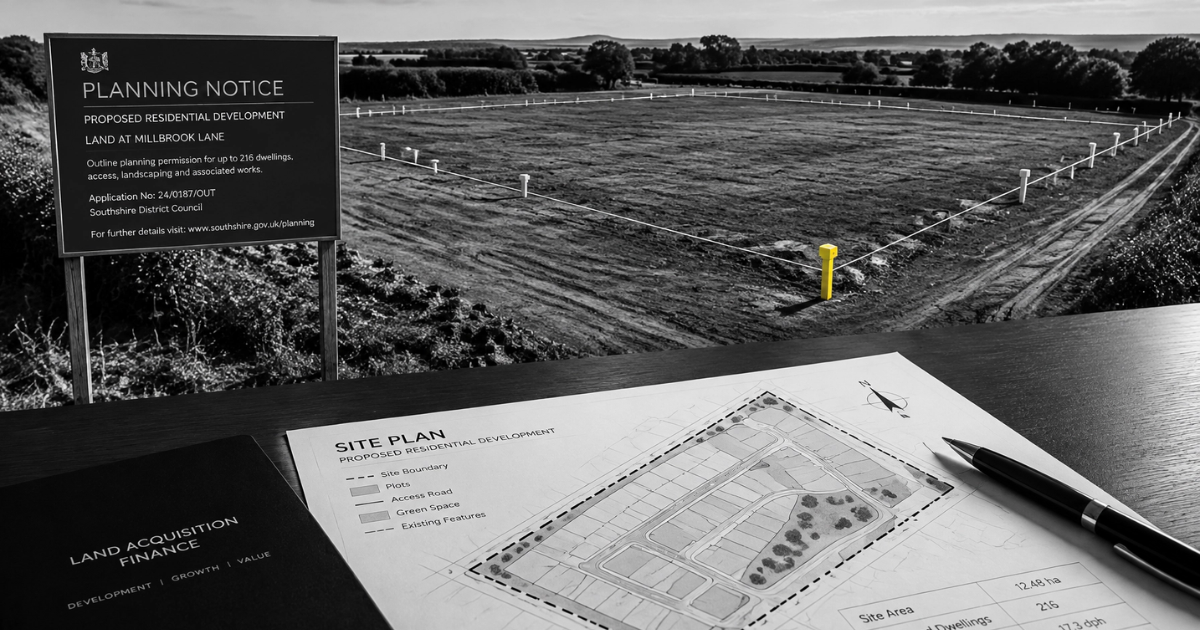
Land and Development Finance: Acquiring Strategic Sites Through Auction and Beyond
Land acquisition is often the first major financial hurdle in a property development project. Finding a site with potential is one thing. Securing the money to purchase it, obtaining or progressing planning permission, funding construction and repaying the finance from the completed development are separate challenges that need to work together.
For developers buying through auction, the pressure can be even greater. A desirable site may attract competitive bidding, while the legal pack, planning position and completion deadline leave little room for financial uncertainty.
This is where land and development finance comes in.
Unlike a standard residential mortgage, development finance is structured around the potential value of a completed project. A lender must understand not only what the land is worth today, but what can realistically be built on it, how much the project will cost, how long it will take and how the loan will eventually be repaid.
Land with an implementable planning permission may be easier to finance than a speculative site with no consent. However, planning permission alone does not make a development viable. Access, services, title restrictions, construction costs, market demand and the developer's experience all influence the funding decision.
This guide explains how UK land and development finance works, how lenders assess different types of sites, what to investigate before buying land at auction and how to structure funding from acquisition through to the final sale or refinance.
"Land does not have a value; it has a possibility. The lender funds the possibility only as far as the evidence for it reaches."
— Deji Nehan, Auction Demystified: Unlocking Auction Success
Key takeaways
| Key point | What it means for a developer |
|---|---|
| Land is assessed differently from completed property | Its value depends heavily on planning, access, services, title and development potential |
| Planning status affects lender appetite | Consented sites are generally more straightforward to assess than speculative land |
| Development finance can combine acquisition and construction funding | The lender assesses the overall project, not simply the land purchase |
| GDV is a major funding constraint | The projected value of the completed development must support the proposed borrowing |
| Auction land requires specialist due diligence | Overage, access rights, restrictive covenants and planning conditions can materially affect viability |
| The funding strategy should be agreed before bidding | A site can be commercially attractive but financially impossible to complete |
Table of contents
- Why land is funded differently from buildings
- Types of land and their funding profiles
- How land and development finance works
- Understanding GDV, LTC and LTGDV
- A worked example of land acquisition and development finance
- Buying development land at auction
- How planning permission affects funding
- Development finance by project size
- From site acquisition to development exit
- What lenders assess before approving a facility
- Common mistakes when financing development land
- Frequently asked questions
Why land is funded differently from buildings
A completed property has an established use and can usually be valued against comparable properties that have recently sold. Land is different.
Its value may depend on what a developer is permitted to build, what a planning authority might approve, whether the site can be accessed, whether utilities can be connected and whether the finished development will attract buyers or tenants.
Consider two plots of similar size:
- Plot A has full planning permission for four residential units, an established access arrangement and nearby utility connections.
- Plot B has no planning permission, uncertain access and no confirmed route for connecting essential services.
Although the plots might look similar, they do not represent the same lending proposition.
Plot A offers a more defined route from acquisition to development. Plot B requires the developer to overcome several uncertainties before the intended scheme can proceed.
That difference affects valuation, lender appetite, the amount of money available and the conditions attached to the facility.
Why lenders apply lower land advances
Lenders generally take a cautious approach to land because:
- Planning risk: The proposed development may not receive permission, or the existing consent may not support the developer's intended scheme.
- Valuation uncertainty: There may be fewer directly comparable transactions, particularly for unusual or strategic sites.
- Liquidity risk: Land can be harder to sell quickly than a completed residential property.
- Infrastructure costs: Roads, drainage, utilities and remediation can materially increase the cost of bringing a site forward.
- Legal restrictions: Covenants, easements, access rights and overage agreements can reduce the site's value or restrict development.
- Longer timescales: Some sites require months or years of planning, design and infrastructure work before construction can begin.
As a result, a lender may advance a lower proportion of the land value than it would against a completed property.
Indicative market discussions sometimes refer to land advances in the region of 40–60% of an accepted site value where planning is in place. However, this is not a universal lending range. The actual advance can be lower, higher in a suitable structure, or unavailable altogether depending on the site, borrower, valuation and lender.
Unconsented strategic land is particularly challenging. A conventional development lender may not consider it suitable security for a standard development facility.
The important distinction is between land that is simply available to buy and land that has a credible, evidenced route to development.
Types of land and their funding profiles
Not all development sites carry the same risk. Understanding the type of land you are purchasing helps determine which funding route may be appropriate.
| Land type | Potential funding route | Main considerations |
|---|---|---|
| Single plot with full planning permission | Bridging or development finance | Construction costs, planning conditions and exit value |
| Multiple plots with consent | Development finance | Phasing, programme, infrastructure and sales assumptions |
| Land with an application pending | Specialist or conditional funding, where available | Risk of refusal, delay or amended consent |
| Strategic or promotion land without consent | Specialist land arrangements, private capital or landowner agreements | Long planning horizon and uncertain value realisation |
| Garden or infill plot | Case-specific bridging or development finance | Access, boundaries, services and planning suitability |
| Commercial development land | Commercial development finance | Tenant demand, covenant strength and completed asset value |
| Mixed-use development site | Commercial or mixed-use development finance | Residential and commercial elements, planning and exit strategy |
1. Consented development plots
These are often more straightforward to assess because the intended use and approved scheme are more clearly defined.
However, the developer must establish whether the permission is still valid, whether it relates to the exact scheme being proposed and whether outstanding conditions prevent work from starting.
A site with full permission can still have significant development risk if, for example, a pre-commencement condition requires an expensive drainage solution or a highway improvement.
2. Land with outline planning permission
Outline planning permission establishes the principle of development but does not necessarily approve every detail.
Reserved matters may still need approval. These can include matters such as layout, scale, appearance, access and landscaping, depending on what was reserved.
The lender will want to understand what remains outstanding and whether the proposed development is consistent with the outline consent.
Outline permission is therefore not the same as having an immediately buildable site.
3. Strategic land
Strategic land is generally land with potential for future development, often dependent on changes to planning policy, allocation or the grant of permission.
It can be attractive to landowners, promoters and investors who are prepared to work over a longer period to improve the site's development prospects.
However, the absence of planning consent makes conventional development finance difficult. The funding strategy may instead involve:
- An option agreement with the landowner.
- A promotion agreement under which a promoter works to secure planning permission and markets the land.
- Private equity or specialist land investment.
- A conditional purchase arrangement.
- A joint venture with a landowner or development partner.
These structures are not interchangeable with a standard development loan. Each has different legal, financial and commercial implications.
4. Infill and garden development plots
Small sites can appear attractive because they may offer a relatively simple route to building one or two units.
But a small plot can have disproportionately complicated access, drainage, boundary or service issues. The developer must establish whether the site can physically and legally accommodate the intended scheme.
A low purchase price does not automatically make an infill site a good development opportunity.
How land and development finance works
Development finance is usually structured as a facility supporting a defined project. Depending on the lender and transaction, it may fund the site acquisition, construction costs and certain associated expenses.
The facility is normally assessed against the project's costs and the projected value of the completed development.
The main components are:
| Facility component | What it covers | How it is assessed |
|---|---|---|
| Land acquisition | Purchase of the development site | Site valuation, purchase price, planning and security |
| Construction funding | Building and infrastructure costs | Quantity surveyor's assessment, cost plan and programme |
| Professional fees | Eligible project-related professional costs | Lender policy and approved development budget |
| Contingency | Allowance for unforeseen costs | Cost plan and risk assessment |
| Interest and fees | Finance costs over the facility term | Rate, arrangement fees, drawdown structure and term |
| Overall facility limit | Combined lender exposure | Loan-to-cost, loan-to-GDV and lender-specific limits |
Land acquisition funding
The first stage is purchasing the site.
Some development lenders can provide an acquisition advance as part of a single development facility. Others may prefer a separate bridging facility to complete the land purchase, particularly where the site is being acquired at auction and the completion deadline is tight.
The amount available depends on the lender's valuation and the overall development appraisal.
A lender may not accept the purchase price as the site's market value. If the buyer has bid aggressively, the valuation could be lower than the amount paid, leaving the developer with a larger funding gap.
Construction funding
Once the project is ready to proceed, construction funding is generally released in stages.
The lender may appoint a monitoring surveyor to assess progress and approve drawdowns. Funds are not necessarily made available as one unrestricted lump sum at the start of the project.
A typical process may involve:
- The developer submits the required drawdown request.
- The monitoring surveyor inspects the development or reviews supporting evidence.
- The surveyor assesses progress against the agreed programme and budget.
- The lender authorises the approved release.
- The developer uses the funds for the relevant stage of construction.
This staged arrangement helps the lender monitor how its money is being used and whether the project remains on track.
Can development finance cover 100% of construction costs?
Some facilities may fund up to 100% of eligible build costs, but this should never be interpreted as a promise that the lender will fund the entire project.
The overall facility still has to satisfy the lender's loan-to-cost and loan-to-GDV limits. The borrower may also need to contribute the land deposit, acquisition costs, professional fees, contingency and other expenses.
For example, a lender might agree to fund the full approved construction budget while requiring the developer to contribute substantial equity towards the land and other project costs.
The distinction matters: 100% of eligible build costs is not the same as 100% of total development costs.
Understanding GDV, LTC and LTGDV
Three measures are particularly important when assessing development finance.
Gross Development Value (GDV)
Gross Development Value is the estimated market value of the completed development.
For a residential scheme, it may be calculated by adding the expected sale prices of all completed units.
For example:
| Unit | Estimated sale value |
|---|---|
| Unit 1 | £175,000 |
| Unit 2 | £175,000 |
| Unit 3 | £175,000 |
| Unit 4 | £175,000 |
| Unit 5 | £175,000 |
| Unit 6 | £175,000 |
| Total GDV | £1,050,000 |
The £1.05 million figure is a projection, not a guaranteed sale result. A lender will want evidence supporting the assumed values, normally including comparable transactions and an appropriate valuation.
Loan-to-Cost (LTC)
Loan-to-Cost measures the proposed loan against the total eligible project costs.
[
LTC = \frac{\text{Loan Amount}}{\text{Total Project Costs}}\times100
]
If eligible project costs are £700,000 and the proposed facility is £490,000:
[
LTC = \frac{£490,000}{£700,000}\times100 = 70%
]
The borrower would need to fund the remaining costs through equity or another acceptable source.
Loan-to-GDV (LTGDV)
Loan-to-GDV measures the facility against the projected completed value.
[
LTGDV = \frac{\text{Loan Amount}}{\text{Gross Development Value}}\times100
]
If the proposed facility is £682,500 against a GDV of £1,050,000:
[
LTGDV = \frac{£682,500}{£1,050,000}\times100 = 65%
]
This means the proposed facility represents 65% of the estimated completed value.
Why both measures matter
A development may look attractive when measured against GDV but fail the lender's cost-based assessment.
Equally, a project may have a reasonable LTC but a weak projected end value.
Lenders commonly assess both measures alongside profitability, contingency, borrower equity, construction risk and the proposed exit.
Some senior development finance market guides cite indicative limits around 60–70% of total costs and approximately 65% of GDV. These are market illustrations, not universal lender commitments. Individual lenders may apply different limits, and the amount available is generally determined by the most restrictive applicable test.
A worked example of land acquisition and development finance
Consider a developer purchasing a site with planning permission for six residential units.
The following example illustrates how the funding structure might be assessed. It is not a lender offer or a representation that every lender will advance the stated amounts.
Project assumptions
| Item | Indicative amount |
|---|---|
| Land purchase price | £150,000 |
| Estimated construction costs | £510,000 |
| Total land and build costs | £660,000 |
| Projected GDV | £1,050,000 |
| Illustrative acquisition advance | £90,000 |
| Illustrative overall facility ceiling at 65% GDV | £682,500 |
The acquisition advance of £90,000 represents 60% of the £150,000 purchase price.
The overall facility ceiling at 65% of GDV is:
[
£1,050,000 \times 65% = £682,500
]
The proposed acquisition advance and the £510,000 construction budget would total £600,000 before considering any additional eligible costs or finance charges.
At first glance, the structure appears to fit within the illustrative GDV ceiling. However, that does not mean the lender will automatically approve £600,000.
The lender still needs to assess:
- Whether the land valuation supports the proposed acquisition advance.
- Whether the construction budget is realistic and independently assessed.
- Whether professional fees, contingency and finance costs are included.
- Whether the project satisfies the lender's loan-to-cost limit.
- Whether the developer has sufficient equity to cover the funding gap.
- Whether the projected GDV is supported by comparable evidence.
- Whether the scheme can be completed within the proposed term.
The lender may also apply a lower facility limit after its full appraisal.
The lesson: assess the whole project before buying the land
A common mistake is to negotiate the land purchase first and only then investigate how the construction will be financed.
That can leave the developer with a site they can purchase but cannot afford to develop.
The acquisition and construction stages should be modelled together. The developer needs to understand the total funding requirement, the lender's likely contribution, the equity required and the exit before committing to the purchase.
This is especially important at auction, where the buyer may become contractually committed when the hammer falls.
Buying development land at auction
Property auctions can offer access to sites that are not readily available through conventional estate agency channels. These may include individual building plots, redundant commercial premises, infill opportunities, land with planning permission and larger development sites.
However, buying land at auction requires more than identifying an attractive price.
The legal pack may contain restrictions or obligations that significantly change the economics of the development.
What to check in an auction land legal pack
| Pack item | What the developer should investigate |
|---|---|
| Planning documents | Existing permissions, approved drawings, conditions, expiry dates and outstanding reserved matters |
| Overage or clawback | Whether the seller retains a right to additional payment following a future planning or development event |
| Access rights | Whether legal and physical access is established and sufficient for the proposed scheme |
| Utilities and services | Availability, connection costs, capacity and any required infrastructure works |
| Restrictive covenants | Restrictions on building, use, height, density or other development activities |
| Title and boundaries | Ownership, registered title, easements, rights of way, boundary discrepancies and third-party interests |
| Environmental reports | Contamination, flood risk, ground conditions and potential remediation liabilities |
| Highways and drainage | Adoption status, connection arrangements, improvement requirements and maintenance responsibilities |
| Planning obligations | Section 106 agreements, Community Infrastructure Levy exposure and other relevant obligations |
| Special conditions of sale | Completion date, additional costs, deposits and other contractual requirements |
Overage clauses: the hidden cost in some land purchases
An overage clause gives the seller a contractual right to receive additional money if a specified event increases the value of the land.
For example, the seller may be entitled to a percentage of the increase in value if planning permission is granted within a defined period.
Imagine a developer purchases a plot for £150,000. The legal documentation contains an overage arrangement under which the seller receives 30% of a defined increase in development value if a qualifying planning event occurs.
The developer cannot simply ignore that obligation when calculating profitability.
The exact amount payable depends on the wording of the agreement, the trigger event, the valuation mechanism, deductions and any time limits.
Before bidding, the developer should establish:
- What event triggers the payment.
- How the uplift is calculated.
- Whether the payment applies to planning permission, implementation or sale.
- How long the overage arrangement lasts.
- Whether it is protected by a restriction or other title mechanism.
- Whether it affects the lender's security or the proposed exit.
A site can still be viable with an overage agreement. The mistake is failing to price it into the development appraisal.
Access and ransom strips
A site may appear to have a road leading directly to it, but that does not necessarily mean the owner has a legal right to use the route.
The title documents must establish the relevant access rights. The developer should also consider whether the access is physically suitable for construction traffic, emergency vehicles and the eventual completed development.
A ransom strip or third-party ownership of a narrow access area can create a serious obstacle.
The same principle applies to services. A water pipe, electricity connection or drainage route may be nearby without the developer having the legal rights or technical capacity to connect to it.
These issues should be investigated before the auction, not discovered after completion.
Auction deadlines and funding
Traditional unconditional auctions generally create a binding contract when the hammer falls, with the completion date governed by the auction conditions and special conditions of sale.
A 28-day completion period is common in some auction transactions, but it is not universal. The actual contractual deadline must be checked in the legal pack.
If a development lender cannot complete within the required timeframe, a bridging facility may be considered as an acquisition solution, subject to valuation, legal work, underwriting and lender approval.
Read more about auction finance and the funding process.
The key is to establish the funding route before bidding. An indicative conversation with a lender or broker is not the same as having a completed, property-specific facility ready to draw down.
How planning permission affects funding
Planning permission is one of the most important factors in land valuation and development finance.
It provides evidence of what can be built, but the type of permission and the conditions attached to it matter.
| Planning position | Potential funding implications |
|---|---|
| Full planning permission | Often the clearest planning position, subject to conditions, title and viability |
| Outline planning permission | Further reserved matters may need approval before development can proceed |
| Application pending | Greater uncertainty; conventional development funding may be difficult |
| No planning permission | Funding appetite can be limited, particularly for speculative development land |
| Expired permission | The developer may need to obtain fresh consent; previous approval does not guarantee a new grant |
| Permission with unresolved conditions | The cost and timing of discharging conditions may affect the appraisal |
| Permission requiring significant infrastructure | The scheme may need additional funding and a revised programme |
Full planning permission does not mean there is nothing left to do
A decision notice may grant full planning permission but attach conditions that must be satisfied before certain works can begin.
These may relate to:
- Drainage and surface water management.
- Highways and access.
- Landscaping and biodiversity.
- Materials and external appearance.
- Contamination investigations.
- Construction management.
- Other technical details required by the local planning authority.
The developer must read the decision notice and approved plans carefully. The relevant question is not simply whether permission exists, but whether the approved scheme can be implemented on the proposed terms and within the intended programme.
Government guidance explains that planning conditions should be addressed in accordance with the permission and that certain details may need approval before development can begin. GOV.UK guidance on planning conditions.
Outline permission and reserved matters
Outline permission establishes the principle of development, but some details remain to be agreed through reserved matters applications.
A developer should identify exactly which matters were reserved and what approvals are still needed.
The Planning Portal explains that outline permission does not itself authorise the developer to begin the approved development without the necessary reserved matters approvals. Planning Portal: Outline planning consent.
This matters to lenders because unresolved planning details can affect cost, timing and the certainty of the proposed scheme.
Strategic land without planning permission
Strategic land is not necessarily worthless because it lacks planning consent. Its potential may be significant, particularly where there is a credible route to future development.
But potential is not the same as an approved scheme.
The developer needs to understand the planning history, local development plan, infrastructure constraints, environmental designations and the likelihood of the land being brought forward for development.
A speculative site may be better suited to an option or promotion agreement than an immediate purchase funded by a conventional development loan.
Development finance by project size
The appropriate funding structure changes with the scale and complexity of the project.
| Project type | Potential funding structure | Key considerations |
|---|---|---|
| Single-unit self-build | Self-build mortgage or development facility | Borrower's circumstances, planning and staged construction |
| Small development of 2–6 units | Development finance | Land contribution, build budget, GDV and sales evidence |
| Larger residential scheme | Development facility with monitoring | Professional team, contractor capacity, programme and infrastructure |
| Commercial new-build | Commercial development finance | Tenant demand, lease assumptions, valuation and investment exit |
| Mixed-use scheme | Mixed-use or commercial development facility | Separate residential and commercial values, planning and phasing |
| Phased strategic development | Tranche or phase-based funding | Planning milestones, infrastructure and repayment between phases |
Small residential developments
Smaller developments may be suitable for specialist development finance, particularly where planning permission is in place and the developer has a clear construction plan.
However, a small project is not automatically a low-risk project. A single cost overrun or sale delay can have a substantial impact on the overall profit.
Larger and phased schemes
For a larger site, lenders may prefer funding to be structured in phases.
For example, a development might be divided into three phases, with the first group of completed units sold before the next stage of funding is fully deployed.
Phasing can help manage exposure, but it requires careful planning. The developer must establish whether infrastructure, access, services and planning obligations allow the scheme to proceed in the intended sequence.
A phased structure should also account for the cash needed to complete each stage and the timing of receipts from sales.
Commercial and mixed-use developments
Commercial projects may involve offices, retail, industrial units, leisure premises or a combination of uses.
The lender will assess the proposed completed asset, the strength of the local market and the likely exit.
For an investment-led commercial development, the proposed rental income, tenant demand and capitalisation assumptions may be relevant. For a sale-led project, the lender will need evidence supporting the expected disposal value.
Mixed-use projects can require separate analysis of the residential and commercial elements, including how each part will be valued and sold or refinanced.
From site acquisition to development exit
A successful development finance structure connects every stage of the project.
The land purchase is only the beginning. The developer needs a funding plan that remains workable as the project moves through planning, construction and completion.
| Project stage | Potential funding route | What needs to happen |
|---|---|---|
| Land acquisition | Development facility or bridging finance | Complete the purchase and satisfy the lender's security requirements |
| Planning and design | Developer equity or an agreed facility allocation | Progress technical design, planning approvals and professional work |
| Pre-construction | Development facility | Finalise contractor arrangements, cost plan, programme and conditions |
| Construction | Staged development finance drawdowns | Complete work and satisfy monitoring requirements |
| Practical completion | Remaining facility and project cash flow | Complete outstanding works, certification and handover requirements |
| Sales or refinance | Development exit or repayment from proceeds | Repay the development facility and settle associated costs |
Stage 1: Acquire the site
The first challenge is completing the purchase.
If the site is being bought at auction, the developer must work backwards from the contractual completion deadline.
A development facility may be suitable where the lender can complete the acquisition and support the construction programme. Where timing or underwriting makes that impractical, a separate bridging loan may be considered.
However, the developer should not assume that a bridge can automatically be refinanced into development finance. The second lender will carry out its own assessment of the property, borrower and project.
Stage 2: Progress planning and design
The developer may need to fund architects, planning consultants, engineers, surveys and other professional work.
Some lenders may include eligible fees in the development budget, while others expect the borrower to fund them separately.
The developer should also identify the cost and timing of planning obligations, infrastructure and outstanding conditions.
Stage 3: Prepare for construction
Before construction funding is released, the lender may require an agreed cost plan, building contract, professional team and construction programme.
Depending on the scheme, other requirements may include:
- Building regulations approvals.
- Suitable contractor and professional appointments.
- Insurance arrangements.
- Warranty arrangements for residential units.
- Satisfactory valuation and monitoring reports.
- Evidence that key planning conditions have been addressed.
Stage 4: Draw down construction funding
The lender releases funds according to the agreed facility structure.
The developer needs to manage cash flow carefully. Delays in inspections, incomplete documentation or work that falls behind the approved programme can affect drawdown timing.
The project should retain sufficient contingency to manage unforeseen costs without immediately relying on additional borrowing.
Stage 5: Sell or refinance
Most development facilities are repaid from the sale of completed units or through a suitable refinance.
A sale-led project depends on achieving sufficient proceeds to repay the loan, interest, fees and other liabilities.
A refinance may be appropriate where the developer intends to retain the completed property as a rental investment, but the new lender will assess the completed asset and the borrower's ability to meet the relevant criteria.
Where the project needs more time, an extension or development exit facility may be possible, but neither should be treated as automatic. The developer should discuss the repayment strategy with the lender well before the original facility reaches maturity.
What lenders assess before approving a facility
A lender is not simply financing a piece of land. It is assessing the risk of a development project and the likelihood of recovering its money.
The appraisal usually considers several connected areas.
1. The site and planning position
The lender will want to understand:
- What is being purchased?
- What is the current planning status?
- Does the permission support the proposed development?
- Are there outstanding planning conditions?
- Are access and service arrangements satisfactory?
- Are there title restrictions or third-party rights?
- Is the site affected by environmental or ground risks?
A valuation and legal review may identify issues that are not obvious from the auction catalogue or marketing particulars.
2. The development appraisal
The lender will assess the overall project economics.
This generally includes land cost, construction costs, professional fees, finance charges, contingency, sales costs and projected GDV.
The developer should be able to explain the assumptions behind the appraisal rather than simply presenting an optimistic end value.
A useful appraisal should also test less favourable scenarios. What happens if build costs rise? What if sales values fall? What if the programme takes longer than expected?
A project that only works under perfect conditions may not be sufficiently robust.
3. The developer's experience and financial position
Experience matters, particularly for more complex developments.
A lender may ask about previous projects, completed schemes, the developer's role in those projects and the availability of a suitable professional team.
A first-time developer is not automatically excluded from development finance. However, the lender may want additional comfort through an experienced contractor, development manager, joint venture partner or other professional support.
The developer's available equity and ability to cover overruns are also important.
4. The construction plan
The lender will want evidence that the project can be delivered within the proposed budget and programme.
Relevant documents may include:
- Detailed cost plan.
- Contractor quotations or building contract.
- Construction programme.
- Quantity surveyor's report.
- Professional team details.
- Contingency allowance.
- Insurance and warranty information where applicable.
An unrealistic programme or poorly supported construction budget can undermine an otherwise attractive site.
5. The exit strategy
The exit explains how the lender will be repaid.
For a sale-led project, the developer should provide evidence supporting the expected sale prices and likely demand.
For a refinance-led project, the developer should establish whether the completed property is likely to meet the requirements of the intended long-term lender.
The exit should be credible even if the project takes longer or the market changes.
Common mistakes when financing development land
1. Bidding before confirming the funding route
An attractive auction lot can create pressure to act quickly. But bidding without a credible finance plan exposes the developer to the risk of winning a site that cannot be funded.
Better approach: Discuss the proposed acquisition and development with an experienced finance professional before bidding. Allow time for valuation, legal review and lender underwriting.
2. Treating planning permission as a guarantee of viability
Planning consent does not guarantee that the development can be delivered profitably.
Unresolved conditions, infrastructure costs and planning obligations can change the economics.
Better approach: Review the full planning documentation and cost the outstanding requirements before committing.
3. Ignoring the overall facility cap
A developer may calculate the land advance and build funding separately without testing the combined borrowing against GDV and total project costs.
Better approach: Model the complete facility, including interest and eligible fees, before purchasing the site.
4. Underestimating infrastructure costs
Road access, drainage, utilities and remediation can be expensive.
Better approach: Obtain technical reports and cost estimates early. Do not rely on the assumption that nearby infrastructure can be connected cheaply.
5. Overestimating GDV
A developer may base projected sale prices on asking prices rather than completed comparable transactions.
Better approach: Use realistic local evidence and allow for market movement, sales costs and the time required to sell the completed units.
6. Assuming a bridging loan will automatically refinance
A short-term acquisition loan may solve a completion problem, but the development lender will still assess the site and scheme independently.
Better approach: Discuss the intended refinance before taking the initial facility. Understand what must happen for the next lender to approve the development funding.
7. Leaving the exit until the end
If sales are slower than expected, the developer may reach the facility maturity date with an outstanding balance.
Better approach: Monitor the exit throughout the project and speak to the lender early if the programme or sales assumptions change.
Frequently asked questions
1. How much can I borrow to buy land for development?
There is no single maximum that applies to every site. Indicative market discussions may refer to advances of around 40–60% of an accepted land value for certain consented sites, but the actual amount depends on planning status, valuation, borrower experience, site risks and the proposed development.
Unconsented strategic land may be unsuitable for conventional development finance altogether.
2. Can I use development finance to buy land?
Yes. Some development facilities include funding for the initial site acquisition as well as the construction programme.
The lender will assess the land purchase as part of the wider project, including the proposed GDV, total costs, planning position and the developer's contribution.
3. Can I buy land at auction using development finance?
Yes, where the lender can approve and complete the transaction within the contractual deadline.
The developer should start discussions before bidding and allow time for valuation, legal work and underwriting. If the development lender cannot meet the auction deadline, bridging finance may be an alternative, subject to its own approval process.
4. Can development finance fund 100% of build costs?
Some lenders may fund up to 100% of eligible construction costs, provided the overall facility satisfies their lending limits.
This does not mean the lender will fund 100% of the land, professional fees, contingency, interest and every other project expense. The developer will generally need to contribute equity.
5. What is the difference between land acquisition finance and development finance?
Land acquisition finance is used to purchase a site. It may be provided through bridging finance or as the acquisition element of a development facility.
Development finance is designed to support the wider project, potentially including the site purchase and staged construction costs.
The correct structure depends on the planning position, completion deadline and readiness of the project.
6. Is land without planning permission eligible for development finance?
It can be difficult. Many mainstream development lenders prefer a site with an established planning position because the proposed development and its value are easier to assess.
Specialist funding or alternative arrangements may be available for certain opportunities, but speculative land carries a different risk profile and may require equity, an option agreement or a promotion structure.
7. What is an overage clause when buying development land?
An overage clause is a contractual arrangement that may entitle the seller to additional payment if a specified event increases the value of the land.
The trigger might be the grant of planning permission, implementation of a development or a future sale.
The payment calculation and time period depend on the agreement. Buyers should have the clause reviewed by a solicitor and include any potential liability in the development appraisal.
8. What does GDV mean in development finance?
GDV means Gross Development Value. It is the estimated market value of the completed development.
For example, if a scheme is expected to produce six units worth £175,000 each, the projected GDV is £1.05 million.
Lenders use GDV as one of the measures for assessing how much they may be prepared to lend. The figure must be supported by appropriate valuation evidence.
9. What happens if planning permission expires?
The developer may need to apply for fresh planning permission or explore whether another planning route is available.
Previous consent does not guarantee that a new application will be approved on the same terms. The impact on value and finance will depend on the planning history, current policy and the proposed development.
10. What is the difference between full and outline planning permission?
Full planning permission approves the detailed development proposal, subject to any conditions.
Outline permission establishes the principle of development but leaves specified details for later approval through reserved matters.
A developer buying land with outline consent must establish which matters remain outstanding and how they affect the programme and costs.
11. What taxes apply when buying land for development?
In England and Northern Ireland, Stamp Duty Land Tax (SDLT) depends on the nature of the land and transaction.
Non-residential and mixed-use land can fall under different SDLT rates from residential property. Land that forms part of a dwelling's garden or grounds may be treated differently from standalone commercial or agricultural land.
Scotland and Wales have separate property transaction taxes: Land and Buildings Transaction Tax and Land Transaction Tax respectively.
The classification can be more complicated than simply describing a site as a development plot. Obtain tax advice and check the relevant official guidance before exchange or auction bidding.
Useful starting points include the GOV.UK non-residential and mixed-use SDLT guidance and the residential SDLT guidance.
12. What happens if the development takes longer than expected?
A delayed project can create additional interest costs and may reach the end of its facility term before the development is sold or refinanced.
An extension may be possible, but it depends on the lender, the reasons for the delay and the project's financial position. A development exit facility may also be considered where the project and repayment strategy meet the new lender's requirements.
The developer should address potential delays early rather than waiting until the loan maturity date.
Funding your next development site
The strongest development opportunities are not necessarily the sites with the lowest guide prices or the most impressive projected GDV.
They are the sites where the planning position, legal structure, acquisition price, construction costs, funding and exit strategy work together.
For developers buying through auction, that preparation needs to happen before the hammer falls. A site can look attractive on paper and still become an expensive problem if the legal pack contains an overlooked overage obligation, the access rights are inadequate or the overall development facility cannot support the project.
Auction360 helps property investors and developers understand the finance options available for land acquisition, auction purchases and development projects.
Whether you are considering a consented residential plot, a commercial development site or a larger project requiring staged funding, the right starting point is a clear assessment of the site and the complete funding requirement.
Planning to acquire land for your next development?
Book a funding consultation with Auction360 to discuss your proposed site, acquisition deadline and development finance requirements before you commit.
About the author
Deji Nehan is a property finance professional, wealth coach and author of Auction Demystified: Unlocking Auction Success. Through Auction360, he helps property buyers and investors understand auction finance, bridging finance and funding structures for property opportunities.
Learn more about the book at Auction360.
Disclaimer
This article is for general educational purposes and does not constitute financial, legal, tax or planning advice. All lending figures and funding structures discussed are indicative illustrations, not offers or guarantees of finance. Actual terms depend on the lender's criteria, valuation, borrower circumstances, property, planning position and full underwriting.
Planning and property transaction tax rules vary across the UK. Obtain appropriate professional advice before purchasing land or committing to a development project.
Your property may be repossessed if you do not keep up payments on a mortgage or any other debts secured on it.