
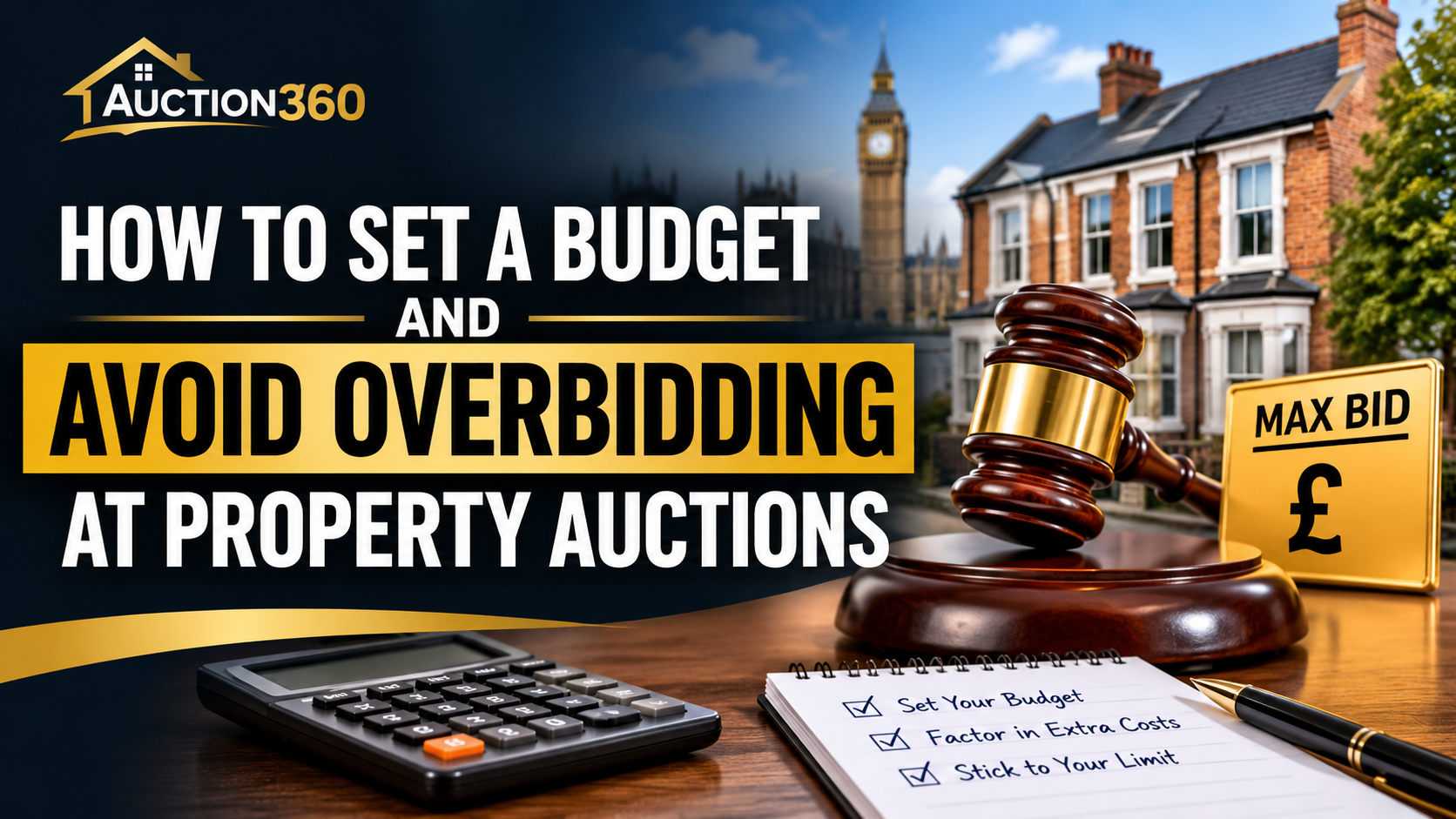
Introduction
Property auctions present exciting opportunities for investors looking to acquire properties below market value, secure repossessions, purchase refurbishment projects and build long-term wealth. However, the excitement of competitive bidding can sometimes lead investors to make costly financial mistakes.
One of the biggest mistakes property buyers make at auctions is overbidding. The pressure to win, competition from other bidders and fear of losing a seemingly attractive deal can cause investors to exceed their original budget.
A successful property investor understands that buying a property at auction is not simply about winning the bid. It is about purchasing the right property at the right price while maintaining a healthy profit margin.
Whether you are a first-time auction buyer, an experienced property investor or someone exploring Buy, Refurbish, Refinance (BRR) opportunities, setting a realistic budget is essential.
In this guide, we explore how to establish your auction budget, calculate your maximum bidding limit, account for additional costs and avoid the emotional decisions that can turn a promising investment into a financial burden.
1. Understand Your Financial Position Before Attending an Auction
Before registering to bid at a property auction, establish exactly how much money you can afford to invest.
Your budget should be based on your available capital, financing arrangements and investment objectives, rather than the advertised guide price of the property.
Consider the following:
Available cash: How much money do you have readily available?
Mortgage or bridging finance: How much funding can you realistically secure?
Deposit requirements: Can you pay the required deposit immediately if successful?
Additional costs: Have you accounted for legal fees, auction fees, refurbishment and taxes?
Contingency funds: Do you have additional funds for unexpected expenses?
Avoid committing your entire available capital to the purchase price. Maintaining a financial reserve gives you flexibility when unexpected expenses arise.
2. Research the Property's True Market Value
2. Research the Property's True Market Value
One of the most important steps in setting an auction budget is determining what the property is genuinely worth.
Do not base your valuation solely on the auction guide price. Guide prices are marketing indicators and should not be treated as confirmation of a property's market value.
Instead, conduct independent research.
How to establish the property's market value:
Compare similar properties: Research recently sold properties in the same neighbourhood with similar sizes, layouts and conditions.
Check sold prices: Use platforms such as Rightmove, Zoopla and HM Land Registry to understand actual transaction prices.
Assess the location: Consider transport links, schools, employment opportunities, amenities and local regeneration projects.
Evaluate property condition: A property requiring extensive refurbishment should be valued differently from a fully renovated property.
Consider future demand: Assess whether the property is likely to attract tenants or future buyers.
Where possible, obtain an independent valuation from a qualified property professional.
Remember that a property advertised at £120,000 is not necessarily worth £120,000. Equally, a property with a £90,000 guide price may attract competitive bidding and sell for considerably more.
Your investment decision should be based on evidence, not the auctioneer's advertised price.
3. Calculate Your Maximum Bidding Limit
Your maximum bid is the highest amount you are prepared to pay for a property while still achieving your investment objectives.
This is one of the most important figures you must establish before entering an auction.
Rather than deciding your maximum bid while competing against other buyers, calculate it beforehand.
For property investors, a useful approach is:
Maximum Bid = Expected Property Value ? Refurbishment Costs ? Purchase and Finance Costs ? Contingency ? Target Profit
Let's consider an example.
Illustrative investment scenario
You identify a property with an estimated market value of £200,000 after refurbishment.
Your investment calculations look like this:
| Description | Estimated cost |
|---|---|
| Expected resale value | £200,000 |
| Refurbishment costs | £30,000 |
| Purchase, legal, tax and finance costs | £15,000 |
| Contingency allowance | £5,000 |
| Target investment profit | £25,000 |
| Maximum purchase bid | £125,000 |
YOUR MAXIMUM BIDDING LIMIT
£125,000
Illustrative calculation based on the assumptions above.
The property may look attractive at £130,000 or £140,000, but paying more than £125,000 would reduce your target profit unless you can legitimately improve the numbers.
This calculation is particularly useful for investors purchasing properties to refurbish and resell.
For a Buy, Refurbish, Refinance (BRR) investment, you should also calculate the expected rental income, refinance valuation, mortgage costs and cash flow. A high resale valuation does not automatically mean a successful BRR investment.
4. Account for All Additional Auction Costs
One of the biggest budgeting mistakes investors make is concentrating exclusively on the hammer price.
The hammer price is only one part of the total acquisition cost.
Before bidding, identify every expense associated with purchasing, completing and preparing the property for investment.
Some important costs include:
A. Buyer's premium and auction fees
Some auction houses charge buyers an additional fee. This could be a fixed amount or a percentage of the successful bid.
Check whether VAT applies and whether the fee is payable immediately.
B. Solicitor and conveyancing fees
You may need to pay for legal advice, searches, title investigations and conveyancing services.
It is advisable to engage a solicitor experienced in auction transactions before bidding.
C. Stamp Duty Land Tax (SDLT)
If you are purchasing property in England or Northern Ireland, you may need to pay Stamp Duty Land Tax.
The amount depends on the purchase price, your ownership circumstances, property type and eligibility for relief.
Additional-property purchases generally attract higher rates. Certain non-UK-resident purchases may also attract a surcharge. Always calculate your tax liability before establishing your maximum bid.
GOV.UK+1
If the property is in Wales or Scotland, different property transaction taxes apply.
D. Survey and valuation costs
A professional survey can identify structural problems, damp, roofing defects and other issues that may require expensive repairs.
E. Refurbishment expenses
Consider the cost of:
Roofing and structural repairs.
Plumbing and electrical installations.
Kitchen and bathroom upgrades.
Flooring, painting and decoration.
Windows and doors.
Heating systems.
Building regulations and planning requirements, where applicable.
F. Finance and holding costs
If you are using bridging finance or another short-term funding arrangement, include:
Arrangement fees.
Interest payments.
Valuation fees.
Broker fees.
Exit fees, where applicable.
Insurance.
Utilities and council tax during the holding period.
A property that looks profitable at the hammer price may become an expensive investment once all these costs are included.
5. Include a Contingency Fund in Your Budget
Property investment rarely goes exactly according to plan.
Unexpected repairs, contractor delays, material price increases and additional legal requirements can affect your original financial projections.
This is why you should always include a contingency allowance.
For refurbishment projects, investors commonly use an initial allowance of around 10–15% of the estimated refurbishment budget, increasing it where the property's condition or scope of work creates greater uncertainty.
For example:
| Refurbishment budget | Contingency at 10% | Total |
|---|---|---|
| £10,000 | £1,000 | £11,000 |
| £20,000 | £2,000 | £22,000 |
| £30,000 | £3,000 | £33,000 |
| £40,000 | £4,000 | £44,000 |
These are planning illustrations, not guaranteed allowances.
For properties requiring major structural work, a more substantial reserve may be necessary.
Never use your contingency fund to justify increasing your auction bid. Its purpose is to protect your investment when unexpected costs arise.
6. Understand the Difference Between Guide Price, Reserve Price and Market Value
Understanding these three terms can help you avoid making poor bidding decisions.
| Term | Meaning |
|---|---|
| Guide price | The auctioneer's advertised indication of the price level at which the seller may be willing to consider offers. |
| Reserve price | The confidential minimum price at which the seller is willing to sell, subject to the auction terms. |
| Market value | An independent assessment of the property's likely value in the open market. |
A low guide price can attract more potential bidders, creating competition and pushing the final selling price higher.
For example, a property advertised with a guide price of £100,000 may eventually sell for £135,000.
That does not necessarily mean the property is worth £135,000.
Your decision should be guided by your valuation, investment strategy and maximum bidding limit.
Key takeaway: Never confuse an attractive guide price with a profitable investment opportunity.
7. Research the Legal Pack Before Bidding
A property's legal pack is one of the most important documents to review before participating in an auction.
It contains legal information about the property and the conditions under which the seller intends to complete the transaction.
Failing to examine the legal pack can expose you to unexpected financial obligations.
Ask an experienced conveyancing solicitor to review the documentation and identify potential risks.
Pay particular attention to:
Title restrictions and ownership issues.
Leasehold terms and remaining lease length.
Ground rent and service charges.
Outstanding arrears or liabilities.
Restrictive covenants.
Planning permission and building regulations.
Special conditions of sale.
Additional seller's legal fees.
Completion deadlines and deposit requirements.
The Royal Institution of Chartered Surveyors (RICS) recommends obtaining the property particulars, reviewing the legal documentation and seeking professional advice before bidding.
RICS+1
Remember, a legal issue could introduce additional expenses that were not included in your original calculations.
8. Inspect the Property and Estimate Refurbishment Costs
Never rely entirely on photographs or online property descriptions.
Where possible, arrange a physical inspection before the auction.
A property that looks like a straightforward refurbishment project may have hidden structural or maintenance problems.
Consider taking a builder, surveyor or experienced property professional to the viewing.
Your inspection should consider:
The condition of the roof and external walls.
Signs of damp, mould or water damage.
Electrical and plumbing systems.
Structural cracks and movement.
Windows, doors and insulation.
Heating and ventilation.
Garden, drainage and boundary conditions.
Any immediate health and safety concerns.
Request quotations from contractors rather than relying on rough estimates.
Where the property requires significant refurbishment, consider obtaining more than one quotation.
This will help you understand the realistic cost of bringing the property to the required standard.
9. Arrange Your Finance Before Entering the Auction
One of the most expensive mistakes an investor can make is winning a property auction without having the necessary funding in place.
Traditional property auctions commonly require buyers to pay a deposit immediately after a successful bid, often around 10%, with the balance due within the completion period specified in the contract.
Modern-method auctions operate differently and may involve a reservation fee and a longer contractual process.
The exact terms vary, so always check the auction conditions before registering to bid.
NRLA+2
Potential funding options include:
Cash purchases.
Bridging finance.
Auction finance.
Buy-to-let mortgages, where suitable.
Development finance for qualifying projects.
Private investment or joint venture funding.
If you intend to use bridging finance, speak to a specialist broker before the auction.
Confirm the amount available, valuation requirements, property eligibility, interest rate, fees and exit strategy.
Do not assume that a mortgage agreement in principle guarantees that the lender will finance the particular auction property.
Your financing arrangements must match the contractual completion deadline.
10. Avoid Emotional Bidding and Auction Pressure
Even experienced investors can become caught up in the excitement of a competitive auction.
You may identify a property that appears to offer an excellent opportunity. However, when other bidders begin competing, the temptation to increase your offer can become difficult to resist.
This is where discipline matters.
Five ways to control emotional bidding:
Set your maximum bid in advance: Write down the exact figure and commit to it.
Do not chase other bidders: Their financial circumstances and investment calculations are not your responsibility.
Avoid attachment to a particular property: There will always be other investment opportunities.
Do not increase your limit because of competition: A property does not become more valuable simply because several people want it.
Be prepared to walk away: Losing a property is better than acquiring an investment that no longer makes financial sense.
Professional investors understand that the objective is not to win every auction. The objective is to secure profitable investments.
11. Use an Investment Strategy to Guide Your Bidding Decision
Your bidding limit should reflect the strategy you intend to use after purchasing the property.
Different investment strategies have different financial requirements.
| Investment strategy | What to consider before bidding |
|---|---|
| Buy, Refurbish, Sell | Resale value, refurbishment costs, selling fees and target profit. |
| Buy, Refurbish, Refinance (BRR) | Rental income, post-refurbishment valuation, refinance criteria and cash flow. |
| Buy to Let | Rental demand, mortgage payments, operating expenses and yield. |
| HMO Investment | Licensing, planning requirements, compliance, room demand and management costs. |
| Property Development | Construction costs, planning, professional fees, finance and development exit value. |
For example, a property may be suitable for a cash buyer but unsuitable for an investor relying on a standard mortgage.
Similarly, a property that offers an attractive refurbishment opportunity may not generate sufficient rental income to support a BRR strategy.
Your investment strategy should determine the price you are willing to pay, not the excitement of the auction room.
12. Learn When to Walk Away from an Auction
Knowing when to stop bidding is just as important as knowing when to start.
There is no obligation to purchase every property you research.
If bidding exceeds your maximum limit, walk away.
You should also reconsider a property if:
New information reveals significant structural defects.
The legal pack identifies unexpected liabilities.
Refurbishment costs exceed your original estimate.
Finance is no longer available on acceptable terms.
The expected rental income does not support your investment.
The potential resale value is lower than originally anticipated.
Remember that the money spent on research, surveys and legal advice should not influence you into making an unprofitable purchase.
These are due diligence expenses, not reasons to continue bidding.
13. Create a Property Auction Budget Checklist
Before participating in any property auction, use this checklist to ensure you have considered the most important financial and legal requirements.
Auction360: Pre-Auction Budget Checklist
0 of 14 completed
0%
I have established my available investment capital.
I have researched the property's market value.
I have compared similar recently sold properties.
I have calculated my maximum bidding limit.
I have included legal fees and auction charges.
I have calculated the relevant property purchase tax.
I have obtained refurbishment estimates.
I have included a contingency fund.
I have reviewed the legal pack with a solicitor.
I have inspected the property or arranged a professional survey.
I have confirmed my funding arrangements.
I understand the deposit and completion deadline.
I have established a realistic investment exit strategy.
I am prepared to walk away if bidding exceeds my limit.
Reset checklist
14. Common Mistakes Investors Make When Budgeting for Property Auctions
Even with the right investment strategy, poor financial planning can undermine an otherwise attractive property purchase.
Here are some common mistakes to avoid:
| Mistake | How to avoid it |
|---|---|
| Bidding based on the guide price | Conduct independent market research. |
| Ignoring additional auction fees | Read the auction conditions and calculate the full acquisition cost. |
| Underestimating refurbishment | Obtain professional quotations and include contingency. |
| Failing to review the legal pack | Instruct a solicitor before bidding. |
| Relying on unconfirmed finance | Arrange suitable funding before the auction. |
| Ignoring the completion deadline | Confirm the contractual timetable and availability of funds. |
| Bidding emotionally | Establish a maximum bid and stick to it. |
| Having no exit strategy | Identify your resale, rental or refinancing plan before purchasing. |
15. Final Thoughts: Discipline Is the Key to Successful Property Auction Investing
Property auctions can provide excellent opportunities for investors looking to acquire properties, build portfolios and generate long-term wealth.
However, success does not come from simply securing the highest bid or purchasing a property at what appears to be a bargain price.
It comes from understanding the numbers, conducting thorough due diligence and maintaining financial discipline.
Before entering your next auction, remember three important principles:
Research before you bid.
Calculate before you commit.
Prepare before you purchase.
Your maximum bid should always reflect the property's true investment potential, the total cost of acquisition and your desired financial outcome.
The most successful auction investors are not necessarily those who win the most properties. They are those who consistently make informed purchasing decisions and protect their investment capital.
At Auction360, we believe that successful property investment starts with knowledge, preparation and the right financial strategy.
16. Frequently Asked Questions (FAQs)
1. How do I set a budget for buying a property at auction?
Start by establishing your available capital and financing arrangements. Research the property's market value, estimate refurbishment costs, include legal fees, auction charges, taxes and finance costs, then establish a maximum bidding limit that protects your target profit.
2. What is the maximum amount I should bid at a property auction?
Your maximum bid depends on the property's value, purchase costs, refurbishment requirements, finance expenses and investment objectives. Calculate the total project costs and deduct them, together with your target profit, from the expected end value.
3. Should I bid above the property auction guide price?
You can bid above the guide price if your independent valuation and investment calculations support it. However, never exceed your predetermined maximum bid simply because other buyers are competing.
4. What additional costs should I consider when buying at auction?
Consider auction fees, buyer's premiums, legal fees, conveyancing, Stamp Duty Land Tax or the applicable regional property tax, surveys, valuation fees, refurbishment, insurance and finance costs.
5. How much deposit do I need to buy a property at auction?
Traditional property auctions commonly require a deposit of approximately 10% of the purchase price. However, the exact amount and payment arrangements depend on the auction conditions. Modern-method auctions may require a reservation fee instead.
6. Can I use bridging finance to purchase a property at auction?
Yes. Bridging finance is commonly used for auction purchases, particularly where properties require refurbishment or cannot immediately qualify for standard mortgage lending. You must confirm the lender's criteria, available funds, costs and exit strategy before bidding.
7. How do I calculate the potential profit from an auction property?
Estimate the property's resale value, then deduct the purchase price, refurbishment expenses, legal costs, taxes, auction charges, finance expenses, holding costs and selling expenses. The remaining amount represents your estimated profit before any applicable personal or corporate taxes.
8. Why is it important to review the legal pack before bidding?
The legal pack provides essential information about ownership, title restrictions, lease conditions, special sale conditions and other potential liabilities. Reviewing it with a solicitor helps identify legal and financial risks before you become contractually committed.
9. What should I do if bidding goes above my budget?
Walk away. Do not increase your bidding limit because of competition or emotional attachment. Another property may offer a better investment opportunity.
10. Is buying property at auction a good investment strategy?
It can be, provided you conduct proper research, understand the risks, arrange appropriate finance and purchase at a price that supports your investment objectives. Auctions are not automatically cheaper than private property sales, so every opportunity must be assessed individually.
17. Further Reading and Useful Resources
For additional guidance when preparing for a UK property auction, consult:
Disclaimer: This article is for educational and informational purposes only. It does not constitute financial, legal, tax or investment advice. Auction conditions, property taxes and transaction requirements vary. Seek advice from suitably qualified professionals before committing to a purchase.
18. About Auction360
Auction360 is dedicated to helping property investors understand property auctions, auction finance and investment opportunities in the UK property market.
Through practical education, expert insights and property investment resources, Auction360 helps investors make informed decisions and approach property auctions with greater confidence.
Research before you bid. Calculate before you commit. Prepare before you purchase.
Website: www.auction360.co.uk
Disclaimer
This article is for general educational and informational purposes. It is not an offer of finance, a recommendation to borrow or a guarantee that Glenhawk will approve any particular application.
Lending criteria, interest rates, fees, maximum loan sizes and product availability can change. All applications are subject to the lender's underwriting, valuation, legal due diligence and final approval. Borrowers should obtain and review the full facility terms before proceeding.
Bridging finance is short-term borrowing secured against property. If you do not repay the loan in accordance with its terms, the property used as security may be repossessed. Where a loan is regulated, additional consumer protections and regulatory requirements apply.