
Glenhawk Lender Review: Structured Speed, Bridging Finance and Property Lending Appetite
Glenhawk is a specialist short-term property finance lender whose proposition spans residential bridging, regulated bridging, refurbishment, commercial property, second-charge lending and larger structured real estate transactions.
Its defining characteristic is a focus on short-term finance, supported by institutional funding and a product range designed for property investors, landlords, developers and homeowners with qualifying borrowing requirements.
However, Glenhawk should not be assessed as though every transaction sits within one lending facility. Its products have different minimum and maximum loan sizes, maximum LTVs, terms and eligibility requirements.
The published criteria illustrate that distinction:
- Residential bridging: loans from £250,000, with a published maximum of £10 million and LTVs up to 75% on the intermediary product page.
- Refurbishment bridging: loans from £300,000, with residential day-one LTVs up to 75% and commercial day-one LTVs up to 70%.
- Commercial bridging: loans from £250,000, with a published maximum of £3 million and LTVs up to 70%.
- Regulated bridging: loans from £250,000, with a published maximum of £3 million on the intermediary page and LTVs up to 75%.
- Structured Real Estate: facilities from £5 million to £50 million, with maximum LTVs of up to 75%, depending on the asset and transaction.
Glenhawk also advertises rapid initial decisions. Its residential and commercial propositions refer to indicative terms within hours, while some suitable transactions may complete in as little as five to eight working days. These are potential timeframes, not guaranteed service levels.
For Auction360 customers, Glenhawk may be worth considering where the funding requirement is substantial, the property falls within its appetite and the transaction can be presented with a clear business plan and credible repayment strategy.
The central question is not simply whether Glenhawk can lend quickly. It is whether the particular property, borrower, loan structure and exit fit the relevant product.
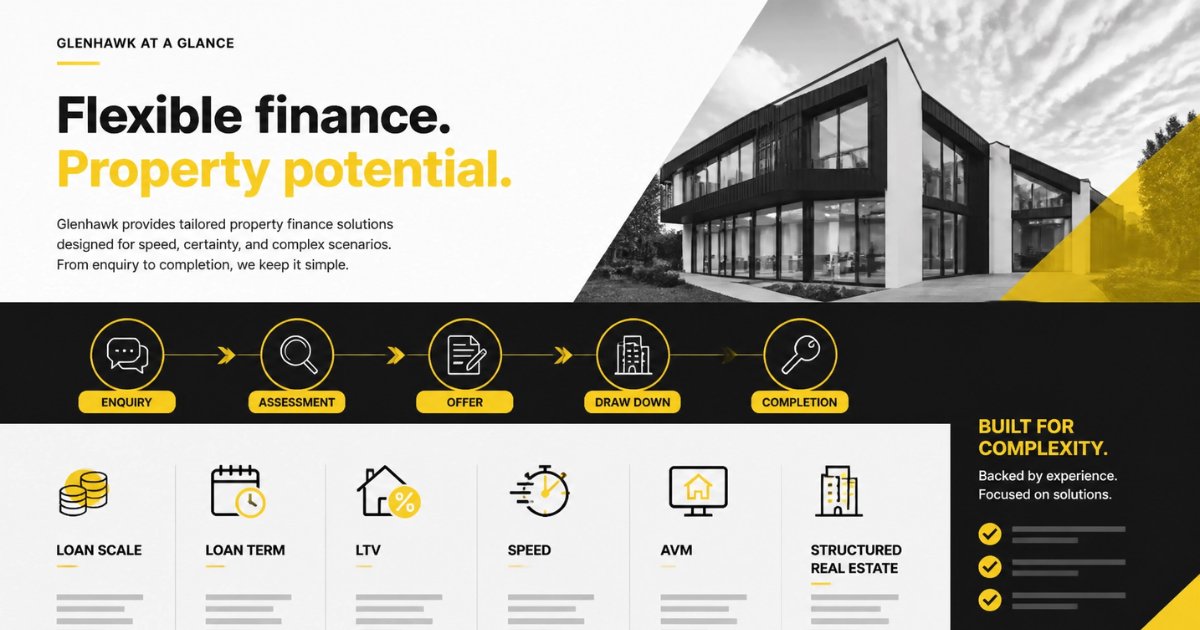
Glenhawk at a Glance
| Lending feature | Published position |
|---|---|
| Main focus | Specialist short-term property finance |
| Standard bridging loan sizes | Vary by product |
| Structured Real Estate | £5m–£50m |
| Maximum LTV | Generally up to 75% on relevant products; lower limits apply to some commercial and land transactions |
| Residential bridging term | 3–24 months |
| Commercial bridging term | 3–18 months on the intermediary product page |
| Refurbishment bridging term | 3–24 months |
| Regulated bridging term | 1–12 months |
| Initial decision | Indicative terms or AIP may be available within hours or under an hour, depending on product |
| Potential completion | Some suitable cases may complete in 5–8 working days |
| Geographic coverage | England, Wales and Scotland on the published products |
| Borrower types | Individuals, companies and other eligible structures, subject to product criteria |
Figures are taken from Glenhawk's published product information. Product availability, criteria, pricing and maximum loan sizes can change and must be confirmed for the specific application.
Behavioural Profile: A Specialist Lender Built Around Short-Term Finance
Glenhawk describes short-term finance as its central focus. It is not a conventional mortgage provider offering bridging as a secondary service.
That specialisation is reflected in its published application process. Brokers can submit a complete enquiry for an initial assessment, with indicative terms potentially issued within hours. Once terms are accepted, underwriting, valuation and legal work can progress in parallel.
This approach can be useful when a borrower is working towards an auction completion deadline or needs to secure a property before a longer-term funding arrangement is available.
1. Speed through early decision-making
Glenhawk advertises AIPs within an hour on some product pages and indicative terms within hours on others.
The distinction matters. An AIP or indicative terms are an initial indication of appetite; they are not the same as a formal mortgage offer, unconditional funding approval or confirmation that completion will take place by a particular date.
The lender still needs to assess the borrower, property, valuation, legal position, loan structure and repayment strategy.
2. Valuation flexibility
Glenhawk states that automated valuation models (AVMs) may be considered in qualifying cases, depending on the product and the property's characteristics.
An AVM can potentially reduce valuation time and cost, but it should not be assumed that every property will qualify. Location, property type, loan-to-value ratio, data confidence and the lender's underwriting requirements can all influence the valuation route.
Where an AVM is unsuitable, a physical valuation or further investigation may be required.
3. A more involved approach to larger transactions
The Structured Real Estate proposition is different from a standard bridging application.
Glenhawk describes a dedicated, relationship-led approach for larger and more complex transactions. Its published proposition covers residential, mixed-use, purpose-built student accommodation (PBSA) and co-living assets, including land, refurbishment and completed properties.
Potential scenarios include developer equity release, stabilisation finance, planning amendments and strategic asset repositioning.
For these cases, the lender's assessment may need to consider the full transaction rather than simply the property's current value and the requested LTV.
4. The importance of a well-prepared submission
The practical broker lesson is straightforward: a strong opportunity needs a clear funding narrative.
A useful submission should explain:
- What is being purchased or refinanced.
- Who is borrowing and how the ownership structure is organised.
- The current property value and the basis for that figure.
- The requested loan and the proposed security.
- Any refurbishment, conversion or repositioning work.
- The professional team responsible for the project.
- The proposed repayment route and supporting evidence.
- The relevant purchase, completion or project deadlines.
The more clearly these points are presented, the easier it is for the lender to identify the appropriate product and the issues that need resolving.
Appetite Matrix: Where Glenhawk May Fit
Glenhawk's published products cover several distinct property finance requirements. The following matrix summarises the main opportunities and the points that should be checked before submission.
| Transaction type | Published lending position | What needs attention |
|---|---|---|
| Standard residential bridging | Up to 75% LTV; loans up to £10m | Property suitability, borrower profile, valuation and exit |
| Auction purchase | Residential and commercial auction scenarios are considered | Auction conditions, legal pack, deposit, completion deadline and funding certainty |
| Light refurbishment | Available through refurbishment or relevant residential products | Scope of works, budget, timescale and post-works plan |
| Heavy refurbishment | Structural and substantial works may be considered under the refurbishment proposition | Structural integrity, contractor capability, cost plan, monitoring and exit |
| Commercial property | Up to 70% LTV on the published commercial product | Asset type, tenant position, valuation and repayment strategy |
| Mixed-use property | Dedicated mixed-use lending is advertised | Residential/commercial split, use, valuation and property configuration |
| Regulated bridging | Up to 75% LTV on the intermediary product page | Consumer purpose, property occupation and regulated lending requirements |
| Second-charge lending | Available under a separate product proposition | Existing first charge, security position, borrower purpose and combined exposure |
| Structured Real Estate | £5m–£50m, with asset-specific maximum LTVs | Transaction structure, asset strategy, planning, value creation and exit |
Residential bridging
Glenhawk's residential bridging product is aimed at borrowers who need short-term finance for purchases, refinancing or other qualifying residential property transactions.
The published intermediary criteria show loans from £250,000 to £10 million, with LTVs up to 75% and terms of three to 24 months.
Auction purchases are specifically within the lender's stated use cases. However, an auction buyer should not interpret product availability as confirmation that a particular lot will be accepted or that the lender can meet its contractual completion deadline.
Refurbishment finance
The refurbishment proposition is relevant to investors who want to improve, modernise or reposition a property before sale or refinance.
Glenhawk states that it can consider cosmetic and structural refurbishment, extensions, loft conversions, basement conversions, changes of use and other substantial works.
Its published intermediary product information includes:
- Residential day-one LTV up to 75%.
- Commercial day-one LTV up to 70%.
- Funding of up to 100% of eligible refurbishment costs, subject to valuation and due diligence.
- Loan sizes from £300,000.
- Terms of three to 24 months.
Funding up to 100% of refurbishment costs does not mean that every borrower can obtain a purchase price and works facility without contributing capital. The overall loan, day-one advance, security, valuation and project economics remain subject to underwriting.
Glenhawk also states that it can consider properties requiring significant refurbishment where their structural integrity is not compromised. Borrowers without extensive refurbishment experience may still be considered, but the lender may want evidence of an appropriate contractor and professional support team.
Commercial bridging
Glenhawk's commercial bridging product is aimed at investors, landlords and developers buying or refinancing commercial and semi-commercial property.
The published intermediary criteria include:
- Loan sizes from £250,000 to £3 million.
- Maximum LTV of 70%.
- Terms of three to 18 months.
- Interest that can be rolled or serviced.
- First-charge security.
The lender lists a broad range of commercial property types, including offices, retail units, industrial properties, hotels, pubs, restaurants and large HMOs.
The suitability of a specific asset will depend on its condition, use, valuation, income profile, location and proposed exit.
Regulated bridging
Glenhawk also offers regulated bridging for qualifying homeowner and consumer scenarios.
Its published intermediary proposition includes loans from £250,000 to £3 million, LTVs up to 75% and terms from one to 12 months.
Potential uses include chain breaks, onward purchases and qualifying home improvement scenarios. Regulated lending is subject to the relevant consumer and property circumstances, and applications must be submitted through an authorised intermediary in accordance with the lender's requirements.
Borrowers should understand that regulated bridging secured against their home carries significant risk. Their home may be repossessed if they do not keep up repayments.
Structured Real Estate
This is Glenhawk's higher-value, bespoke lending proposition.
The published loan range is £5 million to £50 million, with terms of three to 24 months. Glenhawk states that maximum LTVs depend on the asset:
- Residential assets or parts of schemes: up to 75%.
- Commercial assets or parts of schemes: up to 65%.
- Land: up to 50%.
For refurbishment and repositioning of existing assets, Glenhawk also refers to lending of up to 70% LTGDV and up to 90% of costs, subject to case-by-case assessment.
The lender states that it does not provide ground-up development finance through this proposition. That distinction is important for developers considering a site acquisition and full new-build project.
Risk Flags: What Could Slow Down or Weaken an Application?
A risk flag does not automatically mean a decline. It identifies an issue that should be explained and evidenced before the application reaches underwriting.
1. A loan request below the relevant product minimum
Glenhawk's minimum loan sizes vary by product. Residential and commercial bridging are published from £250,000, while refurbishment lending is published from £300,000.
A smaller funding requirement may therefore need a different lender or product route.
2. An unclear repayment strategy
A short-term facility needs a credible exit. Common routes include sale, refinance or repayment from another identified source.
A proposed refinance should be supported by realistic assumptions about the property's future value, rental income where relevant, borrower eligibility and the likely long-term lender criteria.
Simply stating that the property will be refinanced at the end of the term is not a complete exit strategy.
3. Refurbishment risk
A works schedule should explain what is being done, how much it will cost, who will carry out the work and how long the project is expected to take.
Structural work, conversions and changes of use can introduce additional planning, building control, contractor and monitoring requirements.
A project that relies on an optimistic completion date or an unsupported end valuation may be difficult to assess.
4. Valuation uncertainty
The amount a borrower expects a property to be worth is not necessarily the figure a lender will adopt.
Unusual property types, limited comparable evidence, mixed-use configuration, development potential or a complex title can all require further investigation.
Where the proposed loan depends on a particular valuation, the borrower should have supporting evidence rather than relying solely on an agent's estimate.
5. Legal or title complications
Auction properties can present additional legal risks, including restrictive covenants, short leases, title defects, unusual special conditions, occupational issues or outstanding liabilities.
These matters should be identified early. A lender's willingness to consider an asset does not remove the need for the borrower's solicitor to investigate the legal position.
6. An unrealistic auction timetable
A lender may be able to move quickly, but completion also depends on the valuation, legal work, borrower responses, source-of-funds checks and the seller's requirements.
The auction contract sets the actual deadline. A published five-to-eight-working-day completion example should not be treated as a guarantee that every auction purchase can complete within that period.
7. Over-reliance on maximum LTV
The headline maximum is not an automatic entitlement. The final facility may be lower because of the valuation, property type, borrower profile, loan size, works, security or exit.
The correct question is whether the proposed loan works within the lender's actual assessment, not whether it appears to fit a headline LTV.
Speed Index: How Quickly Can Glenhawk Complete?
The following is an Auction360 assessment of Glenhawk's published process, not a lender service-level agreement or a promise of completion.
| Stage | Published or practical position | Auction360 assessment |
|---|---|---|
| Initial enquiry | Indicative terms within hours on relevant products | Potentially fast where the submission is complete |
| AIP | Under an hour is advertised on some product pages | Useful for initial direction, not a formal offer |
| Underwriting | Begins after terms are accepted | Depends on the complexity and quality of the case |
| Valuation | AVMs may be considered in qualifying cases; physical valuations may be needed | Flexibility can help, but property suitability is decisive |
| Legal work | Can progress alongside valuation and underwriting | Early solicitor instruction and a clean title can reduce delay |
| Completion | Some suitable cases may complete in 5–8 working days | Achievable in selected cases, not a universal timeframe |
What makes a fast completion more realistic?
A borrower who needs a short completion timetable should aim to have the following ready before submission:
- Full property address and details.
- Purchase price and proposed loan amount.
- Auction legal pack, where applicable.
- Borrower and ownership structure.
- Evidence of deposit and source of funds.
- Details of existing borrowing and security.
- Valuation evidence and comparable properties.
- Refurbishment schedule and cost plan, if relevant.
- Solicitor details and confirmation of availability.
- A credible exit strategy with supporting evidence.
The objective is to reduce avoidable questions after the application has entered the lender's process.
Strengths and Limitations
Strengths
1. Broad short-term property finance proposition
Glenhawk covers residential, regulated, commercial, refurbishment, second-charge and structured real estate lending. This gives brokers several potential routes to explore, although the criteria differ between products.
2. Capacity for larger transactions
The Structured Real Estate facility range of £5 million to £50 million gives Glenhawk a proposition for larger and more complex property transactions beyond conventional bridging requirements.
3. Refurbishment funding
The lender's willingness to consider structural refurbishment and eligible works funding can be relevant to investors buying properties that need improvement before sale or refinance.
4. Published focus on rapid initial decisions
AIPs and indicative terms within hours can help borrowers establish whether a proposed transaction is worth progressing. The benefit depends on submitting sufficient information at the outset.
5. Flexible interest arrangements on relevant products
Some products allow interest to be rolled or serviced. The appropriate arrangement depends on the facility and the borrower's cash-flow position.
6. Experience across different asset types
Glenhawk's published commercial and structured real estate propositions cover a range of property types, including mixed-use, hospitality, industrial and residential investment assets.
Limitations and points to consider
1. Minimum loan sizes may exclude smaller transactions
A £250,000 minimum on several core products, and £300,000 on refurbishment bridging, means Glenhawk may not be suitable for lower-value purchases or modest funding requirements.
2. Maximum LTV varies by product and asset
The 75% headline figure does not apply universally. Commercial assets and land have lower published maximums under the Structured Real Estate proposition.
3. Fast initial terms do not guarantee fast completion
Valuation, underwriting, legal work and due diligence remain essential. A quick AIP should never be treated as proof that the funds will be available by the auction completion date.
4. Ground-up development is not part of the published Structured Real Estate proposition
Developers seeking finance for a full new-build scheme should check the lender's current scope carefully and compare lenders that specifically offer ground-up development finance.
5. Product criteria and pricing can change
Rates, fees, loan limits and eligibility requirements are subject to change. The borrower should obtain current terms for the exact transaction before making a financial commitment.
Best-Fit and Not-Ideal Scenarios
Where Glenhawk may be a good fit
Glenhawk may be worth exploring when:
- The loan requirement meets the relevant product minimum.
- A borrower needs short-term finance for a residential or commercial purchase.
- An auction purchase requires a lender able to assess the legal pack and completion timetable.
- A property needs refurbishment before sale, letting or refinance.
- The project involves a mixed-use or commercial asset within the lender's appetite.
- A larger investor or developer needs a bespoke facility for an existing asset, repositioning project or portfolio.
- The borrower can demonstrate a credible repayment strategy and provide the necessary evidence.
Where another lender may be more suitable
An alternative lender may be worth considering when:
- The loan requirement is below Glenhawk's product minimum.
- The project is a ground-up development requiring specialist development finance.
- The property or borrower falls outside the relevant product criteria.
- The proposed LTV exceeds the lender's appetite.
- The legal or valuation position is unlikely to meet the required timetable.
- A longer-term mortgage is already available on suitable terms and there is no compelling reason to use short-term finance.
The right comparison should consider the total cost of borrowing, net advance, interest structure, fees, security, repayment flexibility and the probability of completing within the required timeframe.
Market Positioning: Standard Bridging Meets Bespoke Real Estate Finance
Glenhawk occupies two related positions in the short-term property finance market.
For standard and mid-sized transactions, its proposition is built around defined product categories, published lending limits and a process designed to move initial terms, valuation and legal work forward efficiently.
For larger transactions, Structured Real Estate provides a more bespoke approach. The focus moves beyond a simple loan-to-value calculation and towards the complete transaction: asset quality, ownership, planning position, value creation, funding requirement and repayment strategy.
This distinction matters for property investors.
A straightforward residential auction purchase may be assessed through the residential bridging proposition. A substantial mixed-use repositioning project or a multi-million-pound portfolio transaction may require the structured team and a more detailed assessment of the overall business plan.
Glenhawk's published case studies also illustrate its activity across different property scenarios, including portfolio refinancing and complex refurbishment transactions.
From an Auction360 perspective, Glenhawk is worth considering when a transaction needs a combination of short-term funding capacity, a suitable property appetite and a well-presented funding strategy.
It should not automatically be treated as the best option simply because a borrower needs speed. The product must fit the property, the loan requirement and the exit.
How Auction Buyers Should Approach Glenhawk
For auction buyers, the most important work happens before the bid.
A buyer should establish whether the lender is likely to consider the property, whether the proposed loan is sufficient, whether the legal pack raises issues and whether the facility can realistically complete within the contractual deadline.
A practical preparation process includes:
Before the auction
- Confirm the relevant Glenhawk product and minimum loan size.
- Establish the likely valuation and maximum available borrowing.
- Review the legal pack with a solicitor.
- Confirm the deposit and remaining purchase funds.
- Identify any refurbishment or property-condition issues.
- Prepare a credible exit strategy.
- Obtain an initial indication of lending appetite.
After a successful bid
- Confirm the final purchase price and contractual completion date.
- Provide the signed memorandum of sale and any outstanding information.
- Progress valuation, underwriting and legal work promptly.
- Respond quickly to lender and solicitor enquiries.
- Keep the exit plan under review and allow for delays.
Auction finance should be arranged around the actual contractual timetable, not an assumed industry average.
For support with the preparation process, explore Auction360's auction finance service, including pre-auction approval, legal pack review and auction risk analysis.
You can also read Auction Demystified: Unlocking Auction Success for a wider guide to preparing for property auctions.
Frequently Asked Questions
Does Glenhawk offer auction finance?
Yes. Glenhawk's residential and commercial bridging propositions identify auction purchases as potential uses of its short-term finance. Each application remains subject to underwriting, property suitability, valuation and legal due diligence.
What is Glenhawk's minimum loan size?
It depends on the product. Glenhawk publishes minimums of £250,000 for residential and commercial bridging, while its refurbishment bridging proposition starts at £300,000. Structured Real Estate starts at £5 million.
What is the maximum Glenhawk loan?
The published maximum for Structured Real Estate is £50 million. Other products have lower limits. For example, the intermediary residential and refurbishment pages publish maximums of £10 million, while commercial bridging is published up to £3 million.
What LTV does Glenhawk offer?
The maximum depends on the property and product. Residential bridging is published up to 75% LTV on the intermediary product page. Commercial bridging is published up to 70%. Under Structured Real Estate, the published maximums are up to 75% for residential assets, 65% for commercial assets and 50% for land.
Can Glenhawk lend up to 80% LTV?
Glenhawk's borrower-facing overview has advertised residential lending up to 80% LTV, while its intermediary residential product page currently publishes up to 75%. These figures should not be treated as interchangeable. Brokers should confirm the current maximum for the exact product and case before relying on an 80% figure.
How quickly can Glenhawk complete?
Glenhawk states that some suitable residential and commercial cases may complete in as little as five to eight working days. This is not guaranteed. The actual timetable depends on valuation, underwriting, legal work, borrower cooperation and transaction complexity.
Does Glenhawk offer refurbishment finance?
Yes. Its refurbishment proposition covers cosmetic and structural works, extensions, loft conversions, basement conversions and changes of use, subject to the property and project meeting its criteria.
Can Glenhawk fund 100% of refurbishment costs?
Glenhawk states that it can fund up to 100% of eligible refurbishment costs on suitable cases. This does not mean that every project will receive full works funding or that the purchase price will also be funded in full. The overall facility remains subject to valuation, security and underwriting.
Does Glenhawk offer regulated bridging?
Yes. Glenhawk has a regulated bridging proposition for qualifying consumer and homeowner scenarios. Applications must meet the relevant regulatory requirements and be submitted through an authorised intermediary in accordance with the lender's process.
Does Glenhawk consider AVMs?
Yes, AVMs may be considered in qualifying cases. Acceptance depends on the product, property, location, LTV and the lender's confidence in the automated valuation. A physical valuation may still be required.
Does Glenhawk provide ground-up development finance?
Glenhawk's published Structured Real Estate information states that it does not provide ground-up development finance through that proposition. It does, however, consider certain refurbishment and repositioning projects involving existing assets.
What should a borrower prepare before approaching Glenhawk?
Prepare the property details, purchase price or current valuation, loan requirement, borrower structure, security details, legal pack where relevant, works schedule, cost plan, professional team and repayment strategy. A complete submission helps the lender assess the transaction more efficiently.
Useful Links
- Glenhawk – Official Website
- Glenhawk – Residential Bridging
- Glenhawk – Refurbishment Bridging
- Glenhawk – Commercial Bridging
- Glenhawk – Regulated Bridging
- Glenhawk – Structured Real Estate
- Glenhawk – Second-Charge Lending
- Glenhawk – Product Guides and Documents
Auction360 Profile
Auction360 helps property investors, developers and auction buyers assess funding options and prepare for property transactions across the UK.
Its service offering includes auction finance, bridging finance, pre-auction approval, legal pack review, auction risk analysis, auction-day funding and support with development and refurbishment finance enquiries.
The objective is to help buyers assess the opportunity before committing, understand the likely funding requirements and plan a realistic repayment route before the hammer falls.
Explore Auction360's auction finance service or submit a funding enquiry.
Author Profile
Deji Nehan is the founder of Auction360 and author of Auction Demystified: Unlocking Auction Success. His work focuses on UK property auctions, specialist property finance and helping investors understand the funding, legal and commercial considerations involved in auction purchases.
“A one-stop solution for everything auction property.” — Deji Nehan, Auction Finance Demystified.
Disclaimer
This article is for general educational and informational purposes. It is not an offer of finance, a recommendation to borrow or a guarantee that Glenhawk will approve any particular application.
Lending criteria, interest rates, fees, maximum loan sizes and product availability can change. All applications are subject to the lender's underwriting, valuation, legal due diligence and final approval. Borrowers should obtain and review the full facility terms before proceeding.
Bridging finance is short-term borrowing secured against property. If you do not repay the loan in accordance with its terms, the property used as security may be repossessed. Where a loan is regulated, additional consumer protections and regulatory requirements apply.