
Introduction
Buying a property at auction can be an exciting opportunity for investors looking to acquire residential, commercial or development properties. Auctions can provide access to properties that may not be readily available through traditional estate agency channels, sometimes at attractive prices.
However, purchasing at auction is very different from buying through the conventional property market. The process is usually faster, the legal commitment can arise immediately after a successful bid, and buyers must be prepared to meet strict payment and completion deadlines.
One of the biggest challenges investors face is arranging the right finance. A property may appear to be an excellent investment, but without suitable funding in place, even the most promising opportunity can become a financial burden.
Whether you are a first-time auction buyer or an experienced property investor, understanding how to finance an auction purchase is essential. From choosing the wrong lender to underestimating additional costs, certain mistakes can expose buyers to unnecessary financial and legal risks.
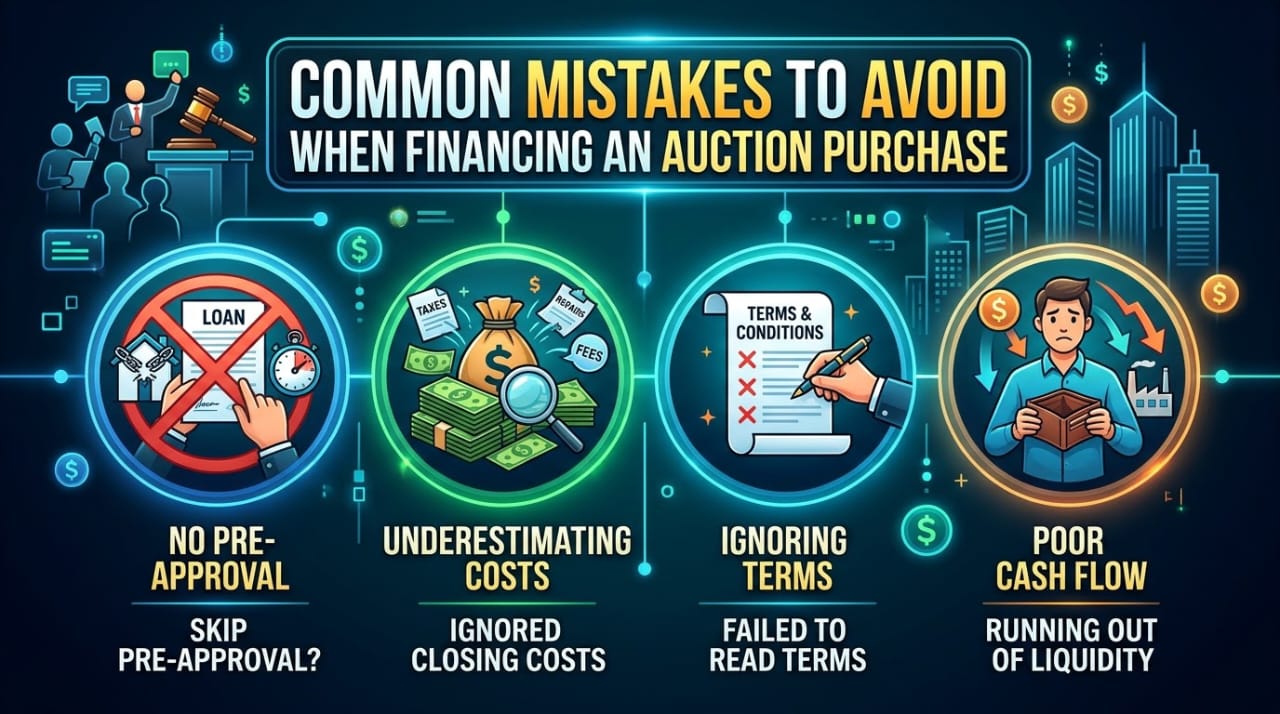
In this guide, we explore 10 common mistakes to avoid when financing an auction purchase, alongside practical advice and answers to frequently asked questions to help you prepare before placing your next bid.
Understanding How Auction Property Financing Works
Before exploring the common mistakes, it is important to understand the auction purchase process.
In a traditional unconditional property auction, a successful bid will normally create a legally binding contract when the auctioneer's hammer falls. Buyers are commonly required to pay a deposit immediately, often 10% of the purchase price, although the auction conditions may specify a different amount.
The remaining balance must then be paid within the completion period stated in the contract. Some auctions provide around 28 days, but buyers should never assume this is the standard deadline. The legal documents and special conditions determine the actual completion requirements.
This short timeframe means that buyers cannot always rely on arranging a conventional mortgage after winning the property.
Some investors use cash, traditional mortgages, bridging loans or specialist refurbishment finance, depending on the property and their investment objectives.
The key is to identify the most appropriate funding option before committing to the purchase.
10 Common Mistakes to Avoid When Financing an Auction Purchase
1. Bidding Before Securing Finance
One of the most common mistakes auction buyers make is attending an auction and placing bids without first understanding how they will finance the purchase.
It is easy to become excited when an attractive property comes onto the market. However, winning the bid is only the beginning of the financial commitment.
If your finance is not available within the required timeframe, you could face serious consequences, including losing your deposit and potentially being liable for additional costs.
How to avoid this mistake:
- Speak to a mortgage adviser or specialist auction finance broker before the auction.
- Establish how much you can realistically borrow.
- Obtain an agreement in principle or other appropriate indication of lending capacity.
- Understand the lender's requirements and likely timescale.
- Have sufficient funds available for the deposit and associated costs.
Remember, an agreement in principle is not the same as a formal loan offer or a guarantee that funds will be released. Make sure you understand any outstanding conditions.
2. Assuming a Traditional Mortgage Will Be Suitable
Traditional mortgages are a common way of financing property purchases. However, not every auction property will meet a mortgage lender's requirements.
For example, a property may be unmortgageable because it has:
- Significant structural defects.
- No functioning kitchen or bathroom.
- Serious damp or roof problems.
- A short or problematic lease.
- Unusual construction.
- Legal or title complications.
Even where a property is mortgageable, the lender's valuation, underwriting and conveyancing processes may not fit the auction's completion deadline.
How to avoid this mistake:
Establish whether the property is suitable for mortgage finance before bidding. Ask a specialist adviser to assess the property type, your circumstances and the likely lending criteria.
Where a conventional mortgage is unsuitable or too slow, bridging finance may be worth considering, provided the costs and repayment strategy are affordable.
3. Focusing Only on the Hammer Price
A property may appear affordable based on its guide price, but the hammer price is not necessarily the total amount you will need to complete the investment.
Many buyers underestimate the additional costs involved in acquiring an auction property.
These may include:
- Auction administration and buyer fees.
- Solicitor and conveyancing fees.
- Stamp Duty Land Tax, where applicable.
- Valuation and survey fees.
- Mortgage or bridging arrangement fees.
- Broker fees.
- Insurance.
- Refurbishment and renovation costs.
- Utilities, maintenance and other holding expenses.
Some auction legal packs also contain special conditions requiring the buyer to pay certain seller's legal costs or other expenses.
How to avoid this mistake:
Prepare a detailed acquisition budget before bidding. Calculate the total amount required to purchase, finance, improve and hold the property.
For investors, it is also important to calculate the expected rental income, resale value, operating expenses and potential profit.
A property that looks like a bargain at auction may not be a profitable investment once all costs have been considered.
4. Ignoring the Legal Pack
The legal pack is one of the most important documents to examine before bidding at auction.
It contains information about the property and the legal terms governing the sale. Depending on the property, it may include title documents, searches, lease information, special conditions of sale and other relevant paperwork.
Ignoring the legal pack or reviewing it without professional assistance can expose buyers to unexpected liabilities.
For example, you may discover restrictions affecting how you can use the property, outstanding service charges, leasehold complications, access issues or additional payment obligations.
How to avoid this mistake:
Instruct a solicitor or conveyancer experienced in auction purchases to review the legal pack before the auction.
Pay particular attention to:
- Ownership and title restrictions.
- Special conditions of sale.
- Outstanding charges and liabilities.
- Lease length and leasehold obligations.
- Planning and building regulations issues.
- Rights of access and restrictive covenants.
- Completion deadlines and additional fees.
Do not assume that everything is satisfactory simply because the seller has provided a legal pack.
5. Underestimating the Cost of Bridging Finance
Bridging finance can be useful for investors who need to complete an auction purchase quickly. It is particularly relevant where a property requires refurbishment or does not meet the requirements of a traditional mortgage lender.
However, bridging finance is generally short-term funding and can be more expensive than a conventional mortgage.
Depending on the lender and product, costs may include:
- Interest charges.
- Arrangement or facility fees.
- Broker fees.
- Valuation fees.
- Legal fees.
- Exit fees.
- Administration charges.
The overall cost can increase significantly if the loan remains outstanding longer than expected.
How to avoid this mistake:
Before accepting a bridging loan, ask the lender or broker to explain the full cost of borrowing.
Understand whether interest is serviced monthly, retained from the loan or rolled up until repayment. Check the total repayment amount and what happens if your planned exit is delayed.
Do not compare lenders based on interest rates alone. Consider the complete cost of the facility and the conditions attached to it.
6. Having No Clear Exit Strategy
An exit strategy is the method you intend to use to repay your borrowing.
This is particularly important when using bridging finance because the loan is designed to be repaid over a relatively short period.
Some investors purchase properties with the intention of renovating and refinancing. Others intend to sell after completing improvements or use another source of capital to repay the loan.
The problem arises when investors secure short-term finance without confirming whether their intended exit is realistic.
For example, a buyer may assume they can refinance onto a buy-to-let mortgage after refurbishment, only to discover that the property does not meet the lender's rental or valuation requirements.
How to avoid this mistake:
Develop your exit strategy before taking out the loan.
Possible exit routes include:
- Refinancing onto a buy-to-let mortgage.
- Selling the property after refurbishment.
- Selling the property in its existing condition.
- Repaying the facility using other available capital.
Assess the likely timeframe, costs and risks associated with your chosen strategy. Where possible, discuss the proposed exit with a suitable lender before completing the purchase.
Always consider an alternative plan in case your first option becomes unavailable.
7. Failing to Understand the Property's Condition
Auction properties are not always in perfect condition. Some may require substantial refurbishment, while others may have hidden defects that are not immediately obvious during a viewing.
A buyer who fails to assess the property's condition properly may underestimate the amount of money required after completion.
Common problems include:
- Structural movement.
- Roof damage.
- Damp and mould.
- Electrical or plumbing defects.
- Asbestos-related concerns.
- Drainage problems.
- Fire safety issues.
- Planning or building regulation breaches.
These issues can affect the property's value, the cost of renovation and its suitability for mortgage finance.
How to avoid this mistake:
Arrange a physical inspection before bidding. Where appropriate, commission a survey from a qualified professional.
Obtain realistic estimates for necessary repairs and refurbishment. If the property is intended for resale or rental, consider whether the planned improvements will make financial sense.
Your funding calculations should reflect the property's actual condition rather than an optimistic estimate.
8. Borrowing the Maximum Without Keeping a Financial Reserve
Some buyers commit nearly all their available capital to purchasing the property, leaving little money for unexpected expenses.
This can create problems when renovation costs increase, completion is delayed or additional payments become necessary.
It is important to remember that purchasing the property is not the end of the financial commitment.
Investors may need additional funds for repairs, insurance, council tax, utilities, professional fees and interest payments while the property is being prepared for its intended use.
How to avoid this mistake:
Maintain a contingency reserve as part of your investment budget.
Before bidding, consider:
- The deposit and balance of the purchase price.
- Finance and professional fees.
- Renovation and maintenance costs.
- Monthly interest or loan repayments.
- Insurance and property holding costs.
- Unexpected expenses and delays.
A sensible financial reserve can help protect your investment when circumstances change.
9. Choosing the Wrong Lender or Finance Product
Not every lender is suitable for every auction property.
Some lenders specialise in standard residential properties, while others focus on buy-to-let, commercial, semi-commercial, refurbishment or development finance.
Choosing a lender simply because it offers an attractive interest rate can result in delays or an unsuccessful application.
For example, a lender may be unwilling to finance a property that requires extensive refurbishment or has an unusual legal structure.
How to avoid this mistake:
Work with a qualified and appropriately authorised mortgage adviser or specialist finance broker who understands auction transactions.
Ask questions about:
- The lender's property criteria.
- Maximum loan-to-value requirements.
- Deposit requirements.
- Valuation arrangements.
- Application and completion timescales.
- Interest and fees.
- Early repayment conditions.
- Exit strategy requirements.
You should also check the relevant firm's regulatory status and understand whether the proposed lending is regulated or unregulated.
10. Missing the Auction Completion Deadline
Winning a property at auction creates a serious legal and financial commitment.
Buyers who fail to complete within the contractual deadline may face financial penalties, loss of their deposit or further legal consequences, depending on the contract.
A common mistake is assuming that the lender, solicitor or broker will automatically resolve any delays.
Unfortunately, the auction contract does not necessarily change simply because your finance provider has not released the funds.
How to avoid this mistake:
Before bidding:
- Confirm the exact completion deadline.
- Ensure your solicitor is ready to act.
- Check that the lender can meet the required timescale.
- Make sure all requested documents are submitted promptly.
- Arrange the deposit and balance funds in advance.
- Keep in regular contact with your broker, lender and solicitor.
Your finance arrangements should be structured around the auction contract, not the other way around.
Choosing the Right Finance Option for an Auction Purchase
The appropriate funding option depends on the buyer's circumstances, the property and the intended investment strategy.
Here are some common options investors may consider.
1. Cash Purchase
A cash purchase allows buyers to complete without relying on mortgage approval.
Advantages:
- No mortgage or bridging interest.
- Greater flexibility when dealing with tight completion deadlines.
- No lender valuation or underwriting requirements.
Considerations:
- A substantial amount of capital is required.
- Funds become tied up in the property.
- Investors should consider the opportunity cost of using their own money.
2. Traditional Mortgage
A traditional residential or buy-to-let mortgage may be suitable where the property meets the lender's criteria and the completion timeframe is achievable.
Advantages:
- May offer lower borrowing costs than short-term finance.
- Suitable for longer-term property ownership.
- Can support a rental investment strategy.
Considerations:
- Mortgage applications can take time.
- The property must meet the lender's requirements.
- Valuation and underwriting may affect the amount available.
3. Bridging Finance
Bridging finance is a short-term funding option commonly used by property investors who need to complete quickly.
It may be suitable for properties requiring refurbishment or those that are not immediately eligible for conventional mortgage finance.
Advantages:
- Can provide faster access to funding.
- May accommodate certain properties unsuitable for standard mortgages.
- Can support refurbishment and resale strategies.
Considerations:
- Interest and fees may be higher.
- The loan must be repaid within the agreed term.
- A realistic exit strategy is essential.
4. Refurbishment Finance
Some specialist lenders provide finance for property purchases involving improvement or renovation work.
Depending on the product, funding may be released in stages as work progresses.
Advantages:
- May support properties requiring significant improvement.
- Can help investors fund both acquisition and eligible refurbishment works.
- May be appropriate for a buy-refurbish-refinance strategy.
Considerations:
- Lenders may require detailed works schedules and costings.
- Valuations and inspections may be required.
- The borrower may need to contribute additional capital.
The availability and suitability of each option will depend on the lender's criteria and the borrower's circumstances.
A Practical Auction Finance Checklist: What to Do Before You Bid
Preparation is one of the most effective ways to reduce the risks associated with auction purchases.
Use the following checklist before committing to a property.
Read the auction catalogue and understand the auction conditions.
Arrange a physical viewing and appropriate survey.
Obtain and review the legal pack with a solicitor.
Confirm the property's suitability for your intended use.
Speak to a specialist mortgage or auction finance broker.
Understand your borrowing capacity and deposit requirements.
Calculate the full acquisition and refurbishment costs.
Compare available finance products and lenders.
Establish a realistic exit strategy.
Confirm the completion deadline and ensure the funding can meet it.
Arrange buildings insurance as required by the contract.
Set a maximum bid and avoid exceeding it.
Frequently Asked Questions About Financing an Auction Purchase
1. Can I use a traditional mortgage to purchase a property at auction?
Yes. You can use a traditional mortgage to purchase an auction property, provided the property meets the lender's requirements and the mortgage can be completed within the contractual timeframe. It is important to arrange the finance before bidding rather than assuming approval will be available afterwards.
2. What is bridging finance, and how does it work for auction purchases?
Bridging finance is a short-term property loan that can help buyers complete purchases quickly. Investors may use it to acquire auction properties, carry out refurbishment and then repay the loan through refinancing or selling the property. The interest rate, fees, term and repayment arrangements should be assessed carefully before proceeding.
3. How much deposit do I need when buying at auction?
A 10% deposit is common at traditional UK property auctions, but this is not universal. The auction conditions may require a different amount, so buyers should check the specific terms before bidding. You should also confirm which funds must be available immediately after a successful bid.
4. How quickly must I complete an auction purchase?
There is no single completion deadline for every auction. Some traditional auctions require completion within approximately 28 days, while others may specify a shorter or longer period. The special conditions of sale and auction contract determine the actual deadline.
5. Can I secure auction finance before attending an auction?
Yes. Buyers can approach specialist lenders or finance brokers before the auction to assess their eligibility and borrowing options. An agreement in principle can help establish likely borrowing capacity, but it is not a guarantee of final approval or release of funds.
6. What happens if my finance is not ready before the completion deadline?
Failure to complete within the contractual deadline can result in serious financial and legal consequences. Depending on the contract, the buyer may lose the deposit and become liable for additional costs or other remedies available to the seller. This is why buyers should confirm their funding arrangements before bidding.
7. Can I use bridging finance to purchase a property that needs renovation?
Yes. Some bridging lenders offer finance for properties requiring refurbishment. However, the lender will assess the property's condition, the proposed works, the borrower's financial position and the intended exit strategy. Not every lender accepts every type of renovation project.
8. What costs should I consider apart from the auction purchase price?
Buyers should budget for auction fees, legal fees, valuation and survey costs, stamp duty or the applicable property transaction tax, finance arrangement fees, interest, insurance, refurbishment and holding costs. The legal pack should also be checked for additional payments that may be required under the sale conditions.
9. What is an exit strategy, and why is it important when using bridging finance?
An exit strategy is the planned method of repaying a loan. Common examples include refinancing onto a buy-to-let mortgage, selling the property after refurbishment or using other available capital. It is important because bridging finance is short-term borrowing, and buyers must be confident that they can repay the facility within the agreed term.
10. Can foreign investors or overseas buyers obtain finance to purchase UK auction properties?
Yes, some UK lenders consider applications from overseas investors and non-UK residents. However, eligibility varies according to residency, income, deposit, credit profile, property type, ownership structure and the lender's criteria. Overseas buyers may need specialist advice to identify suitable finance options and understand the additional costs involved.
Final Thoughts: Preparation Is the Key to Successful Auction Financing
Buying property at auction can create opportunities for investors, but success depends on much more than securing a property at an attractive price.
The right finance must be available at the right time, the legal documents must be properly reviewed, and the buyer must understand the full financial commitment before placing a bid.
A property that appears to offer excellent potential can quickly become a costly mistake if the buyer has not considered the financing arrangements, refurbishment costs, completion deadline and repayment strategy.
The most important lesson is simple: do not prepare only to win the auction; prepare to complete the purchase successfully.
Before raising your paddle or placing your online bid, make sure your finance is ready, your figures make sense and your exit strategy is realistic.
At Auction360, we believe that informed decisions, proper due diligence and the right professional support are essential ingredients for successful property investment.
Are you preparing to buy at auction? Make sure you understand your finance options before you bid.
References and Further Reading
The following resources provide additional information about UK property purchases, auction commitments, property transaction taxes and finance regulation.
- GOV.UK – Buying a home
- GOV.UK – Stamp Duty Land Tax
- Financial Conduct Authority – How to check a firm or individual is authorised
- Financial Conduct Authority – Guidance on regulated mortgage activities
- [Vanderbilt?] VWV – Buying a residential property at auction: Preparation before you bid
Disclaimer: This article is for general educational and informational purposes only. It does not constitute financial, mortgage, tax or legal advice. Auction rules, finance products, tax obligations and lending criteria vary. Buyers should obtain independent professional advice and review the specific auction contract and property documents before bidding.