
How Automated Valuation Models (AVMs) Speed Up Auction Bids: Valuations in Hours, Not Weeks
Introduction
In property auctions, time is not simply a convenience. It can determine whether a buyer secures a property, loses an opportunity or ends up committed to a purchase without having funding properly arranged.
Traditional property valuations can create a bottleneck. A lender may need to instruct a valuer, arrange access, inspect the property, review comparable evidence and issue a report before progressing a finance application. Depending on the property, the valuer's availability and the lender's process, this can take several days or longer.
That presents a particular problem for auction buyers. The catalogue may contain several potential purchases, but the buyer needs to assess which properties are worth pursuing before committing to a bid. Waiting for a separate physical valuation on every shortlisted lot can make that exercise expensive and difficult to complete within the auction timetable.
This is where an automated valuation model (AVM) becomes useful.
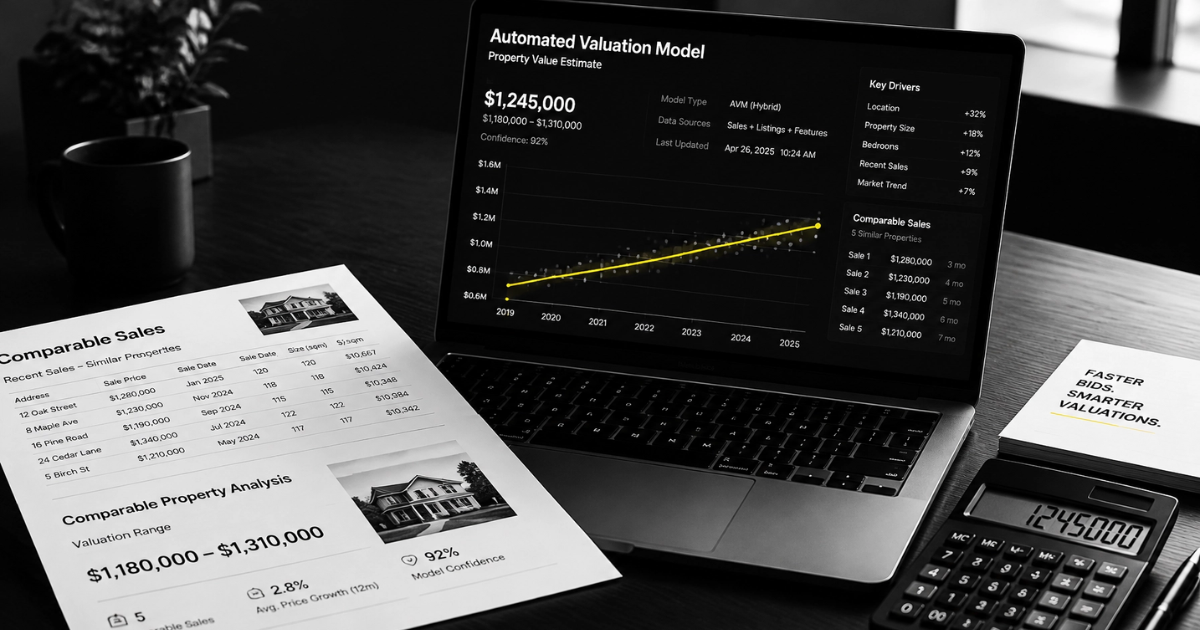
An AVM is a data-driven system that estimates a property's value using information such as comparable sales, property characteristics, historical transaction records and local market data. Depending on the provider and the available information, it can generate an indicative estimate in minutes rather than requiring a surveyor to visit the property first.
For auction finance, that speed can help brokers and lenders screen opportunities, assess potential loan security and identify properties that need further investigation.
However, there is an important distinction: an AVM estimate is not automatically a formal valuation, a survey or a lending decision. It cannot reliably identify every defect, unusual feature, title issue or property-specific risk that might affect a lender's decision.
The real advantage is therefore not that surveyors become unnecessary. It is that technology can help identify which properties need their attention, and at what stage.
"An AVM is a statistician's opinion on a house it has never seen. It is fast, honest about its confidence, and blind exactly where auction property is most interesting: the condition."
— Deji Nehan, Auction Demystified: Unlocking Auction Success
This guide explains how AVMs work, how they fit into the auction finance process, what their confidence scores mean, where their estimates can be misleading and how buyers can use valuation technology without allowing a computer-generated figure to dictate their maximum bid.
This guide reflects the market position at November 2026. AVM capabilities, data coverage, confidence measures and lender acceptance vary by provider and lender.
Key takeaways
- AVMs produce rapid indicative estimates: They use property and market data to estimate value, often without a physical inspection.
- Speed is their main advantage: They can help brokers and lenders screen properties before deciding whether a more detailed valuation is required.
- Not every property is suitable: Standard houses in areas with plenty of comparable sales are generally better candidates than unusual, derelict, heavily altered or specialist properties.
- Confidence matters: An AVM's confidence measure helps explain how reliable its estimate may be, but different providers calculate and express confidence differently.
- An AVM is not a survey: It cannot reliably establish the property's actual condition, structural integrity or all the factors affecting its saleability.
- Formal lending decisions remain lender-specific: Some lenders may accept automated or desktop valuation methods for suitable properties; others require a physical inspection.
- Buyers should use AVMs for screening, not bidding decisions: Your maximum bid must account for the full purchase costs, works, finance, exit strategy and risks.
Table of contents
- What is an automated valuation model?
- How an AVM actually estimates property value
- Why property valuation became a bottleneck in auction finance
- How AVMs change the auction finance timeline
- AVM vs desktop valuation vs physical valuation
- Where AVMs work well and where they struggle
- How to interpret an AVM report
- The hybrid valuation process: technology and professional judgement
- How auction buyers can use AVMs before bidding
- Common mistakes when relying on automated valuations
- Frequently asked questions
What is an automated valuation model?
An automated valuation model is a computer-based system that estimates the market value of a property using data and statistical analysis.
Rather than sending a surveyor to inspect every property, an AVM processes available information about the property and its surrounding market to produce an estimated value.
Depending on the model, the information may include:
- Previous residential property sale prices.
- Recent comparable transactions in the same neighbourhood.
- Property type, size and configuration.
- Location and geographical characteristics.
- Historical market movements.
- Local supply and demand indicators.
- Available property records.
- Other datasets relevant to the model's design and coverage.
Some modern AVMs use machine learning to identify patterns across large datasets. Others use statistical or rule-based methods. The term AVM does not necessarily mean that artificial intelligence is involved.
The output may include a single estimated value, a range of possible values, a confidence measure and information about the comparable evidence used.
For example, an illustrative report might show:
| AVM output | Illustrative result |
|---|---|
| Estimated property value | £184,000 |
| Lower estimate | £176,000 |
| Upper estimate | £192,000 |
| Confidence indicator | 88% |
These figures are fictional and are included to explain how an output might be presented. They are not a standard AVM format or a claim that every provider uses the same confidence scale.
The important point is that the AVM provides an estimate based on available data. It does not independently establish what a particular buyer will pay, what a lender will accept as security or what the property is worth in its actual condition.
Why AVMs matter to auction finance
Auction properties are not always straightforward lending propositions.
A lot may be a conventional two-bedroom house in an established residential area. Another may be a property requiring extensive refurbishment, a flat with a complicated lease, a converted building or a house with limited comparable sales.
The first property may be suitable for an automated assessment. The second may require considerably more investigation.
An AVM can help distinguish between these cases early.
For example, a broker reviewing ten potential auction lots may use automated estimates to identify which properties have sufficient comparable evidence to justify further consideration. Properties with unusual characteristics or weak data coverage can be flagged for additional valuation work.
That can make the initial assessment more efficient, particularly when the buyer is considering several lots before an auction.
How an AVM actually estimates property value
An AVM does not simply take the most recent sale price on the street and apply it to every other house.
It processes multiple information points and attempts to estimate how the characteristics of the subject property compare with other properties for which transaction data is available.
The precise methodology is provider-specific, but three broad elements are particularly important.
1. Comparable property transactions
Comparable sales are a central part of residential valuation.
The model looks for properties that resemble the subject property in relevant ways. Depending on the system, it may consider:
- Distance from the property being assessed.
- Property type.
- Number of bedrooms.
- Approximate floor area.
- Transaction date.
- Local market conditions.
- Other recorded property characteristics.
A recently sold three-bedroom semi-detached house may provide more useful evidence for another three-bedroom semi-detached house nearby than a much larger detached property several streets away.
However, proximity alone does not make a property comparable.
A house next to a railway line, a property with a substantially different plot size or a home with a different layout may not be a meaningful comparison, even if it is geographically close.
The quality of the comparable evidence therefore matters as much as the number of transactions.
2. Property characteristics and location data
An AVM may use property records and other datasets to understand the characteristics of the property.
These can include:
- Property type and age.
- Recorded floor area, where available.
- Number of bedrooms, where available.
- Location and neighbourhood characteristics.
- Historical transaction information.
- Other property attributes included in the provider's dataset.
The availability and accuracy of these records vary.
For example, a property may have been extended, converted or substantially altered without all relevant information appearing in the datasets used by the model.
If the AVM believes it is assessing a standard three-bedroom house when the property has actually been converted into a different configuration, its estimate may be based on an incomplete picture.
This is one reason why an AVM should never be treated as a substitute for checking the actual property.
3. Statistical analysis and confidence measures
The model combines the available evidence to produce an estimate.
Some providers also calculate a confidence measure or an estimated range. These are intended to communicate how strongly the available evidence supports the result.
A property in a street with frequent, comparable transactions may generate a more reliable output than a converted property in an area with very few similar sales.
The model may therefore produce a relatively narrow range for the first property and a wider range for the second.
Importantly, a confidence score is not necessarily the probability that the estimated value is correct. Its meaning depends on the provider's methodology, calibration and definition.
A reported 88% confidence score from one provider should not automatically be interpreted as equivalent to an 88% score from another.
The Royal Institution of Chartered Surveyors (RICS) has highlighted the importance of understanding how AVM confidence measures are calculated and the limitations of the underlying data.
For lenders and brokers, the useful question is not simply whether the model has produced a number. It is whether the model has produced a sufficiently reliable estimate for the particular decision being made.
Why property valuation became a bottleneck in auction finance
Traditional valuation processes can involve several stages:
- The lender or broker identifies the need for a valuation.
- A valuation instruction is issued.
- A suitable valuer is appointed.
- Access to the property is arranged where an inspection is required.
- The inspection takes place.
- The valuer prepares the report.
- The lender reviews the report and considers any conditions or concerns.
Each stage can introduce delay.
The timing depends on the lender, the property, the location, access arrangements and the type of valuation required. A straightforward case may progress quickly, while a complex property can require additional enquiries or a specialist report.
Now consider an auction buyer who is assessing three possible properties.
The first is a standard residential house in an established neighbourhood. The second is a converted property with limited comparable evidence. The third is a house requiring substantial refurbishment.
If all three are sent through the same physical valuation process before the buyer has even decided which one to pursue, time and cost can be spent on properties that may never become serious bidding candidates.
An AVM can help with the initial screening.
Instead of immediately commissioning a physical inspection for every property, the broker or lender may first assess whether an automated estimate is available and sufficiently reliable for the intended purpose.
This does not eliminate the need for a physical valuation where one is required. It helps direct valuation resources towards the properties and transactions where further investigation is most valuable.
Why this matters when auction catalogues are released
Auction buyers often work to a compressed timetable.
They may need to:
- Review the catalogue.
- Identify suitable lots.
- Examine legal packs.
- Arrange viewings.
- Estimate refurbishment costs.
- Assess resale or rental potential.
- Speak to a broker.
- Establish a realistic funding strategy.
- Set a maximum bid.
When several properties are being considered, a quick indicative valuation can help the buyer eliminate unsuitable opportunities earlier.
It can also help the broker prioritise which cases should move to a more detailed valuation stage.
The benefit is particularly relevant to investors who regularly assess multiple properties rather than buyers pursuing a single, straightforward purchase.
How AVMs change the auction finance timeline
The main change is that valuation screening can happen earlier in the process.
An AVM may produce an indicative estimate within minutes, depending on the provider and the information available. That allows a broker or lender to consider the property before committing to a more detailed valuation process.
The following table illustrates the difference in workflow. It is not a guaranteed turnaround schedule or a claim that every lender follows the same process.
| Stage | Traditional inspection-led approach | AVM-supported approach |
|---|---|---|
| Initial property assessment | Comparable research and manual checks | Automated data assessment may provide an early estimate |
| Initial value indication | May depend on valuation instruction and report | Can be available within minutes where data coverage permits |
| Property screening | May wait for more detailed valuation evidence | AVM can help identify promising and higher-risk cases |
| Further valuation | Physical or desktop valuation as required | Physical or desktop valuation where required |
| Underwriting | Lender reviews valuation and other evidence | Lender reviews the accepted valuation evidence and other requirements |
| Formal lending decision | Subject to underwriting and conditions | Still subject to underwriting and conditions |
The practical difference for a buyer
Imagine an investor is reviewing three lots:
- Lot A: A conventional two-bedroom terraced house.
- Lot B: A large converted property with unusual internal arrangements.
- Lot C: A property requiring substantial structural work.
An AVM may provide a useful initial estimate for Lot A because there are several comparable properties in the area.
For Lot B, the model may have limited information about the conversion and the property's actual configuration.
For Lot C, the estimate may reflect the property's recorded characteristics without adequately accounting for its current condition.
The broker can use the initial outputs to decide where additional valuation work is needed.
The buyer is not automatically approved for finance on all three properties. Instead, the initial assessment helps identify which opportunities are worth investigating further.
Can an AVM reduce the time to an auction finance decision?
It can, but only where the lender accepts the relevant valuation method and the rest of the application is sufficiently complete.
A valuation is only one part of underwriting.
The lender may still need to assess:
- The borrower's financial position and experience.
- The proposed loan amount.
- The property as security.
- The purchase price and loan-to-value ratio.
- The legal title and auction conditions.
- The proposed exit strategy.
- The source of the deposit and funds.
- Any refurbishment or development plans.
- The relevant regulatory requirements.
An AVM cannot complete these checks.
The more accurate statement is that automated valuation can reduce one potential delay in the process. It does not remove every other stage between an initial enquiry and a completed loan.
AVM vs desktop valuation vs physical valuation
These three approaches are related, but they are not interchangeable.
Understanding the difference is important because a buyer may hear that a lender has completed an automated assessment and assume that the property has been fully valued.
That is not necessarily what has happened.
Automated valuation model
An AVM uses data and statistical methods to estimate value.
It can operate without a physical inspection and may generate an output very quickly.
Its usefulness depends on the quality of the underlying data, the suitability of the property for the model and the provider's methodology.
Desktop valuation
A desktop valuation is generally completed without the valuer physically visiting the property.
The professional may review comparable evidence, property information, available records, photographs and other relevant material.
Unlike a purely automated estimate, a desktop assessment involves professional judgement, although the scope of the assessment is still limited by the information available.
A desktop valuation should not be confused with a full inspection.
Physical valuation
A physical valuation involves a valuer inspecting the property.
The scope of the inspection varies, but it can provide information about the property's actual presentation, condition, layout and features that may not be visible in standard datasets.
A physical valuation is not automatically a full building survey. Its purpose and inspection scope depend on the instructions given by the lender or client.
Comparison table
| Feature | AVM | Desktop valuation | Physical valuation |
|---|---|---|---|
| Property visit | No | Usually no | Yes |
| Speed | Often minutes | Depends on instruction and scope | Depends on access and reporting |
| Human professional judgement | Varies by model and review process | Yes | Yes |
| Uses comparable sales | Yes | Yes | Yes |
| Assesses visible condition directly | No | Only through available evidence | Yes, within inspection scope |
| Suitable for standard properties | Often | Often | Yes |
| Suitable for unusual or complex properties | May be limited | Depends on available evidence | Often more appropriate |
| Can satisfy lender requirements | Only where accepted | Only where accepted | Where required and appropriately instructed |
The practical translation is simple:
The AVM tells you what the available data suggests a property may be worth. The valuer considers the evidence and applies professional judgement. A physical inspection can also reveal property-specific details that a data model cannot see.
For auction finance, the AVM can be useful at the screening stage. The lender must still decide what valuation evidence is acceptable for the particular loan.
Where AVMs work well and where they struggle
An AVM is not equally effective across every property type.
Its performance depends heavily on how much reliable information exists about the property and how closely it resembles other properties in the model's dataset.
Properties where AVMs may be more useful
1. Standard residential houses
A conventional terraced, semi-detached or detached house in an established residential area may have plenty of comparable transaction evidence.
Where the property characteristics are accurately recorded and the market is sufficiently active, an AVM may provide a useful initial estimate.
2. Properties in established neighbourhoods
Areas with regular residential transactions can provide the model with more recent evidence.
That does not guarantee accuracy, but it can improve the quality of the comparisons available.
3. Conventional flats
Some flats may be suitable for automated assessment, particularly where there are comparable units in the same development or nearby buildings.
However, lease length, service charges, building safety issues, restrictions and other flat-specific factors may not be adequately captured by the AVM.
4. Early-stage portfolio screening
An investor assessing multiple conventional residential properties may use AVM estimates to prioritise further investigation.
This can be useful before committing to detailed valuation work on every potential purchase.
Properties where AVMs may be less reliable
1. Derelict and heavily damaged properties
An AVM may use recorded property characteristics and comparable sales to estimate value, but it cannot reliably inspect the actual condition.
A property with severe damp, fire damage, structural movement or extensive deterioration may be worth considerably less than a comparable house in good condition.
2. Heavy refurbishment projects
A model may estimate a current value based on the property's recorded characteristics. It may not understand the full scope or cost of the works required.
It also cannot independently confirm that a proposed refurbishment will achieve a particular resale value.
3. Unusual or converted properties
Properties with non-standard layouts, unusual construction, multiple units or complicated conversions may not have sufficiently similar comparable sales.
The model may struggle to make meaningful adjustments for these differences.
4. Properties with limited transaction evidence
A rural property, specialist building or unusual house in a low-transaction area may have very few relevant comparables.
The model may rely on less similar evidence, which can increase uncertainty.
5. Properties with unusual legal or tenure characteristics
Leasehold restrictions, short leases, title defects, restrictive covenants and other legal issues can materially affect value and lending suitability.
An AVM should not be expected to establish the legal position of the property.
6. Commercial and mixed-use properties
Commercial assets can be more difficult to assess through automated residential valuation methods because value may depend on rental income, lease terms, tenant quality, planning use, operating performance and specialist market evidence.
Some providers offer commercial AVM products, but their suitability depends on the asset class and the quality of available data.
The rule for auction buyers
The more a property differs from a conventional, well-documented residential house, the more carefully its AVM output should be treated.
A strong-looking estimate does not make a property straightforward security.
If the lot has unusual construction, substantial defects, complex tenure or limited comparable evidence, additional professional assessment may be essential.
RICS has similarly highlighted that AVMs tend to be more reliable for standard, homogeneous properties and may be less effective where data is limited or property characteristics are unusual.
How to interpret an AVM report
An AVM report should be read as a set of evidence, not as a single number.
The estimated value may attract the most attention, but the supporting information can be more important when deciding whether the output is useful.
Here are the main elements to examine.
1. The estimated value
This is the model's central estimate.
For example, an AVM might estimate a property at £184,000.
That figure should not automatically become the purchase price, expected resale value or lender valuation.
It is an estimate based on the model's assumptions and data.
2. The estimated value range
Some providers display a lower and upper estimate around the central figure.
An illustrative report might show:
- Lower estimate: £176,000.
- Central estimate: £184,000.
- Upper estimate: £192,000.
A wider range may indicate greater uncertainty.
The buyer should understand why the range is wide. Is the property unusual? Are there few comparable sales? Is the available data old? Is the local market changing quickly?
A range is useful only when its meaning and limitations are understood.
3. The confidence score
A confidence score is intended to communicate how reliable the model considers its estimate to be.
However, there is no single universal AVM confidence scale that every provider uses.
One provider may calculate confidence using the quantity and quality of comparable transactions. Another may use a statistical measure of expected valuation error or a different internal methodology.
For that reason, a buyer should not assume that a score below 80% is automatically unreliable or that a score above 90% guarantees accuracy.
The useful questions are:
- What does this provider's score actually measure?
- How is the score calculated?
- What is the model's performance for this type of property?
- How recent and relevant are the comparable transactions?
- Does the provider explain the uncertainty around the estimate?
4. The comparable properties
Where the report provides comparable transactions, examine them.
Check whether they are genuinely similar in:
- Property type.
- Size and layout.
- Location.
- Condition, where known.
- Tenure.
- Transaction date.
- Sale circumstances, where available.
A model may select a property because it is statistically similar, but that does not mean it is a perfect comparison.
A three-bedroom house with a modern extension may not be a useful benchmark for a smaller, unmodernised property simply because both have the same bedroom count.
5. The data date
Property markets change.
An estimate based on older transaction evidence may not reflect the current market, particularly in areas where prices have moved quickly.
Check when the underlying data was last updated and whether the model's output reflects the valuation date relevant to the lending decision.
6. Missing or inaccurate property information
An AVM can only work with the information available to it.
If the property has been extended, converted or materially altered, check whether those changes are reflected in the records.
If the model has used incorrect floor area, bedroom count or property type, the estimate may be misleading.
The desk habit: shortlist using the point estimate, investigate the range and comparable evidence, and escalate unusual or low-confidence cases for further assessment. Never treat the headline value as a substitute for understanding the property.
The hybrid valuation process: technology and professional judgement
The future of property valuation is not necessarily a choice between computers and surveyors.
In many cases, the more practical approach is a combination of automated analysis, professional review and physical inspection where appropriate.
RICS has described AVM adoption as a broader spectrum of approaches involving different levels of automation, digital data and human intervention.
UK Finance also recognises that lender valuations may be carried out in person, through desktop methods or using automated systems.
This is important because the valuation method is not determined by the buyer's preference alone. The lender decides what evidence is acceptable for its particular transaction.
Stage 1: Initial data assessment
The property details are entered into an AVM or checked against an existing property record.
The model produces an estimate based on available information.
At this point, the output may help the broker identify whether the property appears suitable for further consideration.
Stage 2: Comparable and confidence review
The estimate is reviewed alongside the comparable transactions and any available confidence information.
The broker or lender considers whether the output is credible enough for the intended purpose.
If the data is weak, the property is unusual or the estimate raises questions, further investigation may be needed.
Stage 3: Additional property checks
The valuation evidence is considered alongside other property information.
For an auction property, this may include:
- The auction catalogue description.
- Photographs and viewing information.
- The legal pack.
- Title and tenure information.
- Lease details, where relevant.
- Planning and building regulation information.
- Refurbishment requirements.
- Any known defects or restrictions.
The AVM cannot replace these checks.
Stage 4: Further valuation where required
The lender may require a desktop valuation, physical inspection or specialist report.
This is particularly relevant where the property is unusual, the data is limited, the condition is uncertain or the loan represents a higher level of risk.
Stage 5: Underwriting and lending decision
The lender considers the valuation evidence together with the borrower, loan structure, security and exit strategy.
Only after the lender has completed its required checks and satisfied its conditions can the relevant formal lending decision be made.
The hybrid approach is valuable because it allows technology to handle suitable data-intensive screening while preserving professional judgement for cases that need it.
How auction buyers can use AVMs before bidding
You do not need to be a lender or valuation professional to benefit from the principles behind automated valuation.
As an auction buyer, you can use property data and comparable sales to develop an initial view of whether a lot is worth investigating.
However, public property estimates and online valuation tools are not necessarily equivalent to the AVM used by a lender. They may rely on different datasets, methods and assumptions.
Use them as research tools rather than as proof of value.
Step 1: Establish the property's recorded details
Start with the basic information:
- Full property address.
- Property type.
- Number of bedrooms.
- Approximate floor area.
- Tenure.
- Previous sale history.
- Any known extensions or conversions.
Check whether the available information matches the actual property.
If the records are incomplete or inaccurate, do not assume that an automated estimate will correct them.
Step 2: Research recent comparable sales
Look for recently sold properties in the same neighbourhood.
Prioritise properties that are genuinely similar in size, type, layout and condition.
Do not select comparables simply because they produce a higher valuation.
A sensible comparison should explain why the properties are similar and identify where meaningful differences exist.
Step 3: Separate current value from post-works value
This is particularly important for refurbishment projects.
The property's current condition and its potential value after refurbishment are two different questions.
An AVM may estimate the current value using available records and transaction data. It does not automatically establish the value of the finished property.
For a post-works assessment, examine comparable properties that have already been refurbished to a similar standard.
Allow for differences in floor area, specification, layout, location and market conditions.
Step 4: Check the legal pack and physical condition
A promising automated estimate does not mean the property is suitable for purchase.
Review the legal pack and arrange a viewing where possible.
Pay particular attention to:
- Structural concerns.
- Damp and water ingress.
- Roof condition.
- Electrical and plumbing issues.
- Lease restrictions.
- Title defects.
- Planning and building regulation matters.
- Access and rights of way.
- Occupation and tenancy arrangements.
Seek appropriate professional advice where the issues require specialist assessment.
Step 5: Calculate the full cost of the purchase
Your maximum bid should be based on the economics of the transaction, not simply the estimated property value.
Include:
- Auction purchase price.
- Buyer's premium, if applicable.
- Legal fees and searches.
- Stamp Duty Land Tax or the relevant property transaction tax.
- Bridging finance arrangement and other lender fees.
- Interest and any applicable exit fee.
- Valuation and professional costs.
- Refurbishment budget.
- Contingency.
- Holding costs.
- Selling or refinancing costs.
The tax treatment depends on the location, ownership structure and circumstances of the purchase. In England and Northern Ireland, higher rates of SDLT can apply to additional residential properties. A company does not automatically avoid the higher rates. Scotland and Wales have separate property transaction taxes.
Use the official GOV.UK Stamp Duty Land Tax guidance and HMRC SDLT calculator for relevant England and Northern Ireland transactions. Obtain professional tax advice where the position is complex.
Step 6: Establish your finance and exit strategy
Before bidding, discuss the property with a broker who understands auction finance.
The lender may assess the property using an AVM, desktop valuation or physical valuation, depending on its criteria and the circumstances.
You should understand:
- How much you may be able to borrow.
- What deposit or equity contribution is required.
- Whether the lender will accept the property.
- What valuation method is likely to be required.
- Whether refurbishment finance is needed.
- How the loan will be repaid.
- Whether your proposed exit is realistic within the loan term.
A refinance exit should be supported by a credible assessment of the property's likely post-works value, the borrower's ability to meet the refinance lender's requirements and the expected rental or sale position.
Step 7: Set a maximum bid and stick to it
The AVM may help you decide whether the property deserves further attention.
It should not decide how much you are willing to pay.
Your maximum bid should come from the full financial model, the evidence supporting the property's current and future value, the lender's requirements and the risks you have identified.
A property that appears attractive at £140,000 may become a poor investment at £165,000 once finance costs, refurbishment and other expenses are included.
The discipline is to establish your ceiling before the auction begins.
How Auction360 can help
Auction360's pre-auction approval service and auction risk analysis support buyers in assessing funding and property risks before bidding.
The process can include AVM-backed screening and further valuation work where the circumstances require it. The appropriate valuation method remains dependent on the property, lender and transaction.
The wider auction finance service helps structure funding around the auction purchase, the completion timetable and the proposed repayment strategy.
The objective is not simply to obtain a fast valuation. It is to understand whether the property, the borrowing and the exit strategy make sense before you commit to the purchase.
Common mistakes when relying on automated valuations
AVMs can make property screening more efficient, but their speed can also create a false sense of certainty.
These are some of the mistakes auction buyers should avoid.
1. Treating the AVM estimate as a guaranteed market value
An AVM is an estimate, not a guaranteed sale price.
The actual price achieved may be affected by condition, demand, location, legal restrictions and the circumstances of the transaction.
Use the output alongside comparable evidence and professional advice.
2. Assuming every lender accepts AVMs
Lenders have different valuation policies.
One lender may accept an automated valuation for a particular property and loan size, while another may require a physical inspection.
Never assume that an AVM report automatically satisfies the lender's requirements.
3. Ignoring the confidence measure
A headline value without its supporting evidence can be misleading.
Review the confidence information, range and comparable transactions where available.
If the model's output is uncertain, treat that uncertainty as a reason for further investigation.
4. Using an AVM to value a refurbishment project
A model may not understand the true condition of a property or the full cost of bringing it up to standard.
A property requiring significant works needs a more detailed assessment.
For a refurbishment project, establish the current value, works budget and expected completed value separately.
5. Confusing an indicative estimate with formal approval
An AVM result does not mean that a lender has approved the borrower or the property.
It does not replace underwriting, legal checks, source-of-funds checks or any other lending conditions.
6. Relying on outdated comparable sales
Old transaction data may not reflect current market conditions.
Check the dates and relevance of the comparable evidence before using it to support a bid.
7. Assuming the model understands legal and title risks
An AVM is not a solicitor.
It cannot independently establish whether the title is defective, whether a lease is acceptable or whether a restrictive covenant affects the property.
The legal pack must be reviewed separately.
8. Allowing speed to replace due diligence
A valuation estimate available in minutes can create pressure to move quickly.
That does not mean the buyer should skip the legal, financial or physical checks.
The purpose of technology is to improve decision-making, not to make poor decisions faster.
Frequently asked questions
1. What is an automated valuation model?
An automated valuation model is a data-driven system that estimates a property's value using information such as comparable sales, property characteristics, transaction history and local market data. It can produce an estimate without a physical inspection, although its accuracy depends on the quality and relevance of the available data.
2. Do auction finance lenders accept AVM valuations?
Some lenders accept AVMs for suitable properties and transactions, while others require desktop or physical valuations. Acceptance depends on the lender's criteria, the property type, the loan and the reliability of the available data. An AVM should never be assumed to satisfy every lender's valuation requirements.
3. How quickly can an AVM produce a property valuation?
An AVM can often generate an indicative estimate within minutes once the required property information has been identified and processed. However, the time needed to obtain a formal lending decision is longer because the lender may still need to complete underwriting, legal checks and other assessments.
4. How accurate are automated property valuations?
Accuracy varies by provider, property type, location and the quality of the underlying data. AVMs may perform better for conventional properties in areas with frequent comparable transactions. They can be less reliable for unusual, damaged, converted or specialist properties. A confidence score should be interpreted according to the provider's methodology rather than treated as a universal accuracy percentage.
5. What is the difference between an AVM and a full property valuation?
An AVM estimates value using data and statistical models. A professional valuation involves a valuer applying judgement to the available evidence and the scope of the instruction. A physical valuation includes an inspection of the property, although the extent of that inspection depends on the instruction. These methods provide different levels and types of evidence.
6. Can an AVM value a derelict property?
An AVM may generate an estimate for a derelict property, but the result may not reflect its actual condition. The model may not know about structural damage, severe damp, fire damage or the extent of refurbishment required. A property in this condition generally needs further investigation and an appropriate professional valuation.
7. How do AVMs speed up pre-auction approval?
An AVM can provide an early indicative estimate without waiting for a surveyor to visit the property. This may help a broker or lender screen potential auction lots, identify properties with suitable comparable evidence and decide which cases need further valuation work. It can accelerate one part of the process, but does not guarantee pre-auction approval or a formal offer.
8. Should I rely on an AVM to set my maximum auction bid?
No. An AVM can help you assess whether a property is worth investigating, but your maximum bid should be based on the full cost of the purchase, the property's condition, comparable evidence, finance costs, legal and tax expenses, refurbishment requirements and a realistic exit strategy.
9. Can AVMs estimate post-refurbishment property values?
Some models may produce estimates using recorded property characteristics, but an AVM should not automatically be treated as evidence of the value a refurbished property will achieve. Use comparable sales of similarly refurbished properties and obtain appropriate professional advice. A lender may require a separate valuation when assessing a refinance.
10. What does an AVM confidence score mean?
A confidence score indicates how reliable the provider considers the estimate to be under its own methodology. It may reflect the quantity, quality and relevance of comparable data or a statistical measure of expected error. There is no universal scale, so a score from one provider should not be directly compared with another provider's score without understanding how each is calculated.
11. Can an AVM replace a surveyor?
No. AVMs can support valuation screening and, where a lender accepts them, some lending valuation decisions. They cannot independently inspect a property's physical condition, investigate every unusual feature or replace professional judgement where it is needed. Surveyors and other property professionals remain important for complex and higher-risk cases.
12. Do AVMs work for commercial auction properties?
They can be used for some commercial assets, but the quality and availability of comparable data may be more limited than for standard residential property. Commercial valuation can also depend on rental income, lease terms, tenant strength, planning use and specialist market evidence. A commercial property may therefore require a more tailored valuation approach.
Final thoughts: faster valuation should mean better decisions
Automated valuation models are changing how property professionals assess residential property.
For auction finance, their biggest advantage is the ability to provide an early indication of value without waiting for a physical inspection in every case. That can help brokers screen multiple lots, identify potential valuation risks and prioritise the properties that deserve more detailed investigation.
But speed should never be confused with certainty.
An AVM does not inspect the roof, identify hidden structural defects, interpret the legal pack or guarantee that a lender will accept the property. It is one part of a wider assessment.
The strongest approach combines data, comparable evidence, professional judgement, property due diligence and a credible funding strategy.
For auction buyers, the objective is not to obtain the fastest valuation at any cost. It is to make a better-informed decision before the hammer falls.
If you are considering an auction purchase, speak to Auction360 about assessing the property, arranging suitable finance and preparing your funding strategy before you bid.
About the author
Deji Nehan is the author of Auction Demystified: Unlocking Auction Success, with more than 15 years of experience in property auction and finance. He is the founder of Auction360, a UK auction and bridging finance platform helping property buyers understand funding options, assess auction opportunities and structure finance around their investment objectives.
Learn more about the book at Auction360.
Disclaimer
This article is for general educational purposes and does not constitute financial, legal, tax or investment advice. AVM outputs are estimates and may not reflect the actual condition, market value or lending suitability of an individual property. Valuation methods and lending criteria vary between providers and lenders. Always obtain appropriate professional advice before bidding or entering into a property finance agreement.
Your property may be repossessed if you do not keep up payments on a mortgage or any other debts secured on it.