
How to Get Auction Finance Agreed in Principle Before Bidding: The Pre-Auction Approval Playbook
How do you bid at auction with confidence instead of hope?
You arrange your finance before the sale.
A property auction is not the place to discover whether a lender is willing to support your purchase. Once the hammer falls at a traditional unconditional auction, you are generally contractually committed to completing within the period specified in the auction contract. You cannot simply wait for your bank to finish its underwriting.
That is why pre-auction approval matters.
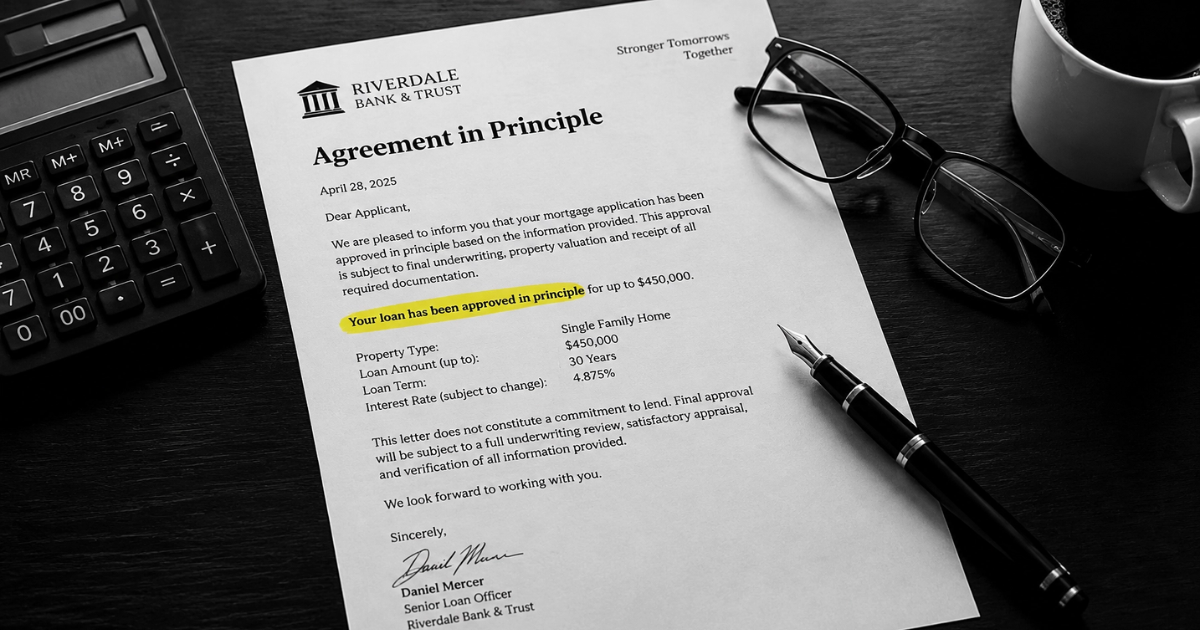
An agreement in principle from a specialist auction finance lender or broker can give you an early indication of how much you may be able to borrow, the types of properties the lender may consider and the likely funding structure. It helps you establish a realistic bidding limit before you make a legally binding commitment.
However, there is an important distinction: an agreement in principle is not a formal loan offer. The specific property, valuation, legal pack and final underwriting still need to be assessed.
This guide explains how to get auction finance agreed in principle, what a broker does behind the scenes, what lenders assess, which documents to prepare and how to turn an initial approval into a practical bidding plan.
This guide reflects the UK market position at October 2026. Processes, approval periods, lender criteria and indicative terms vary between providers.
"The most expensive sentence in an auction room is 'my funding should be fine.' The hammer does not wait for your bank's underwriter."
— Deji Nehan, Auction Demystified: Unlocking Auction Success
Key takeaways
- Arrange an initial finance assessment before bidding, ideally before the auction catalogue is published.
- An agreement in principle can establish indicative borrowing capacity and the lender's broad criteria.
- Pre-auction approval is not a guarantee that a lender will fund every property you bid on.
- Each lot still needs to be checked for condition, valuation, tenure, title and legal suitability.
- Your maximum bid must account for your deposit, borrowing limit, SDLT, auction fees, finance costs and contingency.
- Lenders assess the borrower, property, proposed loan and repayment strategy.
- Having your financial documents ready can reduce avoidable delays.
- A specialist auction finance broker can help match the transaction to an appropriate lender and coordinate the process.
- Never treat a decision in principle as permission to bid above your financial limit.
Table of contents
- Why pre-auction approval changes your auction results
- What is an auction finance agreement in principle?
- What an auction finance broker actually does
- The pre-auction approval process step by step
- What lenders assess before the hammer falls
- Agreement in principle vs formal loan offer
- What should your approval letter contain?
- Documents you need to prepare
- How much does pre-auction approval cost?
- How to calculate your maximum auction bid
- Common pre-auction approval mistakes
- Frequently asked questions
Why pre-auction approval changes your auction results
An auction room rewards preparation.
Two buyers might be interested in exactly the same property. One has already discussed their funding requirements with a specialist broker, understands the likely loan amount and has a clear maximum bid. The other assumes their bank will probably provide the money and plans to arrange the finance after winning.
They may have similar budgets, but they are not approaching the auction with the same level of preparation.
The first buyer has established a funding position before committing. The second is taking a financial risk.
Pre-auction approval helps turn finance from an after-the-fact scramble into part of your bidding strategy.
It can help you answer important questions before the auction:
- What is the maximum amount I may be able to borrow?
- How much deposit and additional capital will I need?
- Which types of property will the lender consider?
- Does the property need to be habitable?
- Can the lender support the proposed refurbishment?
- What is the likely interest structure and loan term?
- What repayment strategy will the lender accept?
- What is the maximum price I can responsibly bid?
These questions matter because winning an auction is only the beginning of the transaction. You still need to complete the purchase and repay the finance.
Auction finance is becoming a more prominent funding route
The latest Bridging Trends figures available at the time of writing show that auction finance accounted for 14% of reported bridging transactions in Q2 2026, up from 11% in Q1.
The average monthly bridging interest rate was approximately 0.81% in Q2, compared with 0.82% in the previous quarter.
These figures demonstrate the role of specialist bridging finance in auction purchases, but they are market averages rather than guaranteed terms for an individual borrower.
Source: The Intermediary – Regulated bridging demand rises in Q2.
What pre-auction approval can establish
A properly prepared initial approval can give you a clearer picture of:
| Approval area | What you want to establish |
|---|---|
| Borrowing capacity | Indicative maximum loan amount |
| Deposit | Your required cash contribution |
| Loan-to-value | The lender's potential advance against an acceptable valuation |
| Property criteria | The types and conditions of properties the lender may consider |
| Loan structure | Potential term and interest treatment |
| Pricing | Indicative rate and fees, subject to the specific property |
| Exit strategy | Whether the proposed repayment route appears viable |
| Timing | Whether the lender's process may fit the auction deadline |
The figures and criteria remain subject to the actual property and final approval. The purpose is to reduce uncertainty, not pretend that every future purchase has already been approved.
What is an auction finance agreement in principle?
An auction finance agreement in principle is an initial indication that a lender may be willing to provide finance subject to further checks and approval.
It is sometimes called:
- Auction finance pre-approval.
- Bridging finance agreement in principle.
- Indicative lending approval.
- Pre-auction finance assessment.
- Decision in principle.
The terminology varies between brokers and lenders. More important than the label is what the document actually confirms.
A useful agreement in principle should explain the assumptions behind the lending indication, including the proposed loan amount, property type, loan-to-value, indicative pricing and any important conditions.
What it does not mean
An agreement in principle does not automatically mean:
- The lender has approved a property you have not yet identified.
- The lender will lend the stated amount against every auction lot.
- The valuation has been completed.
- The legal pack has been approved.
- The final facility agreement has been issued.
- Funds are guaranteed to be released by a particular date.
The lender will still need to assess the actual property and complete its required due diligence.
Why buyers should obtain approval early
Imagine you are an investor looking to purchase residential properties at auction.
You have £50,000 available for a deposit and associated costs. You believe you can borrow up to £200,000 through a specialist bridging lender.
Without an initial assessment, you may be tempted to bid on a property simply because the purchase price appears to fit your budget.
But what if the property needs structural work? What if the valuation comes in below the purchase price? What if the lender does not accept the title or the proposed exit?
An early assessment helps identify these issues before you commit.
It also helps you distinguish between properties that fit your funding criteria and those that require a different finance structure.
What an auction finance broker actually does
A specialist auction finance broker does more than collect documents and send applications to lenders.
The broker's role is to understand the transaction, identify suitable funding options and help prepare the case so that the lender can assess it efficiently.
The process generally involves five important functions.
1. Understanding your borrowing requirements
The broker first needs to understand what you want to buy and how you intend to fund it.
Questions may include:
- Are you buying residential, commercial or mixed-use property?
- Is the property intended for investment or personal occupation?
- Are you purchasing through your own name or a limited company?
- What is your available deposit?
- How much do you expect to borrow?
- Do you have experience buying or renovating property?
- Are you planning to refinance or sell?
- What completion deadline are you working towards?
These details help determine which lenders and products may be appropriate.
2. Matching your circumstances to lender criteria
Not every bridging lender accepts every type of property or borrower.
One lender may be comfortable with a straightforward residential investment purchase but have limited appetite for heavy refurbishment. Another may consider commercial property or more complex security arrangements.
A broker can compare lender criteria against your proposed purchase rather than assuming that one lender will suit every auction transaction.
3. Preparing the application
The broker helps organise the information needed for the initial assessment.
This may include:
- Proof of identity.
- Proof of address.
- Evidence of deposit.
- Bank statements.
- Details of existing property ownership.
- Company information, where relevant.
- Details of the proposed purchase.
- Refurbishment information.
- Exit strategy.
A well-prepared application reduces the likelihood of repeated requests for basic information.
4. Assessing the exit strategy
The broker should challenge the repayment plan, not simply record it.
If you intend to refinance, the broker needs to understand whether the property is likely to meet the future lender's requirements.
If you intend to sell, the proposed sale price, market conditions and likely timescale need to be considered.
A bridging loan that appears affordable at the outset can become expensive if the exit is unrealistic or takes longer than expected.
5. Coordinating the transaction
Once a suitable lender has been identified, the broker can help coordinate the next stages.
This may include:
- Arranging the lender's valuation.
- Passing information to the lender's underwriting team.
- Coordinating with your solicitor.
- Responding to lender enquiries.
- Checking the completion timetable.
- Helping identify outstanding conditions.
A good broker should also be prepared to tell you when a property does not fit the funding criteria.
That early warning can be more valuable than an optimistic indication that later falls apart.
The pre-auction approval process step by step
The most efficient approach is to separate the work that can be completed once from the checks that must be carried out for each individual lot.
Your financial assessment and general borrowing requirements can be prepared in advance. The property-specific work must then be completed when you identify a lot you want to buy.
Step 1: Establish your financial position
Before contacting a broker, calculate how much capital you can commit.
Consider:
- Cash available for the deposit.
- Additional funds available for completion.
- Existing property commitments.
- Other outstanding borrowing.
- Expected refurbishment expenditure.
- Emergency reserves.
- Your ability to service interest, if applicable.
Do not use every pound of available cash as a deposit. You need enough to cover transaction costs and unexpected expenses.
Step 2: Define your target property type
Tell the broker what kind of property you expect to purchase.
For example:
- Habitable residential investment property.
- Residential property requiring light refurbishment.
- Property requiring substantial refurbishment.
- Commercial investment property.
- Mixed-use property.
- Development opportunity.
This matters because lenders have different criteria for different property types and levels of work.
If your target changes significantly, your initial approval may need to be reassessed.
Step 3: Submit your financial documents
Provide the documents requested by the broker or lender.
The more complete your information, the easier it is to identify potential issues early.
Be accurate about your income, existing commitments, credit history and source of funds. Inconsistent information can delay the application or affect the lender's decision.
Step 4: Discuss the exit strategy
Explain how you intend to repay the bridging loan.
For example:
Refinance: You plan to complete the purchase, carry out refurbishment and refinance onto a buy-to-let mortgage.
Resale: You plan to purchase below market value, complete agreed works and sell the property.
Commercial refinance: You intend to acquire a commercial property and refinance onto a longer-term commercial mortgage once the relevant conditions are met.
The lender may require supporting evidence, and the proposed exit must be realistic within the loan term.
Step 5: Obtain an initial lending indication
The broker approaches suitable lenders or obtains an indicative assessment through the relevant lending channel.
The outcome may provide:
- Indicative maximum loan.
- Potential LTV.
- Indicative interest rate.
- Arrangement fee.
- Potential loan term.
- Accepted property categories.
- Important conditions.
- Further documents required.
At this stage, ask what is still outstanding. Do not confuse an initial indication with a completed underwriting decision.
Step 6: Identify a specific auction lot
Once you have an initial funding position, identify the property you intend to bid on.
Send the broker and solicitor the relevant information, including:
- Property address.
- Auction catalogue details.
- Guide price.
- Expected maximum bid.
- Legal pack.
- Property condition.
- Tenure.
- Intended use.
- Auction completion deadline.
The specific lot must be assessed against the lender's criteria.
Step 7: Complete the property-specific checks
The lender may need to arrange a valuation, review the legal position and confirm that the property is acceptable security.
Your solicitor should review the legal pack and highlight any issues that could affect the purchase or the lender's security.
If the property differs materially from the assumptions behind the initial approval, the lender may revise its terms or decline the case.
Step 8: Confirm your bidding limit
Once you have a clearer view of the finance and purchase costs, establish your maximum bid.
Your maximum bid should reflect:
- The amount the lender may advance.
- Your available deposit.
- SDLT and other taxes.
- Auction fees.
- Legal costs.
- Finance fees.
- Refurbishment expenditure.
- Contingency.
- Your investment return or affordability requirements.
Do not increase your maximum simply because the bidding becomes competitive.
Step 9: Bid only when the funding position is understood
Before the auction, confirm the remaining steps required if you win.
Know who will receive the auction documents, who will contact the lender and how quickly the legal process needs to begin.
You should also know whether the lender's indicative approval has any expiry date or conditions that could affect the transaction.
What lenders assess before the hammer falls
Lenders generally consider four broad areas: the borrower, the property, the proposed loan and the exit strategy.
The precise order and weight given to each factor vary by lender and product.
1. The borrower
The lender needs to establish who is borrowing and whether the proposed facility is suitable for their circumstances.
This may include reviewing:
- Identity and address.
- Credit history.
- Financial commitments.
- Source of deposit.
- Income or available funds.
- Existing property portfolio.
- Previous borrowing experience.
- Company structure, where relevant.
Some lenders are comfortable with first-time property investors, while others may prefer applicants with relevant experience. Do not assume that a lack of previous auction purchases automatically rules you out.
2. The property
The property is the security for the loan, so the lender needs to understand what it is being asked to finance.
Relevant factors may include:
- Location.
- Property type.
- Current condition.
- Market value.
- Purchase price.
- Tenure.
- Construction.
- Planning position.
- Access and title.
- Existing occupancy.
- Intended use.
A property requiring extensive refurbishment may need a specialist lender. A property with an unusual title or short lease may also require additional assessment.
3. The loan structure
The lender will consider the amount you want to borrow in relation to the property and the transaction.
This includes:
- Loan-to-value.
- Loan term.
- Interest payment method.
- Arrangement fees.
- Additional security.
- Whether refurbishment funds are required.
- Whether the facility is regulated or unregulated.
The amount you can borrow may be lower than you initially expect if the valuation is below the purchase price or the property falls outside the lender's standard criteria.
4. The exit strategy
The exit is one of the most important parts of a bridging application.
The lender wants to understand how the loan will be repaid.
If the plan is to refinance onto a buy-to-let mortgage, the future lender may assess:
- Property condition.
- Valuation.
- Rental income.
- Interest coverage.
- Borrower affordability.
- Property type.
- Ownership structure.
If the plan is to sell, the lender may consider the property's marketability, proposed sale value and likely timescale.
An exit strategy should be more than a sentence on an application form. It needs to be supported by a credible route to repayment.
Agreement in principle vs formal loan offer
These terms are sometimes used interchangeably in casual conversation, but they do not mean the same thing.
An agreement in principle is an initial lending indication. A formal loan offer follows further checks and approval.
| Stage | What it usually means | Can you rely on it as guaranteed funding? |
|---|---|---|
| Initial enquiry | You have described your proposed borrowing requirements | No |
| Agreement in principle | Indicative willingness to lend, subject to stated assumptions and further checks | No |
| Property-specific assessment | The lender considers the actual lot, valuation and legal information | Not necessarily |
| Formal loan offer | The lender has issued an offer subject to its terms and conditions | Stronger, but conditions still need to be met |
| Completion approval and drawdown | Required conditions have been satisfied and funds are released through the legal process | This is the stage at which the loan completes |
A formal offer may still contain conditions that must be satisfied before funds are released.
Why the distinction matters at auction
Suppose a broker tells you that a lender is prepared to consider a £180,000 bridging loan.
That is useful information, but it does not mean the lender will automatically advance £180,000 against any property you win.
The property may be valued below the purchase price. It may require more extensive works than anticipated. The title may contain restrictions that the lender will not accept.
Pre-auction approval helps you prepare. It does not remove the need for a property-specific decision.
This is also why a lender's stated approval period should not be treated as a guarantee that every purchase within that period will complete.
What should your approval letter contain?
An agreement in principle is only useful if you understand its assumptions and limitations.
Ask the broker or lender to set out the important parameters in writing.
1. Indicative maximum loan
The document should state the indicative amount the lender may be willing to consider.
Check whether the amount is subject to a maximum LTV, valuation or other conditions.
2. Property type and condition
The approval should make clear what type of property the lender is considering.
For example, is it intended for:
- Habitable residential property?
- Light refurbishment?
- Heavy refurbishment?
- Commercial property?
- Mixed-use property?
If you intend to buy different property types, make sure the approval actually covers them.
3. Indicative loan-to-value
Ask what LTV the lender may consider and what valuation basis it will use.
Do not assume the lender will advance the stated percentage of your winning bid. The final calculation may depend on the lender's valuation and policy.
4. Indicative pricing and fees
The document should explain the indicative interest rate or pricing range, arrangement fee and any known additional charges.
Ask whether the interest is expected to be serviced, retained or rolled up.
5. Loan term
Understand the potential term and whether the lender has a minimum interest period or other repayment conditions.
The term must be realistic for the refurbishment, refinance or sale strategy.
6. Outstanding conditions
The document should identify what remains to be checked before the lender can issue a formal offer.
This may include:
- Property valuation.
- Legal pack and title review.
- Full underwriting.
- Proof of deposit.
- Source-of-funds checks.
- Confirmation of the exit strategy.
- Final loan structure.
An approval without clear assumptions and conditions is difficult to use as a bidding tool.
Documents you need to prepare
Having your documents ready can make the initial assessment more efficient.
The exact requirements depend on the lender, the borrower and whether the application is personal or through a company.
The following checklist covers common requests.
Personal documents
Proof of identity, such as a passport or driving licence.
Proof of residential address.
Recent personal bank statements.
Details of existing mortgages and loans.
Information about income and financial commitments.
Details of any relevant credit history issues.
Evidence of available deposit funds.
Company documents, where applicable
Company registration details.
Registered office and ownership information.
Details of directors and shareholders.
Company bank statements, where requested.
Relevant accounts or financial information.
Details of the intended property purchase structure.
Property and transaction information
Property address.
Auction catalogue entry.
Guide price.
Expected purchase price.
Legal pack, when available.
Property photographs or survey information.
Current condition and proposed works.
Tenure and title details.
Auction completion deadline.
Exit strategy documents
Depending on the proposed exit, the lender may request:
Evidence of a likely refinance route.
Rental estimates or comparable evidence.
Refurbishment schedule and budget.
Proposed resale valuation.
Details of any other property sale or capital event.
Evidence of relevant experience.
Do not assume that every lender will request every document. The aim is to have the information available so that it can be provided when needed.
How much does pre-auction approval cost?
The initial assessment or agreement in principle is often provided without a separate lender arrangement fee. However, this is not universal, and the buyer should ask whether any broker or third-party charges apply before proceeding.
The costs associated with the completed finance facility may include:
| Cost | What it covers |
|---|---|
| Broker fee | The intermediary's fee, if applicable |
| Arrangement fee | The lender's fee for setting up the facility |
| Valuation fee | The cost of assessing the property |
| Legal fees | The borrower's and lender's legal work |
| Monthly interest | The cost of borrowing |
| Exit fee | A redemption fee, if included in the agreement |
| Administration fees | Other charges specified by the lender |
What interest rate should you expect?
Bridging Trends reported an average monthly bridging interest rate of approximately 0.81% in Q2 2026.
That is a market-wide average, not a standard auction finance rate.
Individual offers depend on the loan-to-value, property, borrower, loan term, lender and complexity of the transaction. A straightforward residential case may be priced differently from a commercial purchase or heavy refurbishment project.
For that reason, be cautious about treating any advertised monthly rate as a guaranteed quote.
Is pre-auction approval worth the effort?
The value of approval is not simply the interest rate or the time spent preparing documents.
It is the opportunity to identify funding problems before you become contractually committed.
A few days spent understanding the lender's requirements can help you avoid bidding on a property that cannot be funded on the terms you expected.
That does not eliminate every risk, but it gives you a much better basis for making a decision.
How to calculate your maximum auction bid
Your maximum bid should be based on the amount you can fund, not simply the amount you hope the lender will advance.
Consider this illustrative example.
An investor is looking at a residential property with an expected purchase price of £200,000.
The investor has £55,000 available and receives an indicative bridging assessment suggesting a potential loan of up to £150,000, subject to the property and valuation.
The investor should not automatically assume they can bid £200,000.
They need to account for the full transaction.
| Item | Illustrative amount |
|---|---|
| Proposed purchase price | £200,000 |
| Indicative bridging loan | £150,000 |
| Buyer contribution towards purchase price | £50,000 |
| SDLT and auction-related costs | To be calculated |
| Legal and finance fees | To be confirmed |
| Refurbishment budget | To be confirmed |
| Contingency | To be retained |
The buyer's £55,000 must cover more than the £50,000 contribution towards the purchase price. The remaining £5,000 may be insufficient once taxes, legal fees, finance costs and refurbishment are included.
The buyer may therefore need to reduce the maximum bid, increase available capital or find a suitable alternative funding structure.
Your maximum bid is not your maximum loan
These are two different figures.
Your maximum loan is the amount a lender may be willing to advance under its criteria.
Your maximum bid is the highest purchase price you can afford while still covering the deposit, completion funds, transaction costs, project costs and required return.
A sensible maximum bid is therefore the lower of:
- The purchase price supported by the available finance and deposit.
- The purchase price that still makes commercial or personal financial sense.
For investment purchases, calculate the total project cost and expected return before deciding how much to bid.
Remember Stamp Duty Land Tax
For properties in England and Northern Ireland, SDLT may be payable on an auction purchase. The amount depends on the purchase price, property type, buyer circumstances and whether higher rates apply.
Buying through a limited company does not automatically remove the higher rates applicable to additional residential properties.
Scotland and Wales have their own property transaction taxes.
Use the GOV.UK SDLT guidance and GOV.UK SDLT calculator to check the likely tax liability for a purchase in England or Northern Ireland.
Common pre-auction approval mistakes
Pre-auction approval can improve your preparation, but it is only useful if you understand what it does and does not cover.
Avoid these mistakes.
Mistake 1: Assuming an agreement in principle is a guaranteed loan
An initial approval is not the same as a formal loan offer.
The lender still needs to assess the specific property and complete its required checks.
What to do instead: Ask for the outstanding conditions in writing and establish what must happen before the lender can issue a formal offer.
Mistake 2: Getting approval for the wrong property type
An approval based on a habitable residential property may not cover a commercial unit or a property requiring major structural work.
What to do instead: Tell the broker what you genuinely intend to buy. If your target includes several property categories, make sure each is considered.
Mistake 3: Ignoring the legal pack
The lender may be comfortable with the property's general description but reject an issue identified in the title or special conditions.
What to do instead: Have the legal pack reviewed by a solicitor before bidding.
Mistake 4: Treating the maximum loan as your maximum bid
A lender's maximum advance does not include all your other costs.
What to do instead: Calculate your deposit, SDLT, legal fees, finance charges, auction fees, refurbishment budget and contingency before setting your bid limit.
Mistake 5: Leaving the exit strategy until later
A bridging loan is short-term borrowing. You need a realistic repayment plan.
What to do instead: Assess the refinance or resale route before bidding and allow for delays or changes in market conditions.
Mistake 6: Assuming approval lasts indefinitely
An agreement in principle may have an expiry date or be based on information that can change.
What to do instead: Ask how long the approval remains valid and what is required to refresh it. Do not assume that all lenders use a standard 60- or 90-day period.
Mistake 7: Waiting until the auction catalogue is released
If you wait until the last minute to organise your finances, you may not have enough time to complete the initial assessment and property-specific checks.
What to do instead: Prepare your financial documents and discuss your requirements before the catalogue is published where possible.
Frequently asked questions
1. How far in advance should I get auction finance approved?
Ideally, start the process before the auction catalogue you intend to bid on is published, or as soon as you know your target auction date. This gives you time to establish your borrowing requirements, prepare documents and identify suitable lenders. The specific property will still need to be assessed once you find a lot.
2. Does pre-auction approval cost anything?
An initial agreement in principle or lending assessment is often provided without a separate lender arrangement fee, but this depends on the provider. Broker fees, valuation costs and other charges may apply at different stages. Ask for a clear explanation of any charges before proceeding.
3. Is an auction finance agreement in principle binding?
No. It is an initial indication of potential lending, subject to the conditions stated by the lender. The property, valuation, legal position and final underwriting still need to be assessed before a formal offer can be issued.
4. What does an auction finance broker do before the hammer falls?
A specialist broker assesses your borrowing requirements, identifies potential lenders, prepares your application, helps establish the exit strategy and coordinates the property-specific finance process. The broker can also help identify properties or transaction structures that may not fit the lender's criteria.
5. Can first-time buyers get pre-auction approval?
Yes. First-time buyers may be considered for auction finance, depending on the property, borrower circumstances and lender criteria. Where the property will be the buyer's home, regulated mortgage and bridging finance requirements may apply. Appropriate regulated advice should be obtained before proceeding.
6. What is the maximum lot price an approval covers?
The maximum lot price depends on the indicative loan, the deposit you can provide and the additional costs you must pay. It is not necessarily the same as the maximum loan amount. Calculate your total cash requirement and use the property-specific finance assessment to establish a realistic bidding ceiling.
7. Can I get approval for multiple auctions on one application?
You can often complete an initial financial assessment that supports future enquiries across more than one auction. However, each property still needs to be checked against the lender's criteria. A different property type, condition, valuation or legal issue may change the lender's decision.
8. What happens if the lot I win differs from the approved criteria?
The lender will need to assess the actual property. If the condition, tenure, use or valuation differs materially from the assumptions behind the initial approval, the lender may revise its terms or decline the application. This is why the legal pack and property details should be checked before bidding.
9. How long does a pre-auction approval last?
There is no universal validity period. Some lenders may issue indications with a stated expiry date, while others may require an updated assessment when the property or circumstances change. Ask the broker or lender how long the approval remains valid and what is needed to refresh it.
10. What should a pre-auction approval letter contain?
It should clearly state the indicative loan amount, potential LTV, property type or condition assumptions, indicative pricing, loan term, interest treatment and outstanding conditions. It should also explain that the final loan remains subject to property-specific valuation, legal checks and underwriting.
11. Can I bid immediately after receiving an agreement in principle?
Not automatically. Before bidding, you should understand the approval's limitations, have your deposit ready, review the legal pack and establish whether the lender is likely to accept the specific lot. An agreement in principle alone does not guarantee that the lender will complete the purchase.
12. Can a broker guarantee that my auction finance will complete?
No responsible broker should guarantee a lender's final decision or the release of funds before all required checks have been completed. A broker can help prepare and coordinate the application, but the lender makes the lending decision and completion depends on the relevant conditions being satisfied.
Final thoughts: secure your funding position before you compete
The auction room is not the place to discover your borrowing capacity.
If you intend to buy property at auction using bridging finance, the preparation should begin well before the day of sale. Understand your financial position, identify suitable lenders, prepare your documents and establish a credible exit strategy.
Pre-auction approval gives you a clearer picture of what you may be able to borrow and which properties may fit your funding requirements. It also helps you set a sensible bidding limit and identify potential problems before you make a binding commitment.
But remember: an agreement in principle is not a blank cheque. Every lot still needs to pass the relevant valuation, legal and underwriting checks.
At Auction360, our pre-auction approval service helps buyers prepare their funding position before bidding. We can also support the process with legal pack review and auction risk analysis.
Explore our auction finance service or discuss your proposed purchase with the team.
About the author
Deji Nehan is the author of Auction Demystified: Unlocking Auction Success and writes about property auctions, auction finance, bridging loans, mortgages and property investment. His work focuses on helping buyers understand the financial, legal and commercial considerations involved in purchasing property at auction.
Discover the book: Auction Demystified.
Disclaimer
This article is for general educational purposes and does not constitute financial, mortgage, legal, tax or investment advice. An agreement in principle is not a formal loan offer or a guarantee of funding. Lending criteria, rates, fees, approval periods and completion times vary between providers and transactions. Obtain appropriate professional advice before bidding or entering into a secured borrowing agreement.
Your property may be repossessed if you do not keep up payments on a mortgage or any other debt secured against it.